QUESTION IMAGE
Question
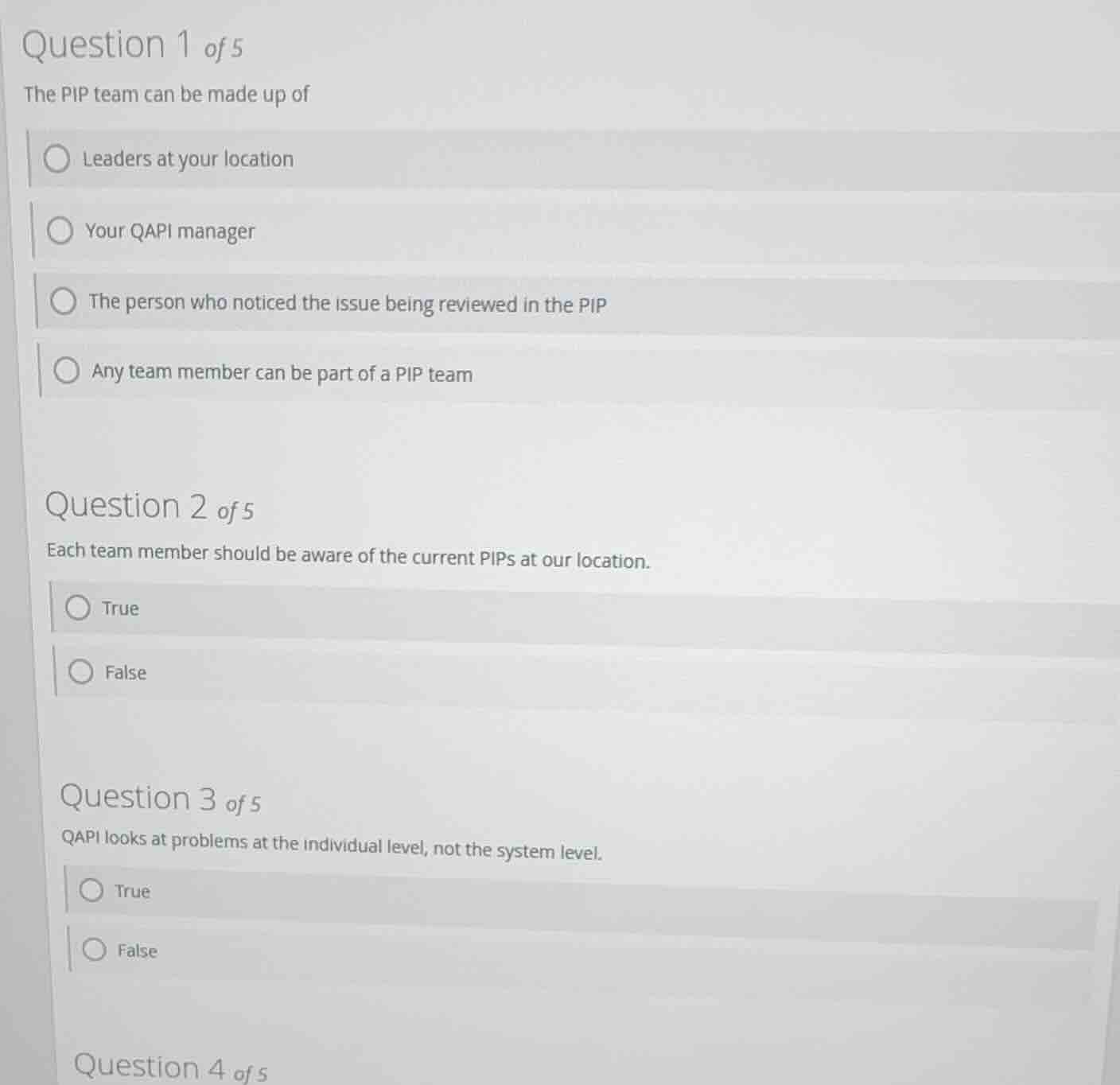
question 1 of 5
the pip team can be made up of
- leaders at your location
- your qapi manager
- the person who noticed the issue being reviewed in the pip
- any team member can be part of a pip team
question 2 of 5
each team member should be aware of the current pips at our location.
- true
- false
question 3 of 5
qapi looks at problems at the individual level, not the system level.
- true
- false
Analyze PIP team composition
The first question asks who can make up a Performance Improvement Project (PIP) team. In Quality Assurance and Performance Improvement (QAPI) frameworks, PIPs are designed to be inclusive and collaborative. While leaders, managers, and the person who identified the issue are valuable, the fundamental principle is that any team member can participate in a PIP team to provide diverse perspectives and front-line insights.
Evaluate team awareness of PIPs
The second question is a True/False statement: "Each team member should be aware of the current PIPs at our location." In healthcare and organizational quality management, transparency and staff awareness of ongoing quality improvement initiatives (PIPs) are critical for alignment, engagement, and successful implementation of improvements. Therefore, this statement is true.
Analyze QAPI focus levels
The third question is a True/False statement: "QAPI looks at problems at the individual level, not the system level." A core tenet of QAPI is that it focuses on systems and processes rather than individual blame. It aims to identify systemic issues and design processes to prevent errors, making the statement that it looks at the individual level false.

Snap & solve any problem in the app
Get step-by-step solutions on Sovi AI
Photo-based solutions with guided steps
Explore more problems and detailed explanations
Question 1
- (A) Leaders at your location
- (B) Your QAPI manager
- (C) The person who noticed the issue being reviewed in the PIP
- (D) Any team member can be part of a PIP team (Correct answer)
Question 2
- (A) True (Correct answer)
- (B) False
Question 3
- (A) True
- (B) False (Correct answer)