Sovi.AI - AI Math Tutor

Scan to solve math questions

QUESTION IMAGE

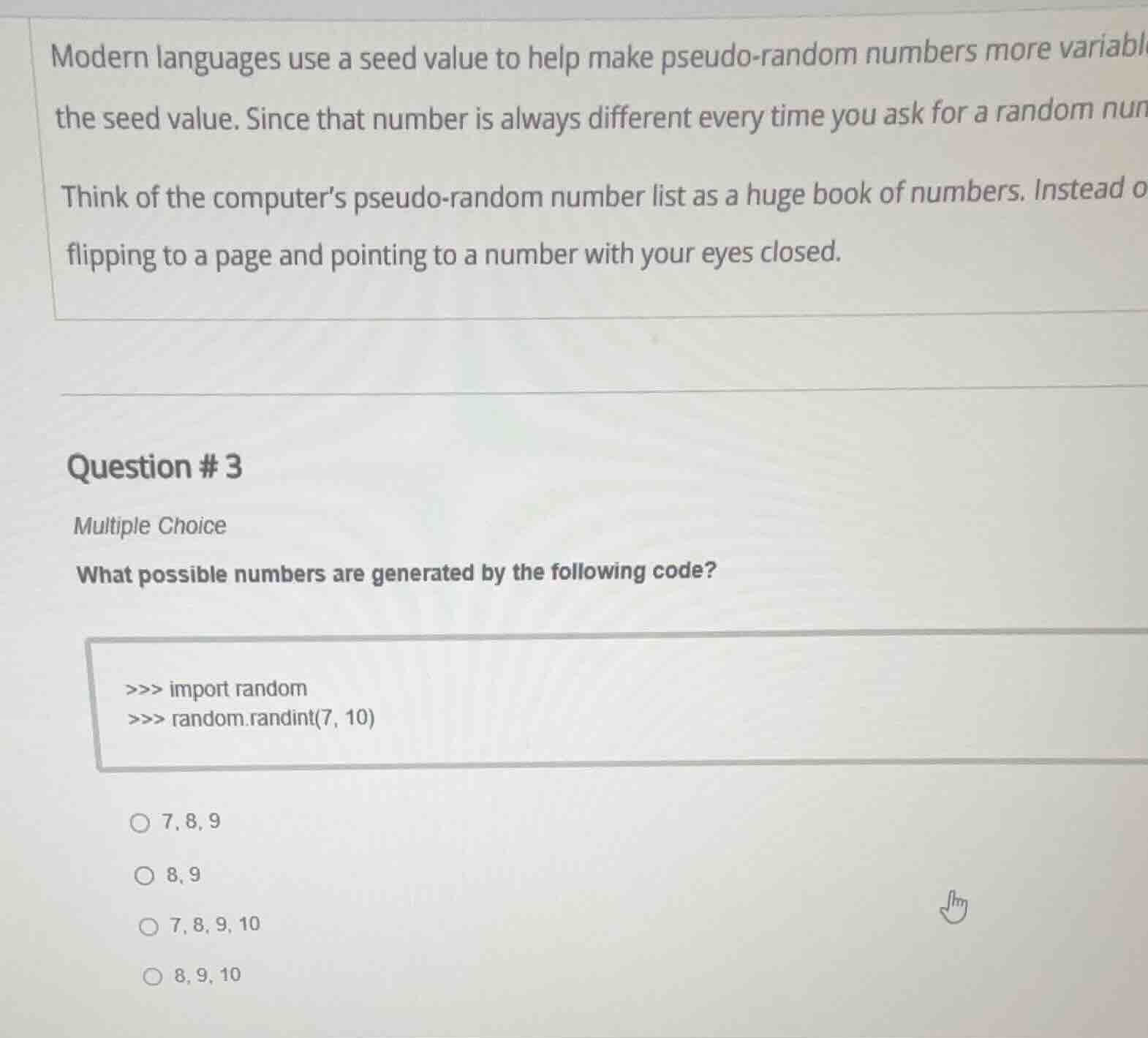
question # 3 multiple choice what possible numbers are generated by the…

Question

question # 3

multiple choice

what possible numbers are generated by the following code?

>> import random
>> random.randint(7, 10)

7, 8, 9
8, 9
7, 8, 9, 10
8, 9, 10

Explanation:

Response

<pre_analysis>
{
"quality": "clear",
"question_count": 1,
"skills_matched": [
"step_cot",
"multiple_choice_formatter",
"explain_then_answer",
"tutor"
],
"needs_drawing": false,
"concepts_used": [],
"new_concepts": [
"Python Random Module",
"randint Function"
],
"current_concepts": [
"Python Random Module",
"randint Function"
]
}
</pre_analysis>

<reasoning>

Analyze the code snippet

The provided Python code imports the random module and calls the function random.randint(7, 10).

Understand the randint function

In Python, the function random.randint(a, b) returns a random integer \(N\) such that \(a \le N \le b\). This means both the lower bound \(a\) and the upper bound \(b\) are inclusive.

Determine the possible outputs

For the call random.randint(7, 10), the lower bound is \(7\) and the upper bound is \(10\). Since both endpoints are included, the possible integers generated are \(7, 8, 9, 10\).

Match with the options

We compare our set of possible numbers \(\{7, 8, 9, 10\}\) with the given choices:

  • Option 1: 7, 8, 9
  • Option 2: 8, 9
  • Option 3: 7, 8, 9, 10
  • Option 4: 8, 9, 10

The correct choice is the third option.
</reasoning>

<answer>
<mcq-option>7, 8, 9</mcq-option>
<mcq-option>8, 9</mcq-option>
<mcq-correct>7, 8, 9, 10</mcq-correct>
<mcq-option>8, 9, 10</mcq-option>
</answer>

<post_analysis>
{
"subject": "Others",
"question_type": "Multiple Choice",
"knowledge_point": [
"Others",
"Computer Science",
"Python Random Module"
]
}
</post_analysis>

Answer:

<pre_analysis>
{
"quality": "clear",
"question_count": 1,
"skills_matched": [
"step_cot",
"multiple_choice_formatter",
"explain_then_answer",
"tutor"
],
"needs_drawing": false,
"concepts_used": [],
"new_concepts": [
"Python Random Module",
"randint Function"
],
"current_concepts": [
"Python Random Module",
"randint Function"
]
}
</pre_analysis>

<reasoning>

Analyze the code snippet

The provided Python code imports the random module and calls the function random.randint(7, 10).

Understand the randint function

In Python, the function random.randint(a, b) returns a random integer \(N\) such that \(a \le N \le b\). This means both the lower bound \(a\) and the upper bound \(b\) are inclusive.

Determine the possible outputs

For the call random.randint(7, 10), the lower bound is \(7\) and the upper bound is \(10\). Since both endpoints are included, the possible integers generated are \(7, 8, 9, 10\).

Match with the options

We compare our set of possible numbers \(\{7, 8, 9, 10\}\) with the given choices:

  • Option 1: 7, 8, 9
  • Option 2: 8, 9
  • Option 3: 7, 8, 9, 10
  • Option 4: 8, 9, 10

The correct choice is the third option.
</reasoning>

<answer>
<mcq-option>7, 8, 9</mcq-option>
<mcq-option>8, 9</mcq-option>
<mcq-correct>7, 8, 9, 10</mcq-correct>
<mcq-option>8, 9, 10</mcq-option>
</answer>

<post_analysis>
{
"subject": "Others",
"question_type": "Multiple Choice",
"knowledge_point": [
"Others",
"Computer Science",
"Python Random Module"
]
}
</post_analysis>