QUESTION IMAGE
Question
question 4
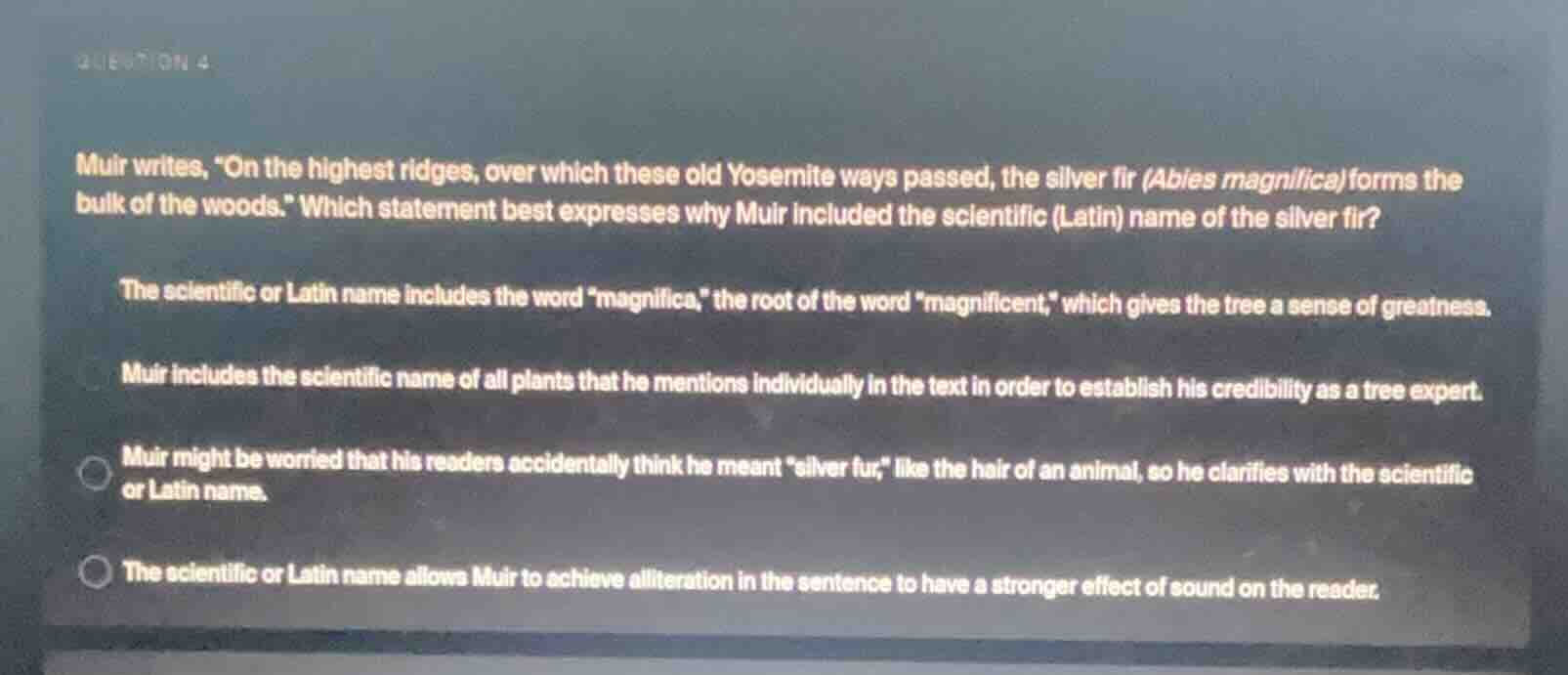
muir writes, \on the highest ridges, over which these old yosemite ways passed, the silver fir (abies magnifica) forms the bulk of the woods.\ which statement best expresses why muir included the scientific (latin) name of the silver fir?
the scientific or latin name includes the word \magnifica,\ the root of the word \magnificent,\ which gives the tree a sense of greatness.
muir includes the scientific name of all plants that he mentions individually in the text in order to establish his credibility as a tree expert.
muir might be worried that his readers accidentally think he meant \silver fur,\ like the hair of an animal, so he clarifies with the scientific or latin name.
the scientific or latin name allows muir to achieve alliteration in the sentence to have a stronger effect of sound on the reader.
Analyze the author's purpose
The question asks why John Muir included the scientific (Latin) name of the silver fir, Abies magnifica. We must evaluate how this choice serves his broader Authorial Intent and Literary Analysis of the text.
Evaluate the options
- Option 1: Points out that magnifica shares a root with "magnificent," giving the tree a sense of greatness. This aligns with Muir's characteristic appreciation and romantic view of nature.
- Option 2: Claims he includes scientific names for all plants to establish credibility. This is an overgeneralization and unlikely to be the primary literary reason.
- Option 3: Suggests he is worried readers will confuse "fir" with animal "fur." This is highly improbable for a literary essay.
- Option 4: Suggests it is for alliteration. While Abies magnifica has some repeating sounds, it does not create a meaningful alliterative pattern with the rest of the sentence.
Determine the best statement
The first option is the most accurate. By using Abies magnifica, Muir subtly evokes the connotation of "magnificent" through its Latin root, reinforcing the grand and majestic nature of the silver fir on the highest ridges.

Snap & solve any problem in the app
Get step-by-step solutions on Sovi AI
Photo-based solutions with guided steps
Explore more problems and detailed explanations
- (A) The scientific or Latin name includes the word "magnifica," the root of the word "magnificent," which gives the tree a sense of greatness. (Correct answer)
- (B) Muir includes the scientific name of all plants that he mentions individually in the text in order to establish his credibility as a tree expert.
- (C) Muir might be worried that his readers accidentally think he meant "silver fur," like the hair of an animal, so he clarifies with the scientific or Latin name.
- (D) The scientific or Latin name allows Muir to achieve alliteration in the sentence to have a stronger effect of sound on the reader.