QUESTION IMAGE
Question
question 4
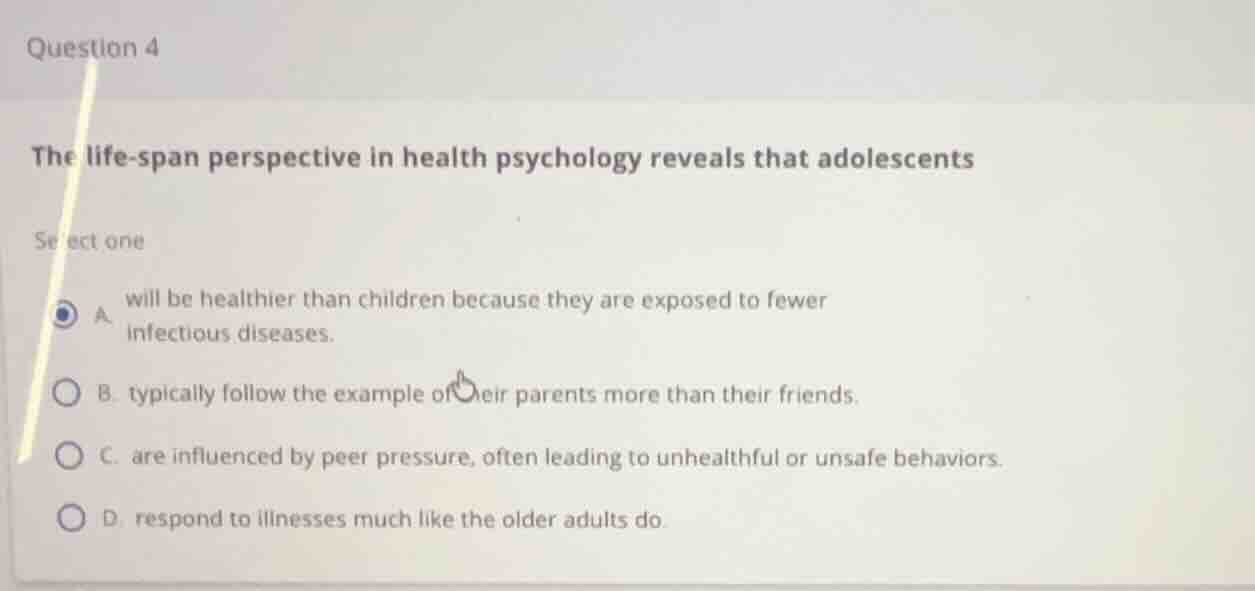
the life-span perspective in health psychology reveals that adolescents
select one
a. will be healthier than children because they are exposed to fewer infectious diseases.
b. typically follow the example of their parents more than their friends.
c. are influenced by peer pressure, often leading to unhealthy or unsafe behaviors.
d. respond to illnesses much like the older adults do.
Analyze the question stem
The question asks what the life-span perspective in health psychology reveals about adolescents.
Evaluate Option A
Option A suggests adolescents are healthier than children due to fewer infectious diseases. While epidemiological patterns change, this does not capture the core developmental focus of the life-span perspective regarding adolescent behavioral risks.
Evaluate Option B
Option B states adolescents follow parents more than friends. Developmental psychology shows peer influence increases significantly during adolescence, making this statement generally incorrect.
Evaluate Option C
Option C states adolescents are influenced by peer pressure, often leading to unhealthy or unsafe behaviors. In health psychology, the life-span perspective highlights adolescence as a critical transition phase where social environments and peer relationships heavily shape health-compromising behaviors (such as substance use or risky driving).
Evaluate Option D
Option D suggests adolescents respond to illnesses like older adults. This is incorrect as health behaviors, coping mechanisms, and physiological responses differ vastly between these developmental stages.

Snap & solve any problem in the app
Get step-by-step solutions on Sovi AI
Photo-based solutions with guided steps
Explore more problems and detailed explanations
- (A) will be healthier than children because they are exposed to fewer infectious diseases.
- (B) typically follow the example of their parents more than their friends.
- (C) are influenced by peer pressure, often leading to unhealthy or unsafe behaviors. (Correct answer)
- (D) respond to illnesses much like the older adults do.