QUESTION IMAGE
Question
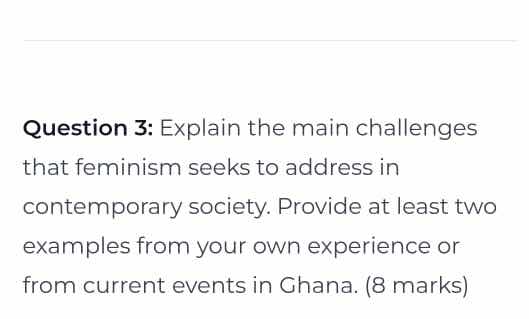
question 3: explain the main challenges that feminism seeks to address in contemporary society. provide at least two examples from your own experience or from current events in ghana. (8 marks)
🆕 New Concept Discovered: Feminist Theory and Gender Inequality
Analyzing systemic barriers and power imbalances based on gender.
Step 1: Define the Core Challenges of Contemporary Feminism
Feminism in contemporary society seeks to address systemic inequalities that limit the rights, opportunities, and well-being of individuals based on their gender. The main challenges include:
- Economic Inequality: This includes the gender pay gap, where women are paid less than men for equal work, and the "glass ceiling," which prevents women from reaching top leadership positions. It also involves the unequal distribution of unpaid domestic and care work.
- Gender-Based Violence (GBV): This encompasses physical, sexual, and psychological abuse, domestic violence, sexual harassment, and harmful traditional practices that disproportionately target women and girls.
- Political and Social Underrepresentation: Women remain significantly underrepresented in legislative bodies, executive government positions, and corporate boards, limiting their influence on policy-making.
- Reproductive Rights and Healthcare Access: Ensuring bodily autonomy, access to safe reproductive healthcare, and maternal health support.
---
Step 2: Apply to the Ghanaian Context (Example 1 - Economic and Social Inequality)
In Ghana, contemporary feminism actively addresses the economic vulnerability of women, particularly in relation to traditional inheritance customs and informal labor.
- The Challenge: While statutory laws like the Intestate Succession Act, 1985 (PNDCL 111) exist to protect surviving spouses and children, traditional patrilineal and matrilineal inheritance systems in many Ghanaian communities still sometimes deprive widows of land and property rights. Additionally, a vast majority of Ghanaian women work in the informal sector (such as market trading), which lacks social security, maternity leave, and stable wages.
- Current Event/Example: The ongoing advocacy surrounding the Spousal Rights Bill (or Intestate Succession Bill amendments) in Ghana's Parliament. Feminist groups and civil society organizations have consistently campaigned for the passage of this bill to ensure that women are legally guaranteed an equitable share of joint property acquired during marriage upon divorce or the death of a spouse.
---
Step 3: Apply to the Ghanaian Context (Example 2 - Political Underrepresentation)
Another major challenge is the low participation of women in formal political decision-making processes.
- The Challenge: Despite women making up more than half of the national population, the percentage of women in Ghana's Parliament has historically hovered around only 13% to 15%, far below the United Nations' recommended minimum threshold of 30%.
- Current Event/Example: The passage of the Affirmative Action (Gender Equity) Bill in July 2024 by Ghana's Parliament. For years, feminist coalitions (such as the Affirmative Action Bill Coalition) campaigned vigorously for this law. The law aims to address the historical marginalization of women by mandating active measures to increase women's representation in public offices, governance, and decision-making spaces to at least 30%.

Snap & solve any problem in the app
Get step-by-step solutions on Sovi AI
Photo-based solutions with guided steps
Explore more problems and detailed explanations
1. Main Challenges Addressed by Contemporary Feminism
- Economic Disparity: Addressing the gender wage gap, lack of property rights, and the burden of unpaid domestic labor.
- Gender-Based Violence (GBV): Combating domestic abuse, sexual assault, and harmful cultural practices.
- Political Underrepresentation: Fighting for equal representation in parliament, local government, and corporate leadership.
2. Examples from Ghana
- Example 1 (Economic & Property Rights): The advocacy for the Spousal Rights Bill to protect women's access to land and marital property, countering traditional customary practices that often disinherit widows.
- Example 2 (Political Representation): The long-standing campaign and recent passage of the Affirmative Action (Gender Equity) Bill in July 2024, designed to legally enforce a minimum of 30% representation of women in public and political leadership roles.