QUESTION IMAGE
Question
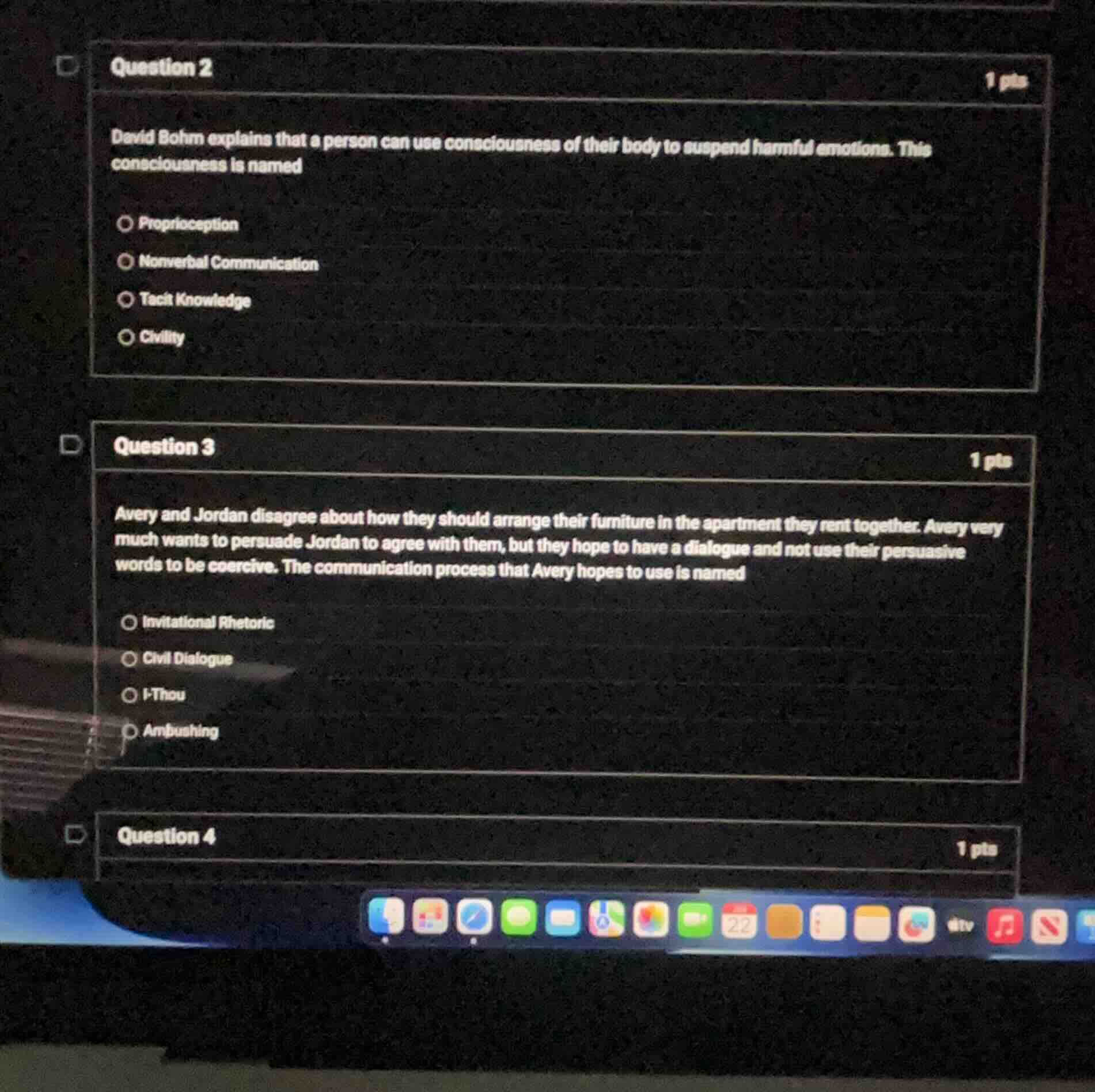
question 2
david bohm explains that a person can use consciousness of their body to suspend harmful emotions. this consciousness is named
proprioception
nonverbal communication
tacit knowledge
civility
question 3
avery and jordan disagree about how they should arrange their furniture in the apartment they rent together. avery very much wants to persuade jordan to agree with them, but they hope to have a dialogue and not use their persuasive words to be coercive. the communication process that avery hopes to use is named
invitational rhetoric
civil dialogue
i-thou
ambushing
Analyze Question 2
The question asks for the term David Bohm uses to describe a person's consciousness of their body to suspend harmful emotions. David Bohm, a theoretical physicist who wrote extensively on dialogue and communication, proposed the concept of "proprioception of thought." Just as physical proprioception is the body's self-awareness of its own movement and position, Bohm argued that we need a similar self-awareness of our thoughts and the physical sensations/emotions they trigger to suspend harmful reactions. Therefore, the correct term is "Proprioception."
Analyze Question 3
The question describes a scenario where Avery wants to persuade Jordan but wishes to use a non-coercive communication process that fosters mutual understanding and dialogue. "Invitational Rhetoric," a concept developed by Sonja K. Foss and Cindy L. Griffin, is defined as an invitation to understanding as a means to create a relationship rooted in equality, immanent value, and self-determination. It explicitly aims to offer perspectives without being coercive or manipulative. Therefore, the communication process Avery hopes to use is "Invitational Rhetoric."

Snap & solve any problem in the app
Get step-by-step solutions on Sovi AI
Photo-based solutions with guided steps
Explore more problems and detailed explanations
Question 2
- (A) Proprioception (Correct answer)
- (B) Nonverbal Communication
- (C) Tacit Knowledge
- (D) Civility
Question 3
- (A) Invitational Rhetoric (Correct answer)
- (B) Civil Dialogue
- (C) I-Thou
- (D) Ambushing