QUESTION IMAGE
Question
question 8
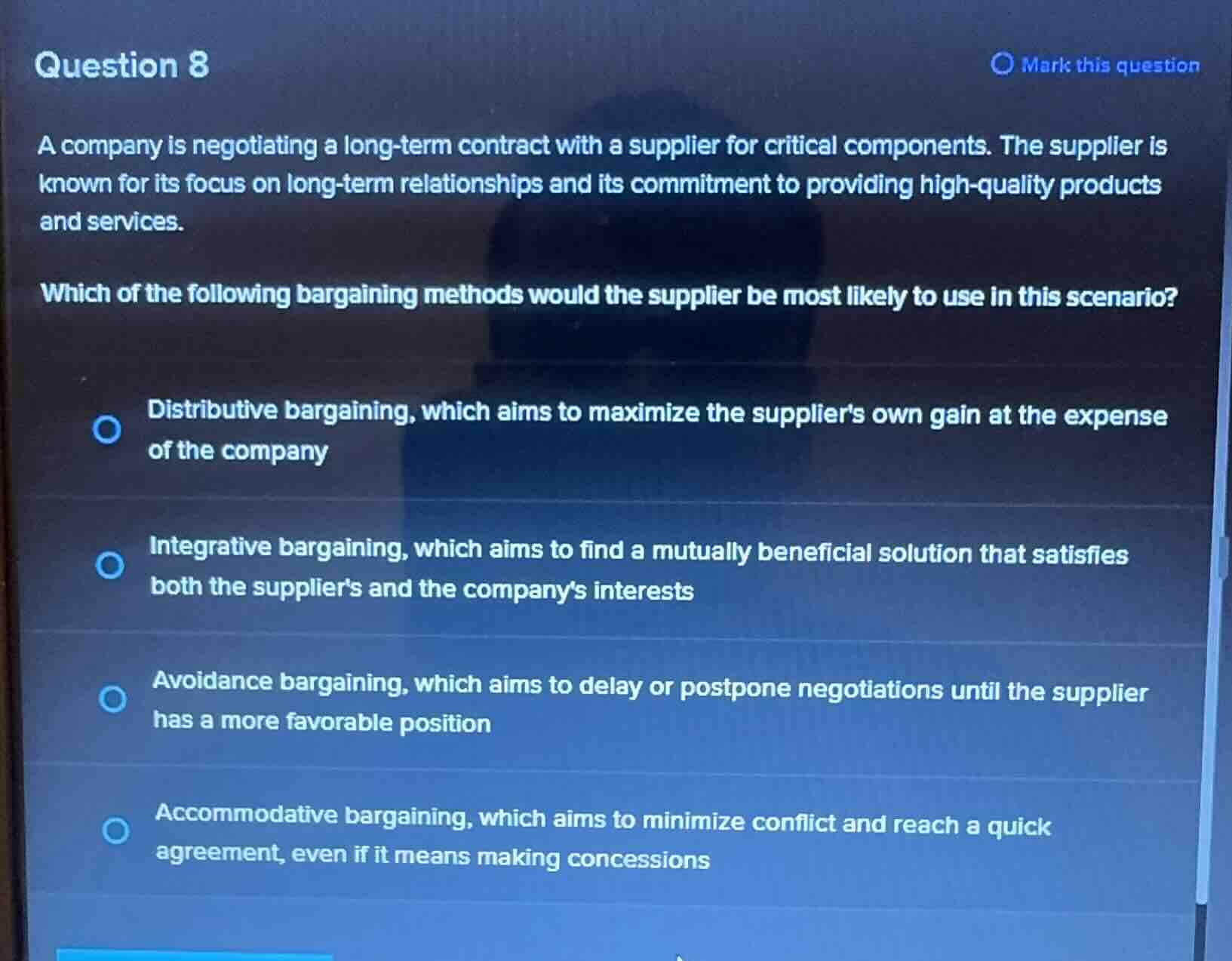
a company is negotiating a long-term contract with a supplier for critical components. the supplier is known for its focus on long-term relationships and its commitment to providing high-quality products and services.
which of the following bargaining methods would the supplier be most likely to use in this scenario?
- distributive bargaining, which aims to maximize the suppliers own gain at the expense of the company
- integrative bargaining, which aims to find a mutually beneficial solution that satisfies both the suppliers and the companys interests
- avoidance bargaining, which aims to delay or postpone negotiations until the supplier has a more favorable position
- accommodative bargaining, which aims to minimize conflict and reach a quick agreement, even if it means making concessions
Analyze the scenario details
The scenario describes a company negotiating a long-term contract with a supplier for critical components. Key characteristics of the supplier include:
- A strong focus on long-term relationships.
- A commitment to providing high-quality products and services.
Evaluate the bargaining methods
Using the Interest-Based Negotiation knowledge point
- Distributive bargaining is a win-lose (zero-sum) approach focused on maximizing individual gain at the other party's expense, which harms long-term relationships.
- Integrative bargaining (often associated with interest-based negotiation) is a win-win approach. It focuses on collaboration, mutual benefit, and preserving long-term relationships by satisfying the interests of both parties.
- Avoidance and accommodative approaches do not actively seek to resolve the complex needs of a long-term, high-quality critical component contract in a balanced, mutually satisfying way.
Therefore, integrative bargaining is the most appropriate method for a supplier focused on long-term relationships and high quality.

Snap & solve any problem in the app
Get step-by-step solutions on Sovi AI
Photo-based solutions with guided steps
Explore more problems and detailed explanations
- Distributive bargaining, which aims to maximize the supplier's own gain at the expense of the company
- Integrative bargaining, which aims to find a mutually beneficial solution that satisfies both the supplier's and the company's interests (Correct answer)
- Avoidance bargaining, which aims to delay or postpone negotiations until the supplier has a more favorable position
- Accommodative bargaining, which aims to minimize conflict and reach a quick agreement, even if it means making concessions