QUESTION IMAGE
Question
question 1
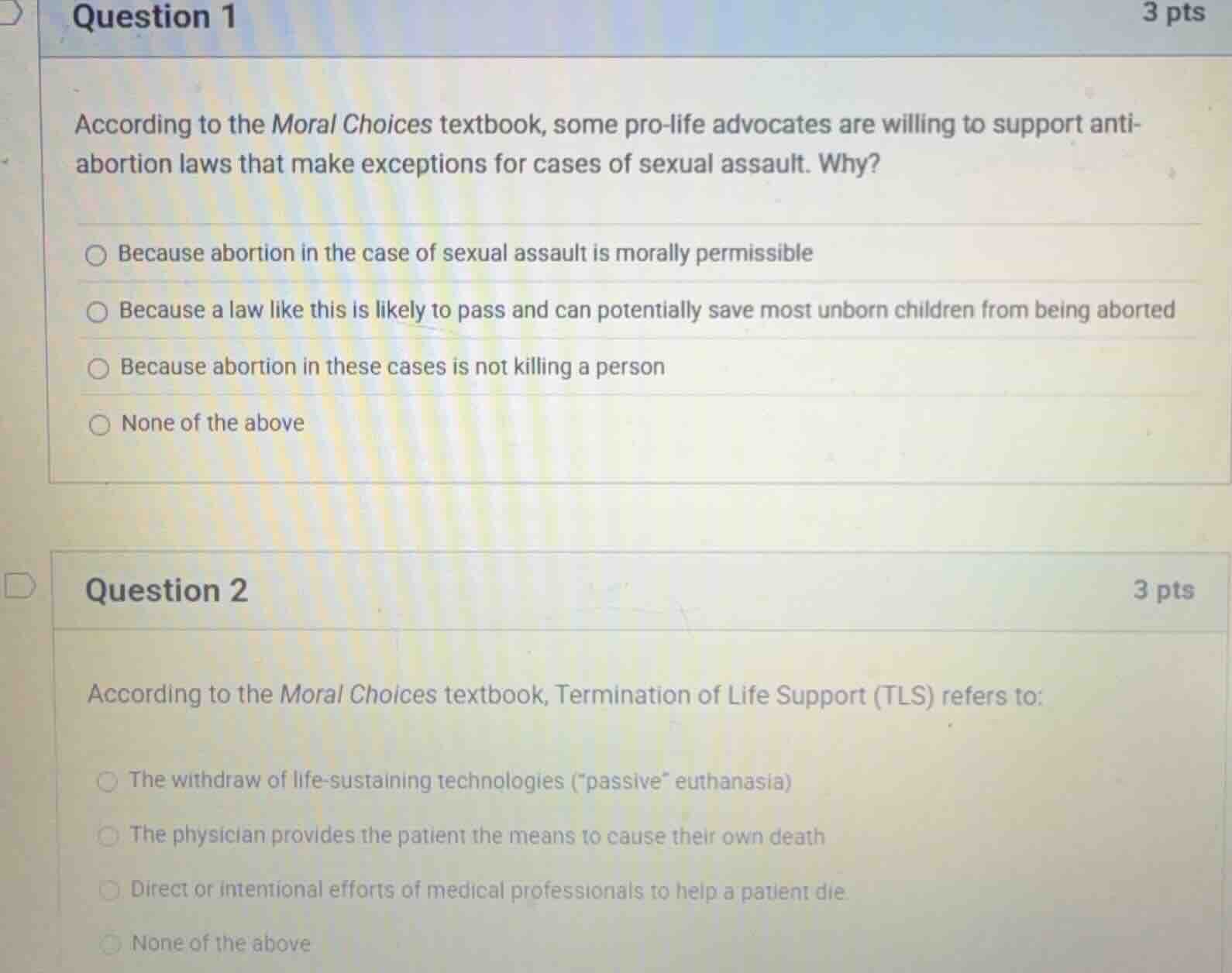
according to the moral choices textbook, some pro-life advocates are willing to support anti-abortion laws that make exceptions for cases of sexual assault. why?
because abortion in the case of sexual assault is morally permissible
because a law like this is likely to pass and can potentially save most unborn children from being aborted
because abortion in these cases is not killing a person
none of the above
question 2
according to the moral choices textbook, termination of life support (tls) refers to:
the withdraw of life-sustaining technologies (\passive\ euthanasia)
the physician provides the patient the means to cause their own death
direct or intentional efforts of medical professionals to help a patient die
none of the above
🆕 New Concept Discovered: Ethical Pragmatism vs. Absolutism
Balancing ideal moral principles with practical, real-world outcomes.
Step 1: Analyze Question 1
In Christian ethics and bioethics textbooks like Scott Rae's Moral Choices, the discussion around abortion laws often highlights a strategic division among pro-life advocates:
- Moral Absolutism: Some argue that because they believe a fetus is a person from conception, no exceptions (including rape or incest) can ever be morally justified.
- Incrementalism / Pragmatism: Others are willing to support legislation that contains exceptions. Their reasoning is pragmatic: a compromise law is politically viable and likely to pass, which will successfully outlaw the vast majority of abortions, thereby saving many unborn lives that would otherwise be lost if they held out for an absolute ban that has no chance of passing.
Therefore, they do not support it because they believe abortion in those cases is morally permissible, but rather because it is a practical step to save as many lives as possible.
- Correct Option for Question 1: "Because a law like this is likely to pass and can potentially save most unborn children from being aborted"
---
Step 2: Analyze Question 2
In medical ethics and the Moral Choices textbook, distinctions are made between different end-of-life decisions:
- Termination of Life Support (TLS): This involves withholding or withdrawing medical treatments (like ventilators or feeding tubes) that are artificially keeping a patient alive, allowing the underlying natural disease process to take its course. This is traditionally classified as passive euthanasia (or allowing to die).
- Physician-Assisted Suicide: This occurs when a physician provides the medical means (like a prescription) for the patient to actively end their own life.
- Active Euthanasia: This involves direct, intentional actions by a medical professional to end a patient's life (such as administering a lethal injection).
Therefore, Termination of Life Support (TLS) refers to the withdrawal of life-sustaining technologies.
- Correct Option for Question 2: "The withdraw of life-sustaining technologies ("passive" euthanasia)"

Snap & solve any problem in the app
Get step-by-step solutions on Sovi AI
Photo-based solutions with guided steps
Explore more problems and detailed explanations
Question 1:
Because a law like this is likely to pass and can potentially save most unborn children from being aborted
Question 2:
The withdraw of life-sustaining technologies ("passive" euthanasia)