QUESTION IMAGE
Question
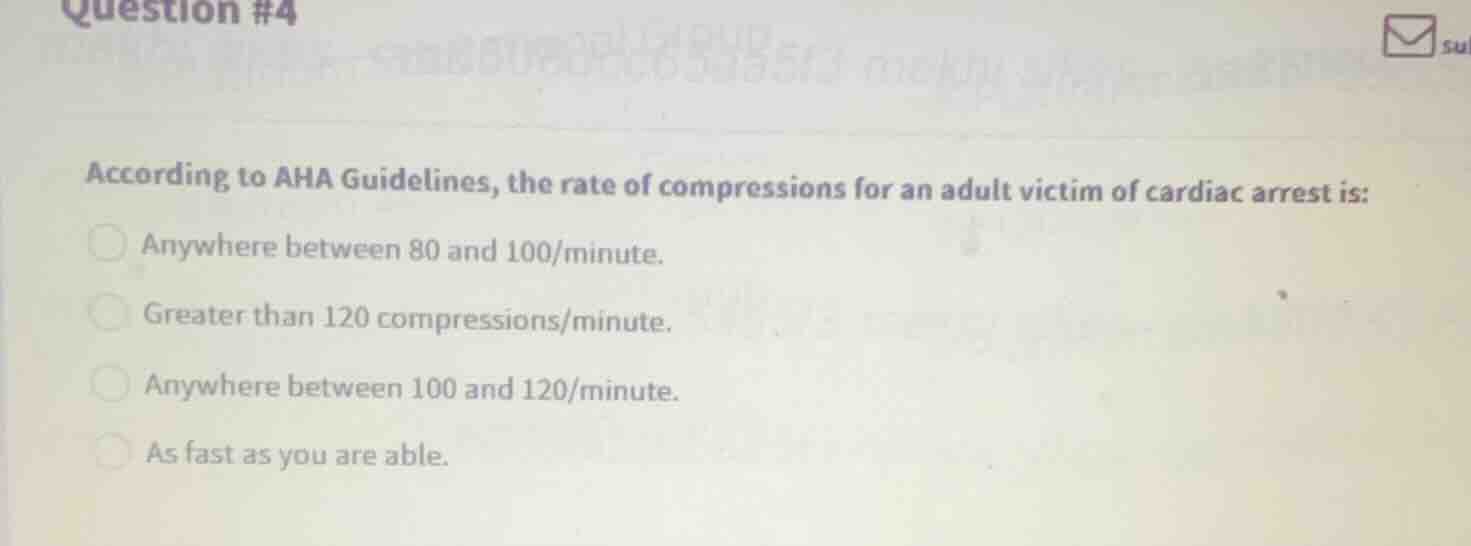
question #4
according to aha guidelines, the rate of compressions for an adult victim of cardiac arrest is:
anywhere between 80 and 100/minute.
greater than 120 compressions/minute.
anywhere between 100 and 120/minute.
as fast as you are able.
<pre_analysis>
{
"quality": "clear",
"question_count": 1,
"skills_matched": [
"direct_cot",
"multiple_choice_formatter",
"explain_then_answer",
"tutor"
],
"needs_drawing": false,
"concepts_used": [],
"new_concepts": [
"CPR Compression Rate",
"AHA Guidelines"
],
"current_concepts": [
"CPR Compression Rate",
"AHA Guidelines",
"Cardiopulmonary Resuscitation"
]
}
</pre_analysis>
<reasoning>
Identify the core clinical question
The question asks for the recommended rate of chest compressions for an adult victim of cardiac arrest according to the American Heart Association (AHA) guidelines.
Recall the AHA CPR guidelines
According to the AHA Guidelines for Cardiopulmonary Resuscitation (CPR) and Emergency Cardiovascular Care (ECC), rescuers should perform chest compressions at a rate of 100 to 120 compressions per minute for adult victims.
Evaluate the given options
- Anywhere between 80 and 100/minute: This rate is too slow and does not meet the current standard of care.
- Greater than 120 compressions/minute: Compressing too fast (above 120/min) reduces the depth of compressions and does not allow the chest to fully recoil, which decreases coronary perfusion pressure.
- Anywhere between 100 and 120/minute: This matches the official AHA recommendation perfectly.
- As fast as you are able: Resuscitation must be controlled; compressing too fast leads to fatigue and poor quality compressions.
</reasoning>
<answer>
<mcq-option>Anywhere between 80 and 100/minute.</mcq-option>
<mcq-option>Greater than 120 compressions/minute.</mcq-option>
<mcq-correct>Anywhere between 100 and 120/minute.</mcq-correct>
<mcq-option>As fast as you are able.</mcq-option>
</answer>
<post_analysis>
{
"subject": "Natural Science",
"question_type": "Multiple Choice",
"knowledge_point": [
"Natural Science",
"Medicine and Health",
"Cardiopulmonary Resuscitation"
]
}
</post_analysis>
Snap & solve any problem in the app
Get step-by-step solutions on Sovi AI
Photo-based solutions with guided steps
Explore more problems and detailed explanations
<pre_analysis>
{
"quality": "clear",
"question_count": 1,
"skills_matched": [
"direct_cot",
"multiple_choice_formatter",
"explain_then_answer",
"tutor"
],
"needs_drawing": false,
"concepts_used": [],
"new_concepts": [
"CPR Compression Rate",
"AHA Guidelines"
],
"current_concepts": [
"CPR Compression Rate",
"AHA Guidelines",
"Cardiopulmonary Resuscitation"
]
}
</pre_analysis>
<reasoning>
Identify the core clinical question
The question asks for the recommended rate of chest compressions for an adult victim of cardiac arrest according to the American Heart Association (AHA) guidelines.
Recall the AHA CPR guidelines
According to the AHA Guidelines for Cardiopulmonary Resuscitation (CPR) and Emergency Cardiovascular Care (ECC), rescuers should perform chest compressions at a rate of 100 to 120 compressions per minute for adult victims.
Evaluate the given options
- Anywhere between 80 and 100/minute: This rate is too slow and does not meet the current standard of care.
- Greater than 120 compressions/minute: Compressing too fast (above 120/min) reduces the depth of compressions and does not allow the chest to fully recoil, which decreases coronary perfusion pressure.
- Anywhere between 100 and 120/minute: This matches the official AHA recommendation perfectly.
- As fast as you are able: Resuscitation must be controlled; compressing too fast leads to fatigue and poor quality compressions.
</reasoning>
<answer>
<mcq-option>Anywhere between 80 and 100/minute.</mcq-option>
<mcq-option>Greater than 120 compressions/minute.</mcq-option>
<mcq-correct>Anywhere between 100 and 120/minute.</mcq-correct>
<mcq-option>As fast as you are able.</mcq-option>
</answer>
<post_analysis>
{
"subject": "Natural Science",
"question_type": "Multiple Choice",
"knowledge_point": [
"Natural Science",
"Medicine and Health",
"Cardiopulmonary Resuscitation"
]
}
</post_analysis>