QUESTION IMAGE
Question
question 81
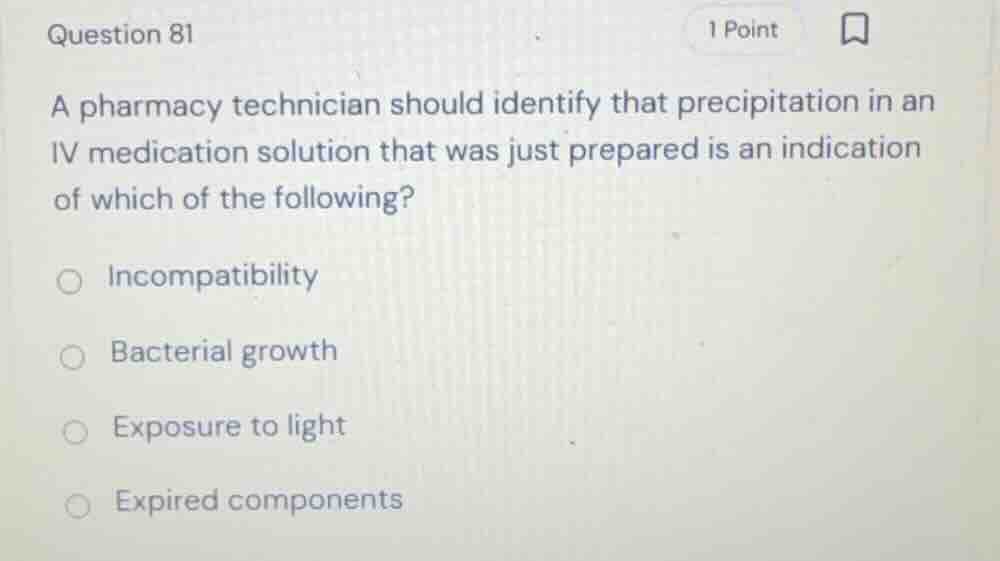
a pharmacy technician should identify that precipitation in an iv medication solution that was just prepared is an indication of which of the following?
incompatibility
bacterial growth
exposure to light
expired components
Analyze the clinical scenario
The question asks about the meaning of precipitation in a newly prepared intravenous (IV) medication solution. We are looking at a physical change occurring immediately after compounding.
Evaluate the options
- Incompatibility: Physical incompatibility occurs when two or more substances are mixed together, resulting in a physical change such as precipitation, turbidity, or color change. This happens immediately or shortly after mixing.
- Bacterial growth: While microbial contamination can cause turbidity, it typically requires time to develop and would not manifest as immediate precipitation in a "just prepared" solution.
- Exposure to light: Photodegradation usually occurs over a longer period of exposure and typically results in discoloration or loss of potency rather than immediate precipitation.
- Expired components: Using expired components might affect potency or sterility, but does not inherently cause immediate precipitation unless there is a specific chemical incompatibility.
Apply sterile compounding principles
Using the Sterile Compounding knowledge point, we know that visual inspection of a freshly prepared sterile compound is critical. The immediate formation of a precipitate (solid particles settling out of the solution) is a classic sign of physical incompatibility between the drug and the diluent, or between multiple drugs mixed in the same container.

Snap & solve any problem in the app
Get step-by-step solutions on Sovi AI
Photo-based solutions with guided steps
Explore more problems and detailed explanations
- Incompatibility (Correct answer)
- Bacterial growth
- Exposure to light
- Expired components