QUESTION IMAGE
Question
question 65
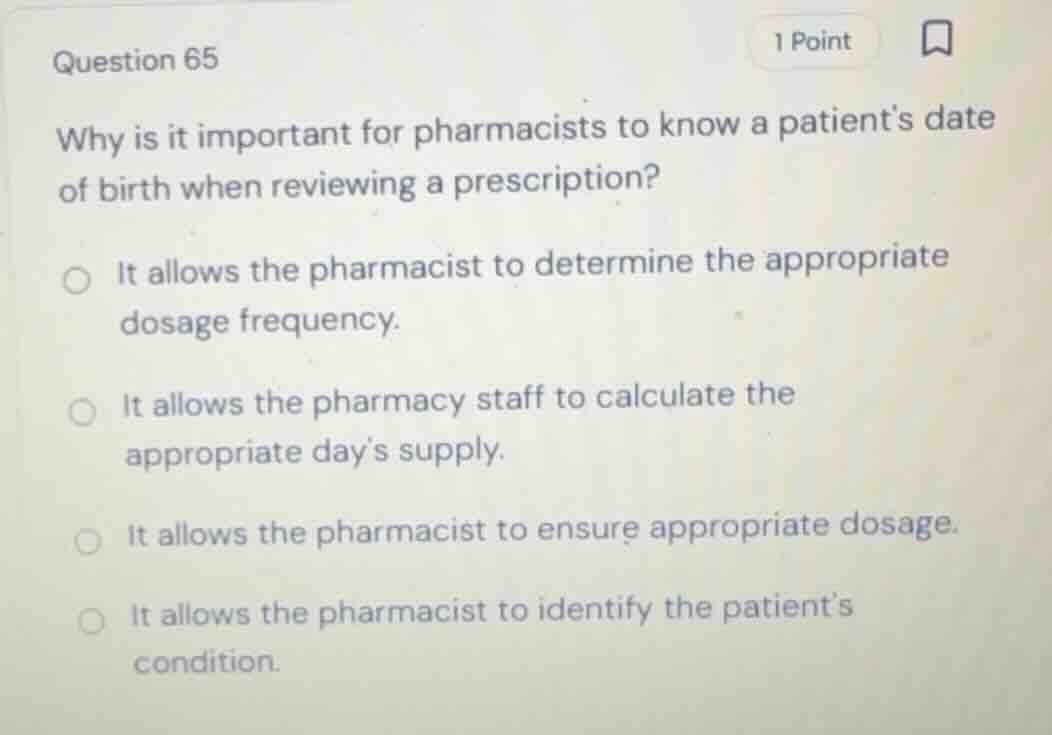
why is it important for pharmacists to know a patients date of birth when reviewing a prescription?
it allows the pharmacist to determine the appropriate dosage frequency.
it allows the pharmacy staff to calculate the appropriate days supply.
it allows the pharmacist to ensure appropriate dosage.
it allows the pharmacist to identify the patients condition.
Analyze the clinical significance of date of birth
The patient's date of birth (DOB) is a critical piece of demographic information on a prescription. It serves two primary clinical purposes: patient identification (to prevent medication errors) and clinical assessment of the therapy, particularly regarding age-dependent dosing.
Evaluate age-dependent dosing safety
Using the Dosage Calculations and Prescription Requirements knowledge points, we know that pediatric and geriatric patients require specialized dosing regimens due to differences in organ development, metabolic rates, and renal clearance. Knowing the patient's age allows the pharmacist to verify that the prescribed dose is safe and appropriate for their age group.
Assess the given options
- Option 1: Dosage frequency is primarily determined by the drug's half-life and the patient's renal/hepatic function, not directly by DOB alone.
- Option 2: Day's supply is calculated using the total quantity dispensed and the daily dosing instructions, which does not depend on DOB.
- Option 3: Ensuring appropriate dosage directly relates to age-based dosing guidelines (e.g., pediatric vs. adult doses). This is a primary clinical reason for verifying DOB.
- Option 4: DOB does not identify the patient's clinical condition or diagnosis.

Snap & solve any problem in the app
Get step-by-step solutions on Sovi AI
Photo-based solutions with guided steps
Explore more problems and detailed explanations
- It allows the pharmacist to determine the appropriate dosage frequency.
- It allows the pharmacy staff to calculate the appropriate day's supply.
- It allows the pharmacist to ensure appropriate dosage. (Correct answer)
- It allows the pharmacist to identify the patient's condition.