QUESTION IMAGE
Question
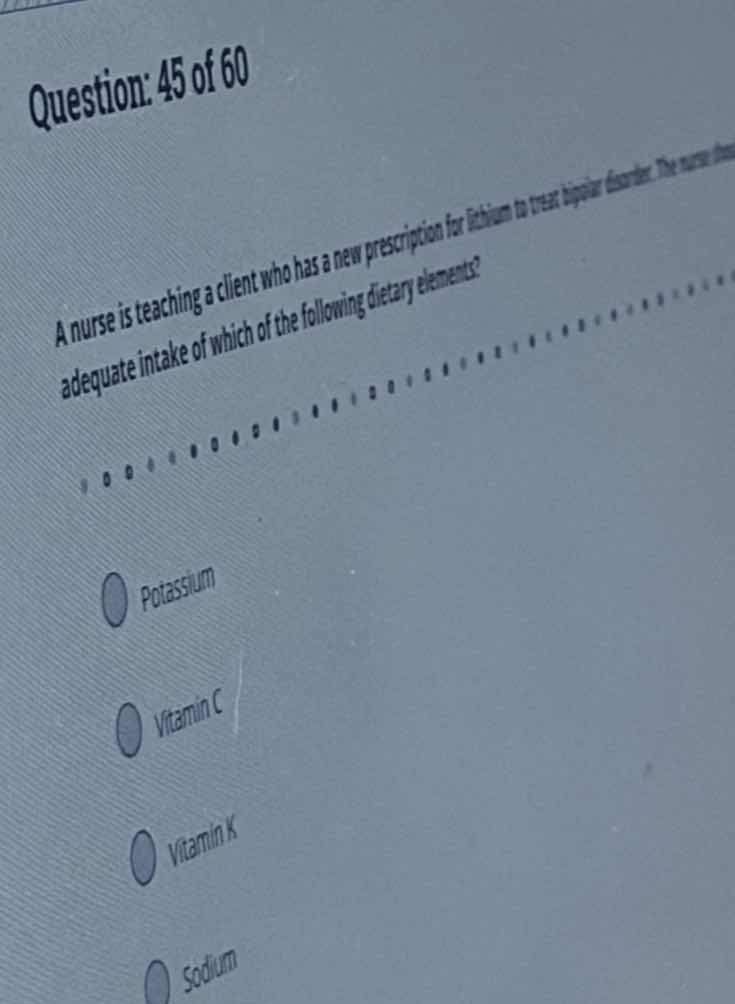
question: 45 of 60
a nurse is teaching a client who has a new prescription for lithium to treat bipolar disorder. the nurse should instruct the client to maintain adequate intake of which of the following dietary elements?
- potassium
- vitamin c
- vitamin k
- sodium
Analyze the mechanism of lithium excretion
Lithium is a monovalent cation that is filtered by the renal glomeruli and reabsorbed in the proximal renal tubules. Because of its chemical similarity to sodium, the kidneys handle lithium in a manner very similar to sodium.
Evaluate the relationship between sodium and lithium
When a client's dietary sodium intake is restricted or if they become dehydrated (losing sodium and water), the kidneys attempt to conserve sodium by increasing its reabsorption in the proximal tubules. Because the kidneys cannot easily distinguish between sodium and lithium ions, this compensatory mechanism also increases the reabsorption of lithium. This leads to decreased lithium clearance and a subsequent rise in serum lithium levels, which can quickly reach toxic ranges.
Determine the clinical education requirement
To maintain stable, therapeutic serum lithium levels and prevent toxicity, the nurse must instruct the client to maintain a consistent and adequate intake of both sodium and fluids. Decreasing sodium intake or experiencing excessive sodium loss (e.g., through heavy sweating, vomiting, or diarrhea) increases the risk of lithium toxicity, whereas a sudden increase in sodium intake can cause lithium levels to drop below the therapeutic range.
Assess the given options
- Potassium: While potassium is an important intracellular electrolyte, its dietary intake does not directly regulate renal lithium reabsorption or clearance.
- Vitamin C: Vitamin C intake does not affect renal handling of lithium.
- Vitamin K: Vitamin K is essential for blood clotting factors but has no interaction with lithium pharmacokinetics.
- Sodium: Adequate and consistent sodium intake is vital to prevent increased renal reabsorption of lithium and subsequent toxicity.

Snap & solve any problem in the app
Get step-by-step solutions on Sovi AI
Photo-based solutions with guided steps
Explore more problems and detailed explanations
- Potassium
- Vitamin C
- Vitamin K
- Sodium (Correct answer)