QUESTION IMAGE
Question
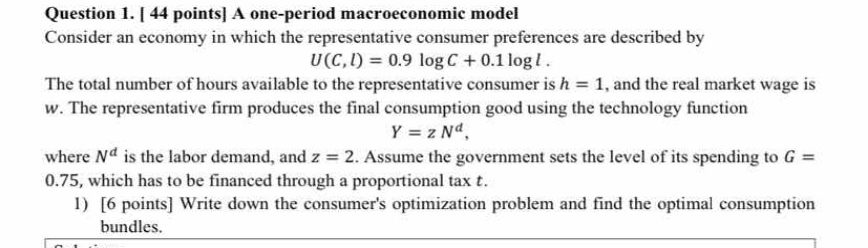
question 1. 44 points a one-period macroeconomic model
consider an economy in which the representative consumer preferences are described by
\\u(c, l) = 0.9 \log c + 0.1 \log l.\\
the total number of hours available to the representative consumer is \\(h = 1\\), and the real market wage is \\(w\\). the representative firm produces the final consumption good using the technology function
\\y = z n^d,\\
where \\(n^d\\) is the labor demand, and \\(z = 2\\). assume the government sets the level of its spending to \\(g = 0.75\\), which has to be financed through a proportional tax \\(t\\).
- 6 points write down the consumers optimization problem and find the optimal consumption bundles.
Formulate the consumer's budget constraint
The representative consumer maximizes utility subject to their budget constraint.
The consumer has a total time endowment of \(h = 1\), which is split between leisure \(l\) and labor supply \(N^s\):
The consumer earns a real wage \(w\) for each unit of labor supplied.
The government levies a proportional tax \(t\) on labor income.
Therefore, the consumer's budget constraint is:
Rearranging this gives the standard budget constraint:
Set up the utility maximization problem
Using the Utility Maximization concept, we write the consumer's optimization problem:
subject to:
and the boundary conditions:
Solve for the optimal consumption bundle
For a Cobb-Douglas utility function of the form \(U(C, l) = a \log C + b \log l\), the optimal expenditure shares on consumption and leisure are proportional to their weights in the utility function.
The total potential income (wealth) of the consumer is:
The optimal expenditure on consumption is:
The optimal expenditure on leisure is:
Solving for \(l\):
State the final optimal bundle
The optimal choices of consumption and leisure as functions of the wage rate \(w\) and the tax rate \(t\) are:

Snap & solve any problem in the app
Get step-by-step solutions on Sovi AI
Photo-based solutions with guided steps
Explore more problems and detailed explanations
The consumer's optimization problem is:
subject to:
with \(C \ge 0\) and \(0 \le l \le 1\).
The optimal consumption bundle is: