QUESTION IMAGE
Question
question 43
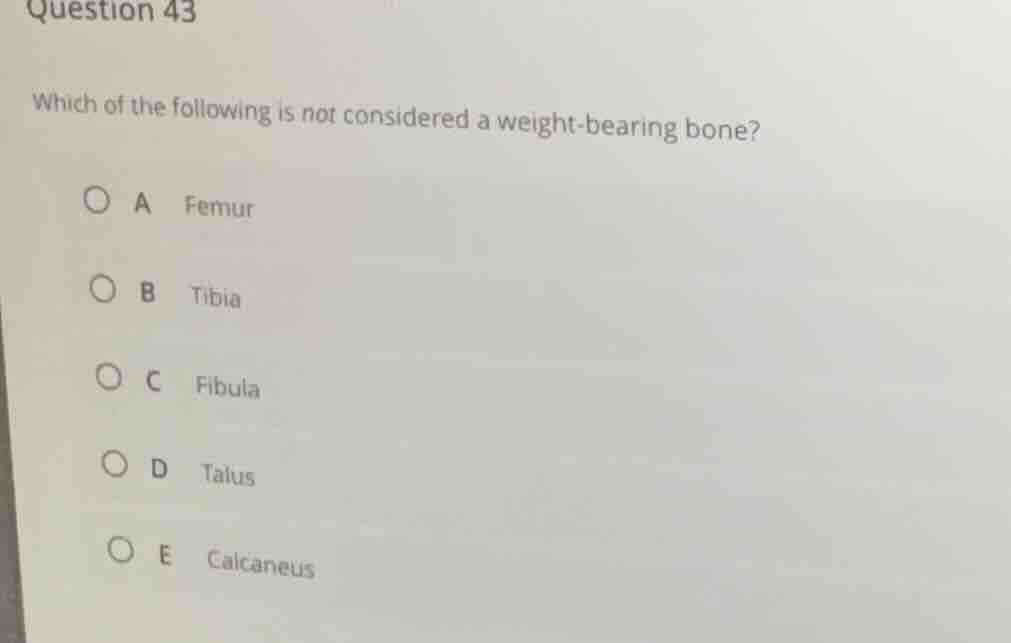
which of the following is not considered a weight-bearing bone?
a femur
b tibia
c fibula
d talus
e calcaneus
Analyze the question prompt
The question asks to identify which of the listed bones is not considered a weight-bearing bone. This requires an understanding of Skeletal Anatomy and how body weight is transmitted through the lower limb.
Evaluate the role of each bone in weight-bearing
- Femur (A): The thigh bone. It is the longest and strongest bone in the body, transmitting the weight of the upper body from the pelvis to the tibia. It is a major weight-bearing bone.
- Tibia (B): The shin bone. It is the larger, medial bone of the leg and is responsible for transmitting body weight from the femur down to the talus of the foot. It is a major weight-bearing bone.
- Fibula (C): The lateral bone of the leg. It runs parallel to the tibia but does not articulate with the femur at the knee joint. Its primary functions are providing attachment sites for muscles and stabilizing the ankle joint, rather than bearing body weight. It carries only about 10% of the body's weight, making it clinically classified as a non-weight-bearing bone.
- Talus (D): A tarsal bone of the foot. It articulates with the tibia and fibula to form the ankle joint, receiving the entire weight of the body from the tibia and distributing it to other tarsal bones. It is a weight-bearing bone.
- Calcaneus (E): The heel bone. It is the largest tarsal bone and transmits body weight from the talus directly to the ground. It is a major weight-bearing bone.
Formulate the final conclusion
Since the fibula does not directly participate in the transmission of body weight from the knee to the ankle, it is classified as a non-weight-bearing bone. Therefore, option C is the correct answer.

Snap & solve any problem in the app
Get step-by-step solutions on Sovi AI
Photo-based solutions with guided steps
Explore more problems and detailed explanations
- (A) Femur
- (B) Tibia
- (C) Fibula (Correct answer)
- (D) Talus
- (E) Calcaneus