QUESTION IMAGE
Question
question 42
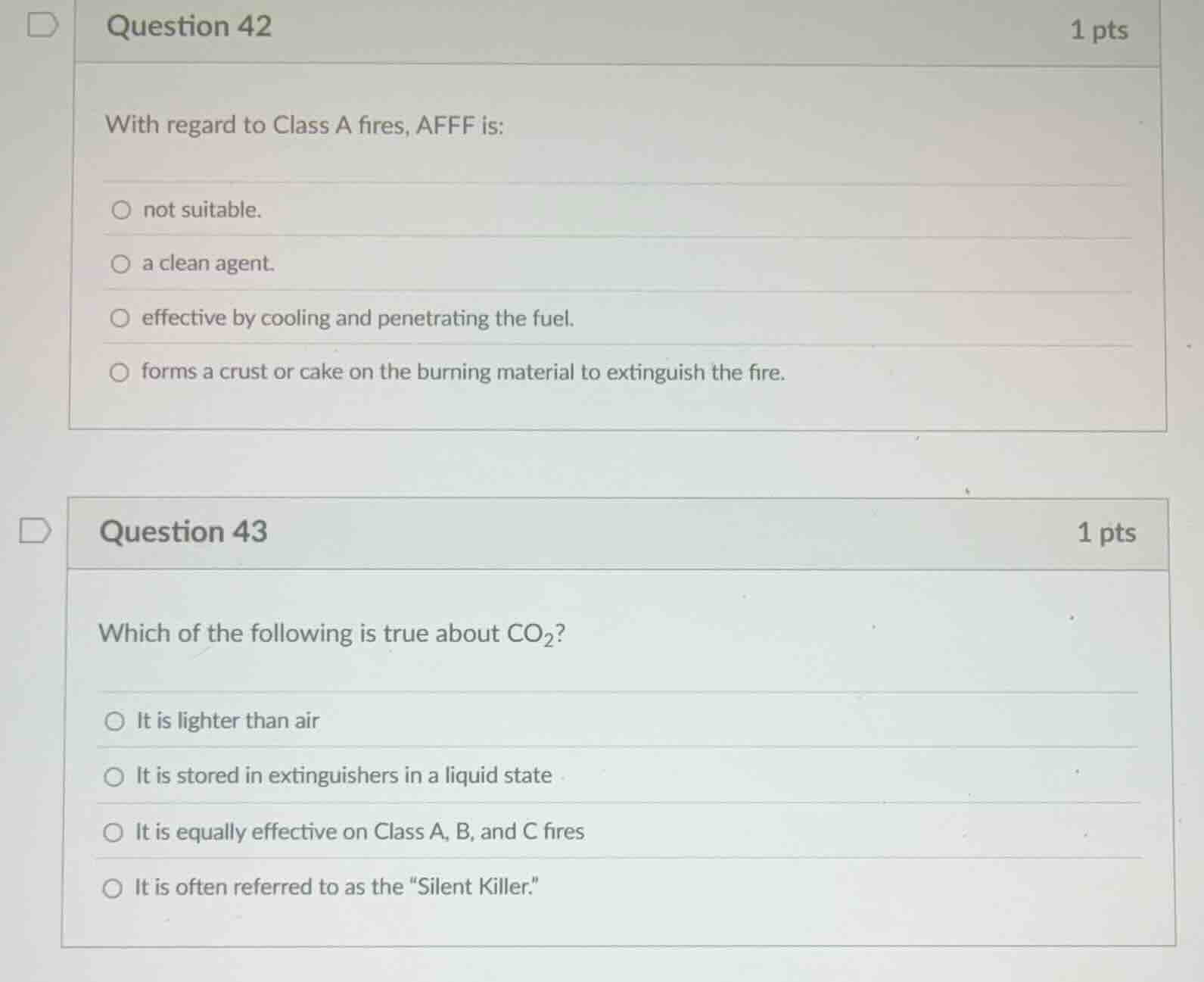
with regard to class a fires, afff is:
not suitable.
a clean agent.
effective by cooling and penetrating the fuel.
forms a crust or cake on the burning material to extinguish the fire.
question 43
which of the following is true about \\(\text{co}_2\\)?
it is lighter than air
it is stored in extinguishers in a liquid state
it is equally effective on class a, b, and c fires
it is often referred to as the \silent killer.\
Analyze Question 42 regarding AFFF on Class A fires
Aqueous Film-Forming Foam (AFFF) is primarily designed for Class B (flammable liquid) fires, but it is also highly effective on Class A (ordinary combustible) fires. Because AFFF is water-based, it cools the fuel. Additionally, the surfactant properties of the foam allow the water to penetrate deep into Class A materials (like wood, paper, or textiles) more effectively than plain water. It does not form a crust or cake (which is characteristic of dry chemical agents like monoammonium phosphate), and it is not a clean agent (like Halon or FE-36).
Analyze Question 43 regarding Carbon Dioxide (CO2)
Let's evaluate the statements about Carbon Dioxide (\(\text{CO}_2\)) extinguishers:
- "It is lighter than air": Incorrect. Carbon dioxide has a molecular weight of approximately 44 g/mol, whereas air has an average molecular weight of about 29 g/mol. Therefore, \(\text{CO}_2\) is heavier than air.
- "It is stored in extinguishers in a liquid state": Correct. Inside the high-pressure cylinder of a \(\text{CO}_2\) extinguisher, the gas is compressed under high pressure (typically around 830 psi at room temperature), which keeps it in a liquid state.
- "It is equally effective on Class A, B, and C fires": Incorrect. \(\text{CO}_2\) is highly effective on Class B and C fires but is generally ineffective on Class A fires because it does not cool the fuel sufficiently to prevent re-ignition.
- "It is often referred to as the 'Silent Killer'": Incorrect. While carbon monoxide (\(\text{CO}\)) is commonly referred to as the "silent killer" due to its odorless, colorless, and highly toxic nature, \(\text{CO}_2\) is not typically given this moniker in fire safety contexts.

Snap & solve any problem in the app
Get step-by-step solutions on Sovi AI
Photo-based solutions with guided steps
Explore more problems and detailed explanations
Question 42
- (A) not suitable.
- (B) a clean agent.
- (C) effective by cooling and penetrating the fuel. (Correct answer)
- (D) forms a crust or cake on the burning material to extinguish the fire.
Question 43
- (A) It is lighter than air
- (B) It is stored in extinguishers in a liquid state (Correct answer)
- (C) It is equally effective on Class A, B, and C fires
- (D) It is often referred to as the "Silent Killer."