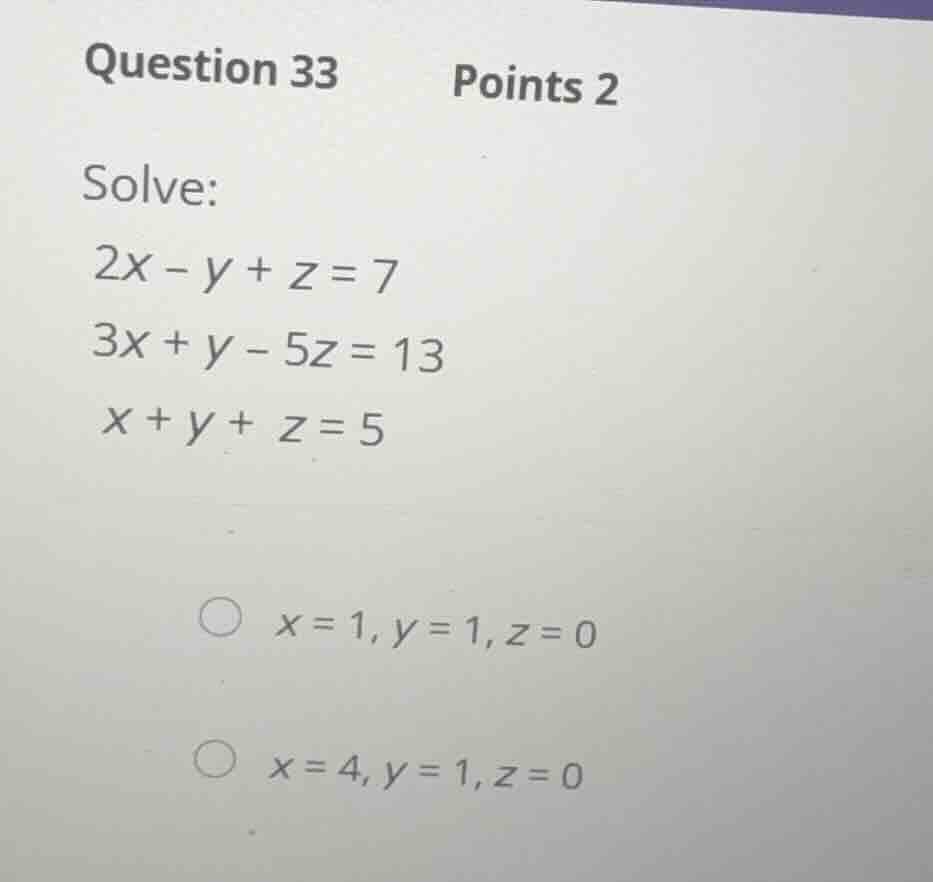
QUESTION IMAGE
Question
question 33 points 2
solve:
\\
\
\\
\\(x = 1, y = 1, z = 0\\)
\\(x = 4, y = 1, z = 0\\)
<pre_analysis>
{
"quality": "clear",
"question_count": 1,
"skills_matched": [
"step_cot",
"multiple_choice_formatter",
"explain_then_answer",
"tutor",
"mastery_adaptive_brevity"
],
"needs_drawing": false,
"concepts_used": [
"Coefficient Matrix",
"Matrix Determinant"
],
"new_concepts": [
"System of Linear Equations",
"Cramer's Rule"
],
"current_concepts": [
"Coefficient Matrix",
"Matrix Determinant",
"System of Linear Equations",
"Cramer's Rule"
]
}
</pre_analysis>
<reasoning>
Set up the system of equations
Using the Coefficient Matrix knowledge point
\[
\]
Eliminate variables to solve the system
We can eliminate \(y\) by adding Equation 1 and Equation 3:
\[
\]
Next, we eliminate \(y\) by subtracting Equation 3 from Equation 2:
\[
\]
Solve the simplified system for x and z
From Equation 5, we express \(x\) in terms of \(z\):
\[
x = 3z + 4
\]
Substitute this expression for \(x\) into Equation 4:
\[
\]
Substitute \(z = 0\) back to find \(x\):
\[
x = 3(0) + 4 = 4
\]
Find the value of y
Substitute \(x = 4\) and \(z = 0\) into Equation 3:
\[
\]
Verify the solution and match options
Using the Matrix Determinant knowledge point
\[
\]
</reasoning>
<answer>
<mcq-option>\(x = 1, y = 1, z = 0\)</mcq-option>
<mcq-correct>\(x = 4, y = 1, z = 0\)</mcq-correct>
</answer>
<post_analysis>
{
"subject": "Mathematics",
"question_type": "Multiple Choice",
"knowledge_point": [
"Mathematics",
"Algebra",
"System of Linear Equations"
]
}
</post_analysis>
Snap & solve any problem in the app
Get step-by-step solutions on Sovi AI
Photo-based solutions with guided steps
Explore more problems and detailed explanations
<pre_analysis>
{
"quality": "clear",
"question_count": 1,
"skills_matched": [
"step_cot",
"multiple_choice_formatter",
"explain_then_answer",
"tutor",
"mastery_adaptive_brevity"
],
"needs_drawing": false,
"concepts_used": [
"Coefficient Matrix",
"Matrix Determinant"
],
"new_concepts": [
"System of Linear Equations",
"Cramer's Rule"
],
"current_concepts": [
"Coefficient Matrix",
"Matrix Determinant",
"System of Linear Equations",
"Cramer's Rule"
]
}
</pre_analysis>
<reasoning>
Set up the system of equations
Using the Coefficient Matrix knowledge point
\[
\]
Eliminate variables to solve the system
We can eliminate \(y\) by adding Equation 1 and Equation 3:
\[
\]
Next, we eliminate \(y\) by subtracting Equation 3 from Equation 2:
\[
\]
Solve the simplified system for x and z
From Equation 5, we express \(x\) in terms of \(z\):
\[
x = 3z + 4
\]
Substitute this expression for \(x\) into Equation 4:
\[
\]
Substitute \(z = 0\) back to find \(x\):
\[
x = 3(0) + 4 = 4
\]
Find the value of y
Substitute \(x = 4\) and \(z = 0\) into Equation 3:
\[
\]
Verify the solution and match options
Using the Matrix Determinant knowledge point
\[
\]
</reasoning>
<answer>
<mcq-option>\(x = 1, y = 1, z = 0\)</mcq-option>
<mcq-correct>\(x = 4, y = 1, z = 0\)</mcq-correct>
</answer>
<post_analysis>
{
"subject": "Mathematics",
"question_type": "Multiple Choice",
"knowledge_point": [
"Mathematics",
"Algebra",
"System of Linear Equations"
]
}
</post_analysis>