QUESTION IMAGE
Question
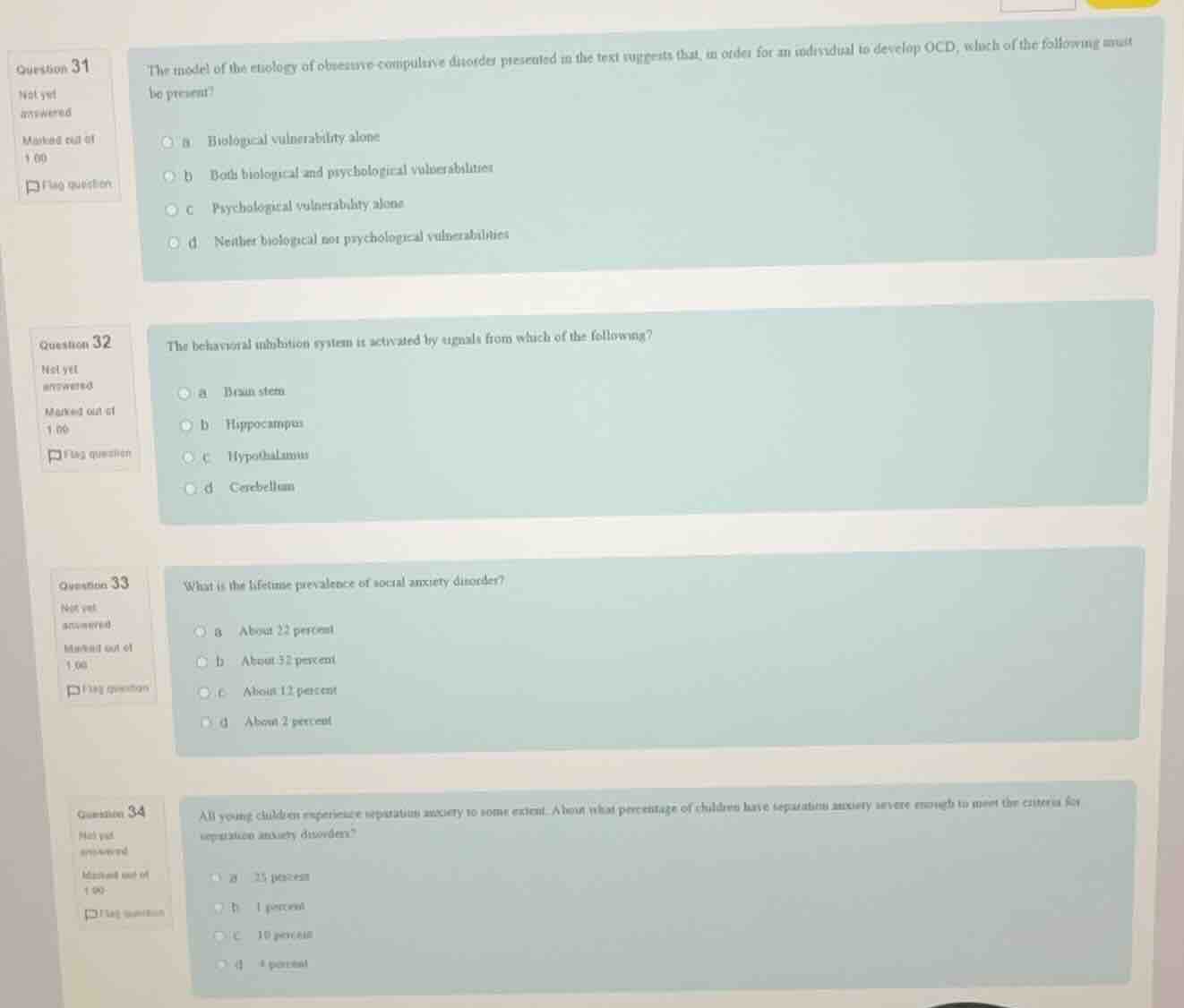
question 31
the model of the etiology of obsessive-compulsive disorder presented in the text suggests that, in order for an individual to develop ocd, which of the following must be present?
a. biological vulnerability alone
b. both biological and psychological vulnerabilities
c. psychological vulnerability alone
d. neither biological nor psychological vulnerabilities
question 32
the behavioral inhibition system is activated by signals from which of the following?
a. brain stem
b. hippocampus
c. hypothalamus
d. cerebellum
question 33
what is the lifetime prevalence of social anxiety disorder?
a. about 22 percent
b. about 32 percent
c. about 12 percent
d. about 2 percent
question 34
all young children experience separation anxiety to some extent. about what percentage of children have separation anxiety severe enough to meet the criteria for separation anxiety disorders?
a. 25 percent
b. 1 percent
c. 10 percent
d. 4 percent
<pre_analysis>
{
"quality": "clear",
"question_count": 4,
"skills_matched": [
"direct_cot",
"multiple_choice_formatter",
"explain_then_answer",
"quick"
],
"needs_drawing": false,
"concepts_used": [
"Social Anxiety Prevalence"
],
"new_concepts": [
"Etiology of OCD",
"Behavioral Inhibition System",
"Separation Anxiety Prevalence"
],
"current_concepts": [
"Etiology of OCD",
"Behavioral Inhibition System",
"Social Anxiety Prevalence",
"Separation Anxiety Prevalence"
]
}
</pre_analysis>
<reasoning>
Analyze Question 31
The integrative model of the etiology of obsessive-compulsive disorder (OCD) suggests that biological vulnerability (e.g., genetic predisposition) and psychological vulnerability (e.g., early experiences of thoughts being dangerous) must both be present to develop the disorder.
Analyze Question 32
The behavioral inhibition system (BIS) is a brain circuit that responds to threat signals, novelty, and punishment. It is activated by signals from the brain stem (such as the locus coeruleus) and travels through the limbic system, particularly involving the septal-hippocampal system. The primary activation signals arise from the brain stem.
Analyze Question 33
Epidemiological data (such as the National Comorbidity Survey Replication) indicates that the lifetime prevalence of social anxiety disorder in the United States is approximately 12.1% (about 12 percent).
Analyze Question 34
While separation anxiety is common in early development, severe separation anxiety meeting the diagnostic criteria for separation anxiety disorder occurs in approximately 4% of children.
</reasoning>
<answer>
Question 31
<mcq-option>a. Biological vulnerability alone</mcq-option>
<mcq-correct>b. Both biological and psychological vulnerabilities</mcq-correct>
<mcq-option>c. Psychological vulnerability alone</mcq-option>
<mcq-option>d. Neither biological nor psychological vulnerabilities</mcq-option>
Question 32
<mcq-correct>a. Brain stem</mcq-correct>
<mcq-option>b. Hippocampus</mcq-option>
<mcq-option>c. Hypothalamus</mcq-option>
<mcq-option>d. Cerebellum</mcq-option>
Question 33
<mcq-option>a. About 22 percent</mcq-option>
<mcq-option>b. About 32 percent</mcq-option>
<mcq-correct>c. About 12 percent</mcq-correct>
<mcq-option>d. About 2 percent</mcq-option>
Question 34
<mcq-option>a. 25 percent</mcq-option>
<mcq-option>b. 1 percent</mcq-option>
<mcq-option>c. 10 percent</mcq-option>
<mcq-correct>d. 4 percent</mcq-correct>
</answer>
<post_analysis>
{
"subject": "Natural Science",
"question_type": "Multiple Choice",
"knowledge_point": [
"Natural Science",
"Psychology",
"Abnormal Psychology"
]
}
</post_analysis>
Snap & solve any problem in the app
Get step-by-step solutions on Sovi AI
Photo-based solutions with guided steps
Explore more problems and detailed explanations
<pre_analysis>
{
"quality": "clear",
"question_count": 4,
"skills_matched": [
"direct_cot",
"multiple_choice_formatter",
"explain_then_answer",
"quick"
],
"needs_drawing": false,
"concepts_used": [
"Social Anxiety Prevalence"
],
"new_concepts": [
"Etiology of OCD",
"Behavioral Inhibition System",
"Separation Anxiety Prevalence"
],
"current_concepts": [
"Etiology of OCD",
"Behavioral Inhibition System",
"Social Anxiety Prevalence",
"Separation Anxiety Prevalence"
]
}
</pre_analysis>
<reasoning>
Analyze Question 31
The integrative model of the etiology of obsessive-compulsive disorder (OCD) suggests that biological vulnerability (e.g., genetic predisposition) and psychological vulnerability (e.g., early experiences of thoughts being dangerous) must both be present to develop the disorder.
Analyze Question 32
The behavioral inhibition system (BIS) is a brain circuit that responds to threat signals, novelty, and punishment. It is activated by signals from the brain stem (such as the locus coeruleus) and travels through the limbic system, particularly involving the septal-hippocampal system. The primary activation signals arise from the brain stem.
Analyze Question 33
Epidemiological data (such as the National Comorbidity Survey Replication) indicates that the lifetime prevalence of social anxiety disorder in the United States is approximately 12.1% (about 12 percent).
Analyze Question 34
While separation anxiety is common in early development, severe separation anxiety meeting the diagnostic criteria for separation anxiety disorder occurs in approximately 4% of children.
</reasoning>
<answer>
Question 31
<mcq-option>a. Biological vulnerability alone</mcq-option>
<mcq-correct>b. Both biological and psychological vulnerabilities</mcq-correct>
<mcq-option>c. Psychological vulnerability alone</mcq-option>
<mcq-option>d. Neither biological nor psychological vulnerabilities</mcq-option>
Question 32
<mcq-correct>a. Brain stem</mcq-correct>
<mcq-option>b. Hippocampus</mcq-option>
<mcq-option>c. Hypothalamus</mcq-option>
<mcq-option>d. Cerebellum</mcq-option>
Question 33
<mcq-option>a. About 22 percent</mcq-option>
<mcq-option>b. About 32 percent</mcq-option>
<mcq-correct>c. About 12 percent</mcq-correct>
<mcq-option>d. About 2 percent</mcq-option>
Question 34
<mcq-option>a. 25 percent</mcq-option>
<mcq-option>b. 1 percent</mcq-option>
<mcq-option>c. 10 percent</mcq-option>
<mcq-correct>d. 4 percent</mcq-correct>
</answer>
<post_analysis>
{
"subject": "Natural Science",
"question_type": "Multiple Choice",
"knowledge_point": [
"Natural Science",
"Psychology",
"Abnormal Psychology"
]
}
</post_analysis>