Sovi.AI - AI Math Tutor

Scan to solve math questions

QUESTION IMAGE

question 30 chloroplasts convert radiant energy from sunlight into chem…

Question

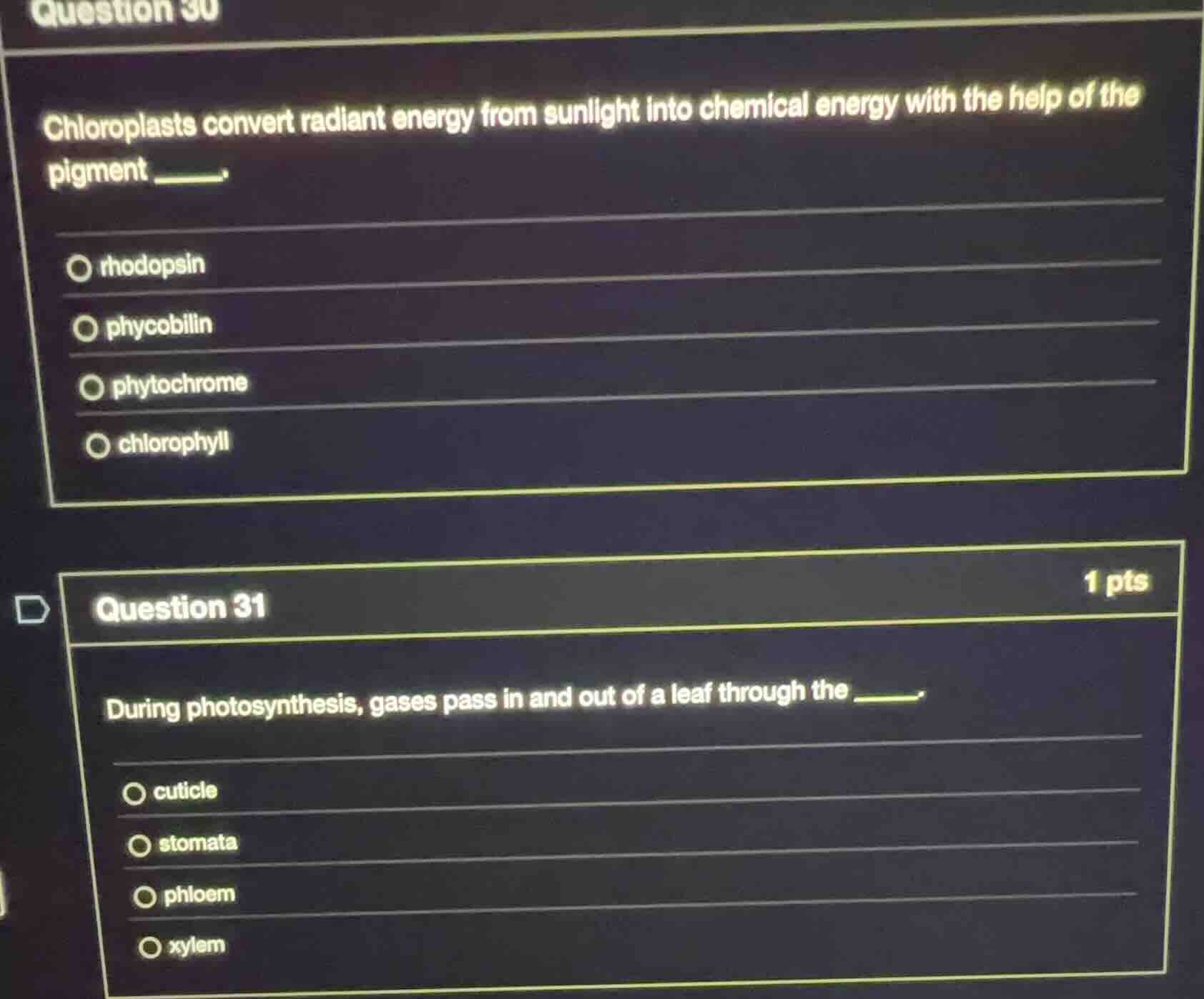
question 30
chloroplasts convert radiant energy from sunlight into chemical energy with the help of the pigment ______.

rhodopsin
phycobilin
phytochrome
chlorophyll

question 31
during photosynthesis, gases pass in and out of a leaf through the ______.

cuticle
stomata
phloem
xylem

Explanation:

Response

<pre_analysis>
{
"quality": "clear",
"question_count": 2,
"skills_matched": [
"direct_cot",
"multiple_choice_formatter",
"explain_then_answer",
"tutor"
],
"needs_drawing": false,
"concepts_used": [
"Photosynthetic Pigments",
"Plant Anatomy"
],
"new_concepts": [],
"current_concepts": [
"Photosynthetic Pigments",
"Plant Anatomy",
"Photosynthesis"
]
}
</pre_analysis>

<reasoning>

Identify the primary photosynthetic pigment

The first question asks for the pigment in chloroplasts that converts radiant energy from sunlight into chemical energy. Using the Photosynthetic Pigments concept, we know that chlorophyll is the primary green pigment responsible for absorbing light energy during photosynthesis.

Evaluate the options for Question 30

  • Rhodopsin is a light-sensitive receptor protein found in the retinas of humans and other animals.
  • Phycobilin is an accessory pigment found in red algae and cyanobacteria.
  • Phytochrome is a photoreceptor plant pigment used to detect light for regulating developmental processes (like flowering).
  • Chlorophyll is the main pigment in chloroplasts that drives photosynthesis. Thus, chlorophyll is the correct choice.

Identify the structures for gas exchange in leaves

The second question asks about the structures through which gases pass in and out of a leaf during photosynthesis. Using the Plant Anatomy concept, we look at the specialized microscopic pores on the leaf surface.

Evaluate the options for Question 31

  • Cuticle is a waxy, waterproof outer layer that prevents water loss but does not facilitate gas exchange.
  • Stomata (singular: stoma) are microscopic pores on the epidermis of leaves that open and close to regulate gas exchange (\(\text{CO}_2\) and \(\text{O}_2\)) and water vapor loss.
  • Phloem is vascular tissue that transports organic nutrients (sugars) throughout the plant.
  • Xylem is vascular tissue that transports water and dissolved minerals from the roots upward. Thus, stomata is the correct choice.

</reasoning>

<answer>

Question 30

<mcq-option>O rhodopsin</mcq-option>
<mcq-option>O phycobilin</mcq-option>
<mcq-option>O phytochrome</mcq-option>
<mcq-correct>O chlorophyll</mcq-correct>

Question 31

<mcq-option>O cuticle</mcq-option>
<mcq-correct>O stomata</mcq-correct>
<mcq-option>O phloem</mcq-option>
<mcq-option>O xylem</mcq-option>
</answer>

<post_analysis>
{
"subject": "Natural Science",
"question_type": "Multiple Choice",
"knowledge_point": [
"Natural Science",
"Biology",
"Photosynthesis"
]
}
</post_analysis>

Answer:

<pre_analysis>
{
"quality": "clear",
"question_count": 2,
"skills_matched": [
"direct_cot",
"multiple_choice_formatter",
"explain_then_answer",
"tutor"
],
"needs_drawing": false,
"concepts_used": [
"Photosynthetic Pigments",
"Plant Anatomy"
],
"new_concepts": [],
"current_concepts": [
"Photosynthetic Pigments",
"Plant Anatomy",
"Photosynthesis"
]
}
</pre_analysis>

<reasoning>

Identify the primary photosynthetic pigment

The first question asks for the pigment in chloroplasts that converts radiant energy from sunlight into chemical energy. Using the Photosynthetic Pigments concept, we know that chlorophyll is the primary green pigment responsible for absorbing light energy during photosynthesis.

Evaluate the options for Question 30

  • Rhodopsin is a light-sensitive receptor protein found in the retinas of humans and other animals.
  • Phycobilin is an accessory pigment found in red algae and cyanobacteria.
  • Phytochrome is a photoreceptor plant pigment used to detect light for regulating developmental processes (like flowering).
  • Chlorophyll is the main pigment in chloroplasts that drives photosynthesis. Thus, chlorophyll is the correct choice.

Identify the structures for gas exchange in leaves

The second question asks about the structures through which gases pass in and out of a leaf during photosynthesis. Using the Plant Anatomy concept, we look at the specialized microscopic pores on the leaf surface.

Evaluate the options for Question 31

  • Cuticle is a waxy, waterproof outer layer that prevents water loss but does not facilitate gas exchange.
  • Stomata (singular: stoma) are microscopic pores on the epidermis of leaves that open and close to regulate gas exchange (\(\text{CO}_2\) and \(\text{O}_2\)) and water vapor loss.
  • Phloem is vascular tissue that transports organic nutrients (sugars) throughout the plant.
  • Xylem is vascular tissue that transports water and dissolved minerals from the roots upward. Thus, stomata is the correct choice.

</reasoning>

<answer>

Question 30

<mcq-option>O rhodopsin</mcq-option>
<mcq-option>O phycobilin</mcq-option>
<mcq-option>O phytochrome</mcq-option>
<mcq-correct>O chlorophyll</mcq-correct>

Question 31

<mcq-option>O cuticle</mcq-option>
<mcq-correct>O stomata</mcq-correct>
<mcq-option>O phloem</mcq-option>
<mcq-option>O xylem</mcq-option>
</answer>

<post_analysis>
{
"subject": "Natural Science",
"question_type": "Multiple Choice",
"knowledge_point": [
"Natural Science",
"Biology",
"Photosynthesis"
]
}
</post_analysis>