QUESTION IMAGE
Question
question 27
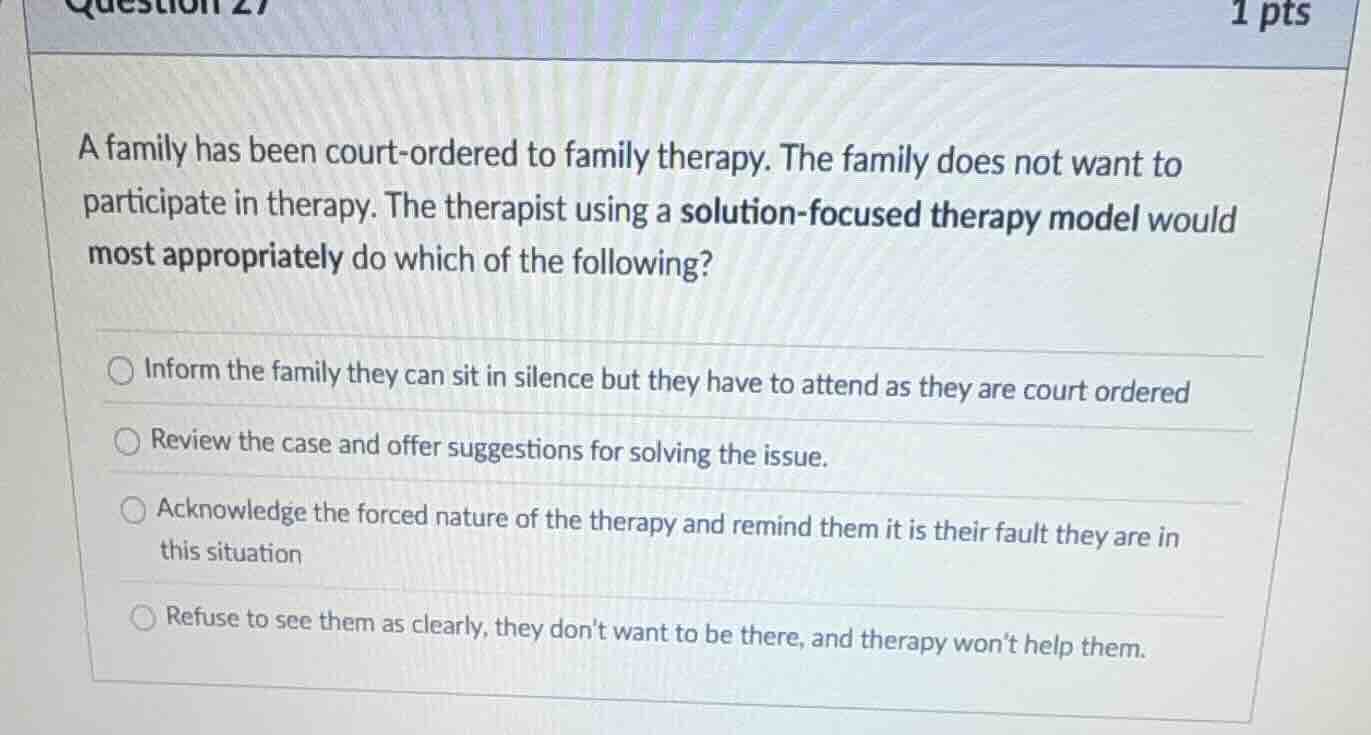
a family has been court-ordered to family therapy. the family does not want to participate in therapy. the therapist using a solution-focused therapy model would most appropriately do which of the following?
- inform the family they can sit in silence but they have to attend as they are court ordered
- review the case and offer suggestions for solving the issue.
- acknowledge the forced nature of the therapy and remind them it is their fault they are in this situation
- refuse to see them as clearly, they dont want to be there, and therapy wont help them.
🆕 New Concept Discovered: Solution-Focused Visitor Relationship
Working with non-voluntary or mandated clients.
Step 1: Understand the client relationship type
In Solution-Focused Brief Therapy (SFBT), clients who are mandated or court-ordered to attend therapy and do not wish to participate are categorized as having a "visitor" relationship with the therapist. They are there because someone else (like a court or judge) thinks they have a problem, but they do not personally identify a problem they want to work on.
Step 2: Determine the therapist's role with a "visitor" client
When working with a visitor-type relationship, the therapist must:
- Acknowledge the non-voluntary nature of their attendance.
- Avoid forcing them to work on goals they do not agree with.
- Remain respectful, non-blaming, and collaborative.
- Clarify the minimum requirements of their mandate (e.g., physical attendance) while giving them control over how they spend that time (e.g., they can choose to sit in silence if they wish).
Step 3: Evaluate the given options
- Option 1: "Inform the family they can sit in silence but they have to attend as they are court ordered"
- Analysis: This option respects the family's autonomy and acknowledges their lack of desire to participate, while clearly stating the legal reality of the court order. It aligns with the SFBT approach of meeting the client where they are without forcing compliance.
- Option 2: "Review the case and offer suggestions for solving the issue."
- Analysis: SFBT is non-directive and does not involve the therapist offering expert suggestions to solve issues, especially when the family has not agreed that an issue exists.
- Option 3: "Acknowledge the forced nature of the therapy and remind them it is their fault they are in this situation"
- Analysis: Blaming the family ("it is their fault") is highly non-therapeutic, confrontational, and violates the core SFBT principle of maintaining a positive, non-blaming stance.
- Option 4: "Refuse to see them as clearly, they don't want to be there, and therapy won't help them."
- Analysis: Refusing to see court-ordered clients is unethical and unprofessional for a therapist assigned to the case.

Snap & solve any problem in the app
Get step-by-step solutions on Sovi AI
Photo-based solutions with guided steps
Explore more problems and detailed explanations
Inform the family they can sit in silence but they have to attend as they are court ordered