Sovi.AI - AI Math Tutor

Scan to solve math questions

QUESTION IMAGE

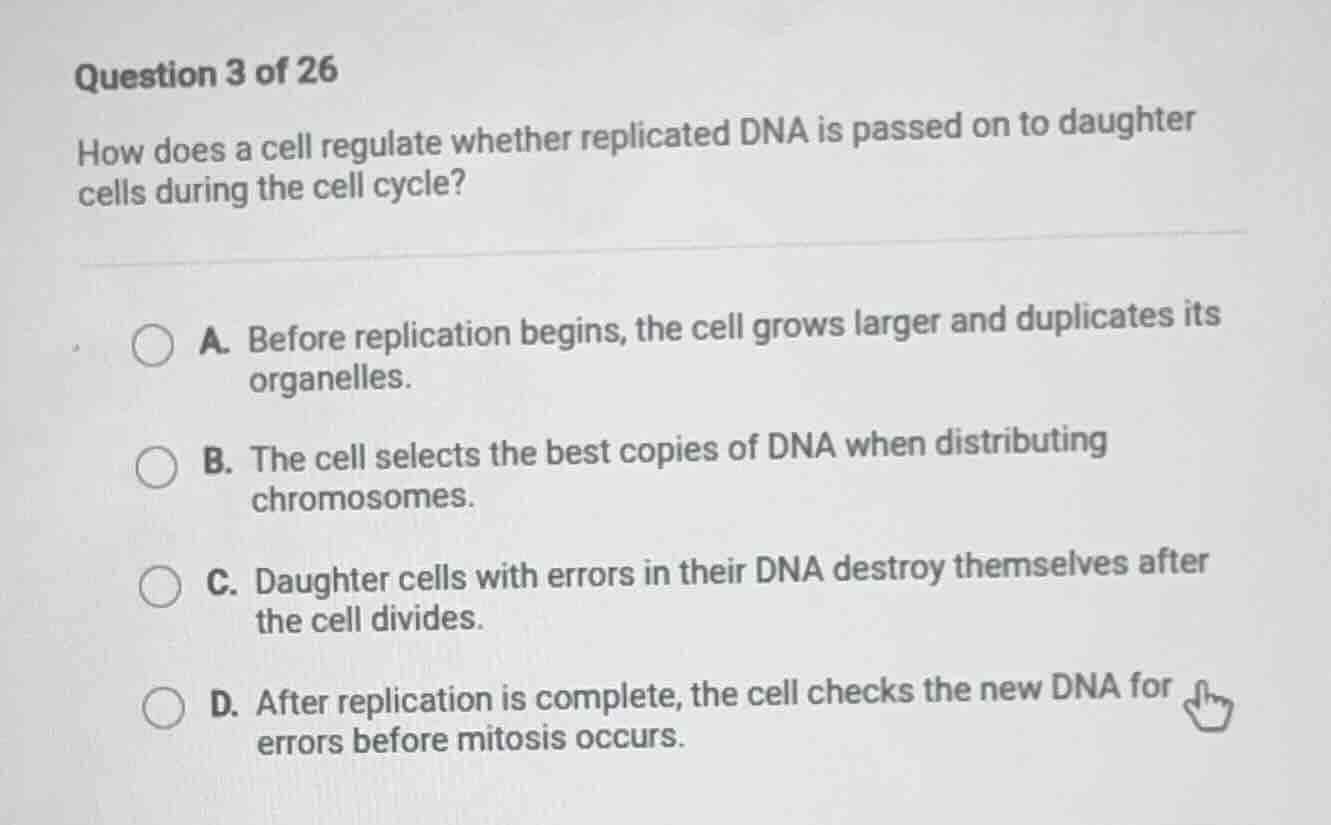
question 3 of 26 how does a cell regulate whether replicated dna is pas…

Question

question 3 of 26

how does a cell regulate whether replicated dna is passed on to daughter cells during the cell cycle?

a. before replication begins, the cell grows larger and duplicates its organelles.
b. the cell selects the best copies of dna when distributing chromosomes.
c. daughter cells with errors in their dna destroy themselves after the cell divides.
d. after replication is complete, the cell checks the new dna for errors before mitosis occurs.

Explanation:

Response

<pre_analysis>
{
"quality": "clear",
"question_count": 1,
"skills_matched": [
"direct_cot",
"multiple_choice_formatter",
"explain_then_answer",
"tutor"
],
"needs_drawing": false,
"concepts_used": [],
"new_concepts": [
"Cell Cycle Regulation",
"Cell Cycle Checkpoints"
],
"current_concepts": [
"Cell Cycle Regulation",
"Cell Cycle Checkpoints",
"DNA Replication"
]
}
</pre_analysis>

<reasoning>

Analyze the question

The question asks how a cell regulates whether replicated DNA is passed on to daughter cells during the cell cycle.

Evaluate Option A

Option A describes G1 phase growth and organelle duplication. This occurs before replication and does not regulate passing on replicated DNA.

Evaluate Option B

Option B suggests the cell selects "best copies" of DNA. Cells do not choose between better or worse copies of identical sister chromatids.

Evaluate Option C

Option C suggests daughter cells destroy themselves after division. Regulation occurs primarily via checkpoints before division to prevent faulty division.

Evaluate Option D

Option D describes the G2 checkpoint. The cell checks replicated DNA for damage or errors before entering mitosis, preventing damaged DNA transmission.
</reasoning>

<answer>
<mcq-option>A. Before replication begins, the cell grows larger and duplicates its organelles.</mcq-option>
<mcq-option>B. The cell selects the best copies of DNA when distributing chromosomes.</mcq-option>
<mcq-option>C. Daughter cells with errors in their DNA destroy themselves after the cell divides.</mcq-option>
<mcq-correct>D. After replication is complete, the cell checks the new DNA for errors before mitosis occurs.</mcq-correct>
</answer>

<post_analysis>
{
"subject": "Natural Science",
"question_type": "Multiple Choice",
"knowledge_point": [
"Natural Science",
"Biology",
"Cell Cycle Regulation"
]
}
</post_analysis>

Answer:

<pre_analysis>
{
"quality": "clear",
"question_count": 1,
"skills_matched": [
"direct_cot",
"multiple_choice_formatter",
"explain_then_answer",
"tutor"
],
"needs_drawing": false,
"concepts_used": [],
"new_concepts": [
"Cell Cycle Regulation",
"Cell Cycle Checkpoints"
],
"current_concepts": [
"Cell Cycle Regulation",
"Cell Cycle Checkpoints",
"DNA Replication"
]
}
</pre_analysis>

<reasoning>

Analyze the question

The question asks how a cell regulates whether replicated DNA is passed on to daughter cells during the cell cycle.

Evaluate Option A

Option A describes G1 phase growth and organelle duplication. This occurs before replication and does not regulate passing on replicated DNA.

Evaluate Option B

Option B suggests the cell selects "best copies" of DNA. Cells do not choose between better or worse copies of identical sister chromatids.

Evaluate Option C

Option C suggests daughter cells destroy themselves after division. Regulation occurs primarily via checkpoints before division to prevent faulty division.

Evaluate Option D

Option D describes the G2 checkpoint. The cell checks replicated DNA for damage or errors before entering mitosis, preventing damaged DNA transmission.
</reasoning>

<answer>
<mcq-option>A. Before replication begins, the cell grows larger and duplicates its organelles.</mcq-option>
<mcq-option>B. The cell selects the best copies of DNA when distributing chromosomes.</mcq-option>
<mcq-option>C. Daughter cells with errors in their DNA destroy themselves after the cell divides.</mcq-option>
<mcq-correct>D. After replication is complete, the cell checks the new DNA for errors before mitosis occurs.</mcq-correct>
</answer>

<post_analysis>
{
"subject": "Natural Science",
"question_type": "Multiple Choice",
"knowledge_point": [
"Natural Science",
"Biology",
"Cell Cycle Regulation"
]
}
</post_analysis>