Sovi.AI - AI Math Tutor

Scan to solve math questions

QUESTION IMAGE

question 23 2.5 pts you have a 7 y/o female patient who comes into the …

Question

question 23

2.5 pts

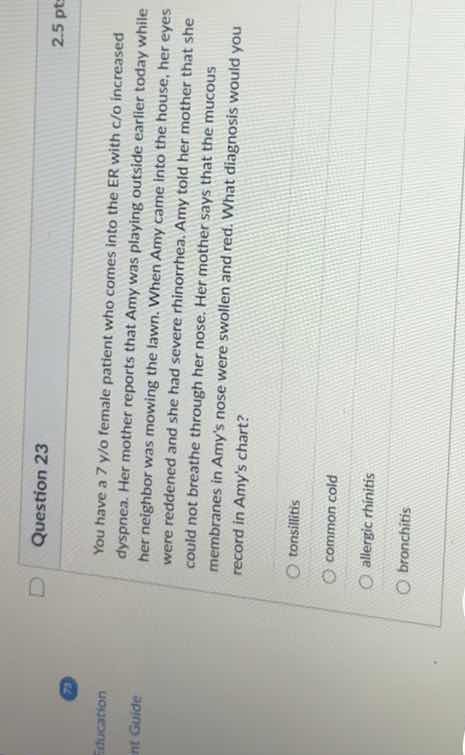
you have a 7 y/o female patient who comes into the er with c/o increased dyspnea. her mother reports that amy was playing outside earlier today while her neighbor was mowing the lawn. when amy came into the house, her eyes were reddened and she had severe rhinorrhea. amy told her mother that she could not breathe through her nose. her mother says that the mucous membranes in amys nose were swollen and red. what diagnosis would you record in amys chart?

tonsillitis
common cold
allergic rhinitis
bronchitis

Explanation:

Response

<pre_analysis>
{
"quality": "clear",
"question_count": 1,
"skills_matched": [
"direct_cot",
"multiple_choice_formatter",
"explain_then_answer",
"tutor"
],
"needs_drawing": false,
"concepts_used": [
"Medical Terminology"
],
"new_concepts": [
"Allergic Rhinitis",
"Clinical Case Analysis"
],
"current_concepts": [
"Medical Terminology",
"Allergic Rhinitis",
"Clinical Case Analysis"
]
}
</pre_analysis>

<reasoning>

Analyze the clinical presentation

The patient is a 7 y/o female presenting with:

  • Chief complaint (c/o) of increased dyspnea (difficulty breathing).
  • Onset occurred after playing outside while a neighbor was mowing the lawn (exposure to freshly cut grass/pollen allergens).
  • Reddened eyes (conjunctival injection).
  • Severe rhinorrhea (runny nose).
  • Nasal congestion (could not breathe through her nose).
  • Swollen and red mucous membranes in the nose (nasal mucosal inflammation).

Evaluate the medical terminology

Using the Medical Terminology knowledge point, we translate the clinical signs:

  • "Rhinorrhea" means a discharge of thin nasal mucus (rhino- = nose, -rrhea = discharge).
  • "Dyspnea" means difficult or labored breathing (dys- = difficult, -pnea = breathing).
  • The combination of acute nasal congestion, rhinorrhea, red eyes, and onset immediately following outdoor allergen exposure (mowed grass) points directly to an allergic reaction affecting the upper respiratory tract.

Differentiate the diagnoses

  • Tonsillitis: Inflammation of the tonsils, typically presenting with sore throat, difficulty swallowing, and fever, rather than acute rhinorrhea and eye redness after grass exposure.
  • Common cold: A viral upper respiratory infection. While it causes rhinorrhea and congestion, its onset is gradual and not typically triggered immediately by outdoor environmental exposure like lawn mowing.
  • Allergic rhinitis: An allergic response causing inflammation of the nasal mucous membranes, characterized by rhinorrhea, nasal congestion, red/itchy eyes, and dyspnea (often associated with allergic asthma), triggered by outdoor allergens like grass pollen. This matches the patient's presentation perfectly.
  • Bronchitis: Inflammation of the bronchial tubes, primarily presenting with a productive cough and chest congestion, rather than prominent nasal and ocular symptoms.

</reasoning>

<answer>
<mcq-option>tonsillitis</mcq-option>
<mcq-option>common cold</mcq-option>
<mcq-correct>allergic rhinitis</mcq-correct>
<mcq-option>bronchitis</mcq-option>
</answer>

<post_analysis>
{
"subject": "Natural Science",
"question_type": "Multiple Choice",
"knowledge_point": [
"Natural Science",
"Medicine",
"Pathology"
]
}
</post_analysis>

Answer:

<pre_analysis>
{
"quality": "clear",
"question_count": 1,
"skills_matched": [
"direct_cot",
"multiple_choice_formatter",
"explain_then_answer",
"tutor"
],
"needs_drawing": false,
"concepts_used": [
"Medical Terminology"
],
"new_concepts": [
"Allergic Rhinitis",
"Clinical Case Analysis"
],
"current_concepts": [
"Medical Terminology",
"Allergic Rhinitis",
"Clinical Case Analysis"
]
}
</pre_analysis>

<reasoning>

Analyze the clinical presentation

The patient is a 7 y/o female presenting with:

  • Chief complaint (c/o) of increased dyspnea (difficulty breathing).
  • Onset occurred after playing outside while a neighbor was mowing the lawn (exposure to freshly cut grass/pollen allergens).
  • Reddened eyes (conjunctival injection).
  • Severe rhinorrhea (runny nose).
  • Nasal congestion (could not breathe through her nose).
  • Swollen and red mucous membranes in the nose (nasal mucosal inflammation).

Evaluate the medical terminology

Using the Medical Terminology knowledge point, we translate the clinical signs:

  • "Rhinorrhea" means a discharge of thin nasal mucus (rhino- = nose, -rrhea = discharge).
  • "Dyspnea" means difficult or labored breathing (dys- = difficult, -pnea = breathing).
  • The combination of acute nasal congestion, rhinorrhea, red eyes, and onset immediately following outdoor allergen exposure (mowed grass) points directly to an allergic reaction affecting the upper respiratory tract.

Differentiate the diagnoses

  • Tonsillitis: Inflammation of the tonsils, typically presenting with sore throat, difficulty swallowing, and fever, rather than acute rhinorrhea and eye redness after grass exposure.
  • Common cold: A viral upper respiratory infection. While it causes rhinorrhea and congestion, its onset is gradual and not typically triggered immediately by outdoor environmental exposure like lawn mowing.
  • Allergic rhinitis: An allergic response causing inflammation of the nasal mucous membranes, characterized by rhinorrhea, nasal congestion, red/itchy eyes, and dyspnea (often associated with allergic asthma), triggered by outdoor allergens like grass pollen. This matches the patient's presentation perfectly.
  • Bronchitis: Inflammation of the bronchial tubes, primarily presenting with a productive cough and chest congestion, rather than prominent nasal and ocular symptoms.

</reasoning>

<answer>
<mcq-option>tonsillitis</mcq-option>
<mcq-option>common cold</mcq-option>
<mcq-correct>allergic rhinitis</mcq-correct>
<mcq-option>bronchitis</mcq-option>
</answer>

<post_analysis>
{
"subject": "Natural Science",
"question_type": "Multiple Choice",
"knowledge_point": [
"Natural Science",
"Medicine",
"Pathology"
]
}
</post_analysis>