QUESTION IMAGE
Question
question 22
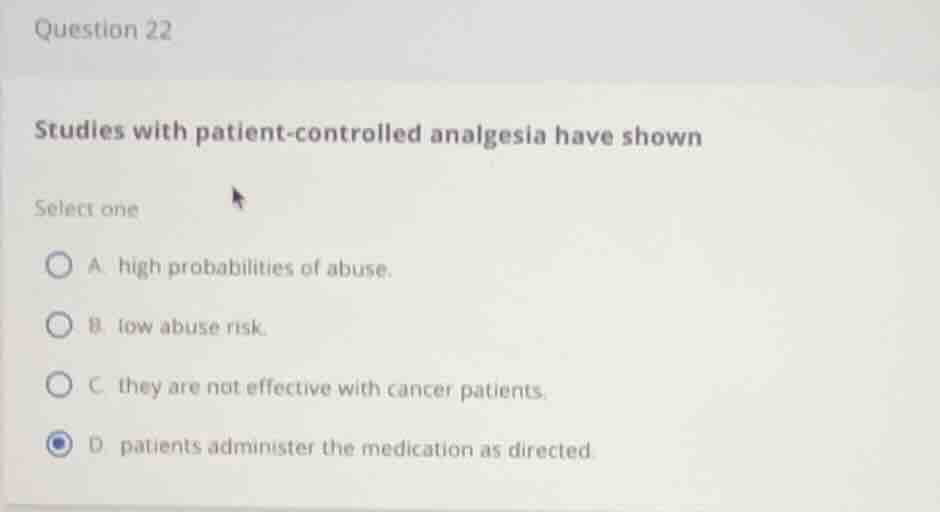
studies with patient-controlled analgesia have shown
select one:
a. high probabilities of abuse.
b. low abuse risk.
c. they are not effective with cancer patients.
d. patients administer the medication as directed.
Define Patient-Controlled Analgesia
Using the Health Psychology and Chronic Pain Management knowledge points, Patient-Controlled Analgesia (PCA) is an interactive drug delivery system allowing patients to self-administer small, controlled doses of analgesic medication (typically opioids) to manage acute or chronic pain.
Analyze clinical outcomes of PCA
Clinical studies consistently demonstrate that when patients are given control over their pain management via PCA, they tend to use less medication overall compared to traditional clinician-administered schedules, resulting in a low risk of drug abuse or addiction in clinical settings.
Evaluate the given options
- Option A suggests high abuse rates, which is contradicted by clinical evidence showing PCA does not increase addiction rates.
- Option B correctly identifies that PCA is associated with a low risk of abuse.
- Option C is incorrect because PCA is highly effective and widely used for cancer pain management.
- Option D is a general operational description rather than a key finding regarding the clinical safety and efficacy outcomes of PCA studies.

Snap & solve any problem in the app
Get step-by-step solutions on Sovi AI
Photo-based solutions with guided steps
Explore more problems and detailed explanations
- (A) high probabilities of abuse.
- (B) low abuse risk. (Correct answer)
- (C) they are not effective with cancer patients.
- (D) patients administer the medication as directed.