QUESTION IMAGE
Question
question 19
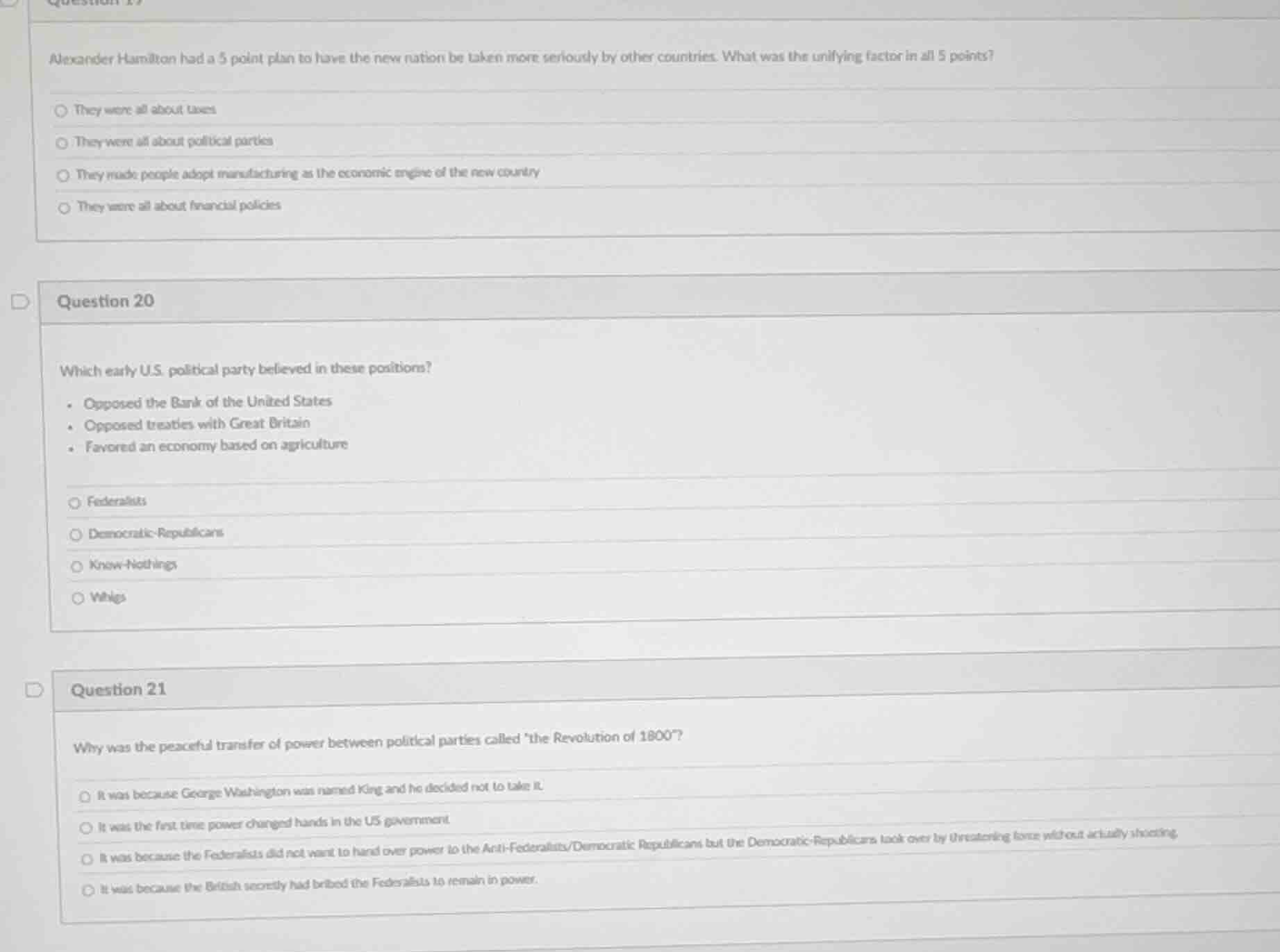
alexander hamilton had a 5 point plan to have the new nation be taken more seriously by other countries. what was the unifying factor in all 5 points?
- they were all about taxes
- they were all about political parties
- they made people adopt manufacturing as the economic engine of the new country
- they were all about financial policies
question 20
which early u.s. political party believed in these positions?
- opposed the bank of the united states
- opposed treaties with great britain
- favored an economy based on agriculture
- federalists
- democratic-republicans
- know-nothings
- whigs
question 21
why was the peaceful transfer of power between political parties called \the revolution of 1800\?
- it was because george washington was named king and he decided not to take it.
- it was the first time power changed hands in the us government
- it was because the federalists did not want to hand over power to the anti-federalists/democratic-republicans but the democratic-republicans took over by threatening force without actually shooting.
- it was because the british secretly had bribed the federalists to remain in power.
Analyze Hamilton's 5-point plan
Alexander Hamilton's financial program aimed to stabilize the early American economy and establish public credit. The five parts of his plan included: establishing public credit (funding and assumption of debts), creating a national bank, levying an excise tax on whiskey, imposing protective tariffs, and establishing a national mint. The unifying factor across all these points is that they were financial policies designed to strengthen the federal government's economic foundation. This directly relates to the Hamiltonian Economic Program.
Identify the early political party's platform
The listed positions are:
- Opposed the Bank of the United States
- Opposed treaties with Great Britain (such as Jay's Treaty)
- Favored an economy based on agriculture (agrarianism)
These core beliefs directly opposed the Federalist platform and were championed by Thomas Jefferson and James Madison, who led the Democratic-Republican Party. This highlights the ideological divide between the Federalists and Anti-Federalists (and later Democratic-Republicans).
Explain the "Revolution of 1800"
The presidential election of 1800 between John Adams (Federalist) and Thomas Jefferson (Democratic-Republican) is historically referred to as the "Revolution of 1800." It earned this name because it marked the first time in modern history that political power in a nation was peacefully transferred from one opposing political party to another, setting a vital democratic precedent.

Snap & solve any problem in the app
Get step-by-step solutions on Sovi AI
Photo-based solutions with guided steps
Explore more problems and detailed explanations
Question 19
- They were all about taxes
- They were all about political parties
- They made people adopt manufacturing as the economic engine of the new country
- They were all about financial policies (Correct answer)
Question 20
- Federalists
- Democratic-Republicans (Correct answer)
- Know-Nothings
- Whigs
Question 21
- It was because George Washington was named King and he decided not to take it.
- It was the first time power changed hands in the US government (Correct answer)
- It was because the Federalists did not want to hand over power to the Anti-Federalists/Democratic Republicans but the Democratic-Republicans took over by threatening force without actually shooting.
- It was because the British secretly had bribed the Federalists to remain in power.