QUESTION IMAGE
Question
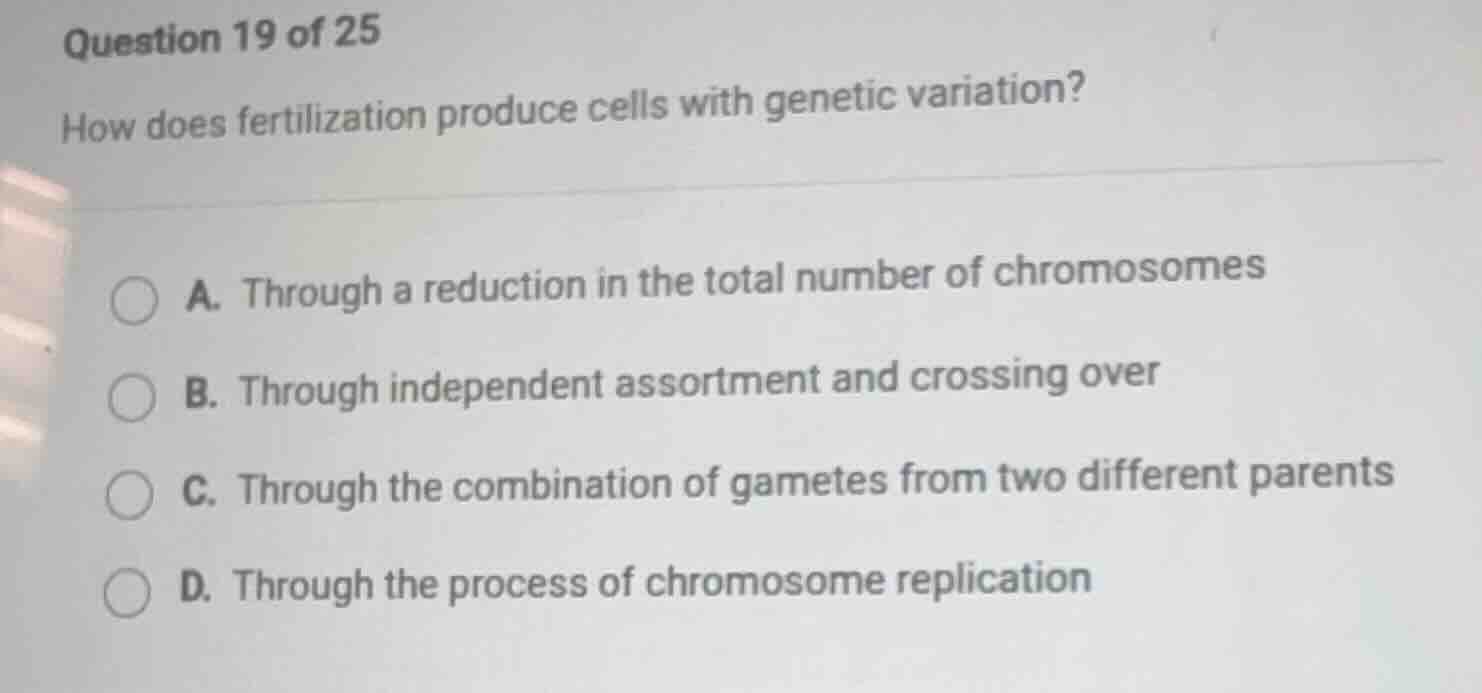
question 19 of 25
how does fertilization produce cells with genetic variation?
a. through a reduction in the total number of chromosomes
b. through independent assortment and crossing over
c. through the combination of gametes from two different parents
d. through the process of chromosome replication
<pre_analysis>
{
"quality": "clear",
"question_count": 1,
"skills_matched": [
"direct_cot",
"multiple_choice_formatter",
"explain_then_answer",
"tutor"
],
"needs_drawing": false,
"concepts_used": [
"Genetic Variation",
"Sexual Reproduction"
],
"new_concepts": [
"Fertilization Mechanisms"
],
"current_concepts": [
"Genetic Variation",
"Sexual Reproduction",
"Fertilization Mechanisms"
]
}
</pre_analysis>
<reasoning>
Define fertilization and its role
Using the Sexual Reproduction knowledge point, fertilization is the process where two haploid gametes (sperm and egg) fuse to form a single diploid zygote. This process combines genetic material from two distinct individuals.
Analyze sources of genetic variation
Using the Genetic Variation knowledge point, we evaluate how different processes contribute to diversity:
- Independent assortment and crossing over occur during meiosis (gamete formation), not during fertilization itself.
- Chromosome replication copies DNA but does not generate new genetic combinations.
- Fertilization creates variation by randomly combining unique gametes from two different parents, resulting in a genetically unique offspring.
Evaluate the given options
- A is incorrect because fertilization restores the diploid number rather than reducing chromosomes.
- B is incorrect because independent assortment and crossing over are meiotic processes.
- C is correct because combining gametes from two parents creates a unique genetic combination.
- D is incorrect because replication simply duplicates existing DNA.
</reasoning>
<answer>
<mcq-option>A. Through a reduction in the total number of chromosomes</mcq-option>
<mcq-option>B. Through independent assortment and crossing over</mcq-option>
<mcq-correct>C. Through the combination of gametes from two different parents</mcq-correct>
<mcq-option>D. Through the process of chromosome replication</mcq-option>
</answer>
<post_analysis>
{
"subject": "Natural Science",
"question_type": "Multiple Choice",
"knowledge_point": [
"Natural Science",
"Biology",
"Sexual Reproduction and Genetics"
]
}
</post_analysis>
Snap & solve any problem in the app
Get step-by-step solutions on Sovi AI
Photo-based solutions with guided steps
Explore more problems and detailed explanations
<pre_analysis>
{
"quality": "clear",
"question_count": 1,
"skills_matched": [
"direct_cot",
"multiple_choice_formatter",
"explain_then_answer",
"tutor"
],
"needs_drawing": false,
"concepts_used": [
"Genetic Variation",
"Sexual Reproduction"
],
"new_concepts": [
"Fertilization Mechanisms"
],
"current_concepts": [
"Genetic Variation",
"Sexual Reproduction",
"Fertilization Mechanisms"
]
}
</pre_analysis>
<reasoning>
Define fertilization and its role
Using the Sexual Reproduction knowledge point, fertilization is the process where two haploid gametes (sperm and egg) fuse to form a single diploid zygote. This process combines genetic material from two distinct individuals.
Analyze sources of genetic variation
Using the Genetic Variation knowledge point, we evaluate how different processes contribute to diversity:
- Independent assortment and crossing over occur during meiosis (gamete formation), not during fertilization itself.
- Chromosome replication copies DNA but does not generate new genetic combinations.
- Fertilization creates variation by randomly combining unique gametes from two different parents, resulting in a genetically unique offspring.
Evaluate the given options
- A is incorrect because fertilization restores the diploid number rather than reducing chromosomes.
- B is incorrect because independent assortment and crossing over are meiotic processes.
- C is correct because combining gametes from two parents creates a unique genetic combination.
- D is incorrect because replication simply duplicates existing DNA.
</reasoning>
<answer>
<mcq-option>A. Through a reduction in the total number of chromosomes</mcq-option>
<mcq-option>B. Through independent assortment and crossing over</mcq-option>
<mcq-correct>C. Through the combination of gametes from two different parents</mcq-correct>
<mcq-option>D. Through the process of chromosome replication</mcq-option>
</answer>
<post_analysis>
{
"subject": "Natural Science",
"question_type": "Multiple Choice",
"knowledge_point": [
"Natural Science",
"Biology",
"Sexual Reproduction and Genetics"
]
}
</post_analysis>