QUESTION IMAGE
Question
question 18
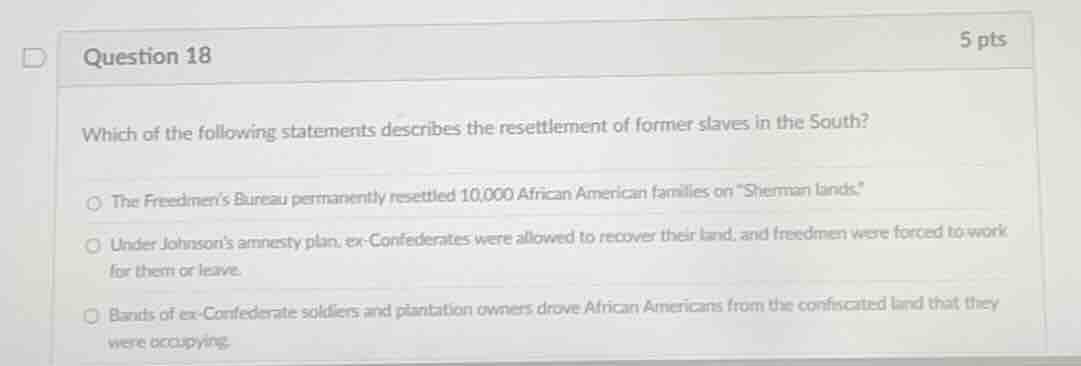
which of the following statements describes the resettlement of former slaves in the south?
- the freedmens bureau permanently resettled 10,000 african american families on \sherman lands.\
- under johnsons amnesty plan, ex-confederates were allowed to recover their land, and freedmen were forced to work for them or leave.
- bands of ex-confederate soldiers and plantation owners drove african americans from the confiscated land that they were occupying.
Analyze the historical context of land resettlement
Using the Reconstruction Era knowledge point, we examine how land redistribution was handled for formerly enslaved people after the Civil War. General Sherman's Special Field Orders No. 15 initially set aside "Sherman lands" for black families, but this was not a permanent resettlement.
Evaluate the first option
The Freedmen's Bureau did not permanently resettle these families because President Andrew Johnson later ordered almost all confiscated and abandoned lands to be returned to their original Confederate owners.
Evaluate the second option
Under President Johnson's lenient amnesty plan, pardoned ex-Confederates recovered their property. Consequently, freedmen who had settled on these lands were forced to sign labor contracts to work for their former masters or face eviction.
Evaluate the third option
While violence and intimidation by white Southerners were widespread, the official, systematic removal and return of land was driven by federal policy under Johnson's executive amnesty, making the second option the most accurate description of the resettlement outcome.

Snap & solve any problem in the app
Get step-by-step solutions on Sovi AI
Photo-based solutions with guided steps
Explore more problems and detailed explanations
- The Freedmen's Bureau permanently resettled 10,000 African American families on "Sherman lands."
- Under Johnson's amnesty plan, ex-Confederates were allowed to recover their land, and freedmen were forced to work for them or leave. (Correct answer)
- Bands of ex-Confederate soldiers and plantation owners drove African Americans from the confiscated land that they were occupying.