QUESTION IMAGE
Question
question 18
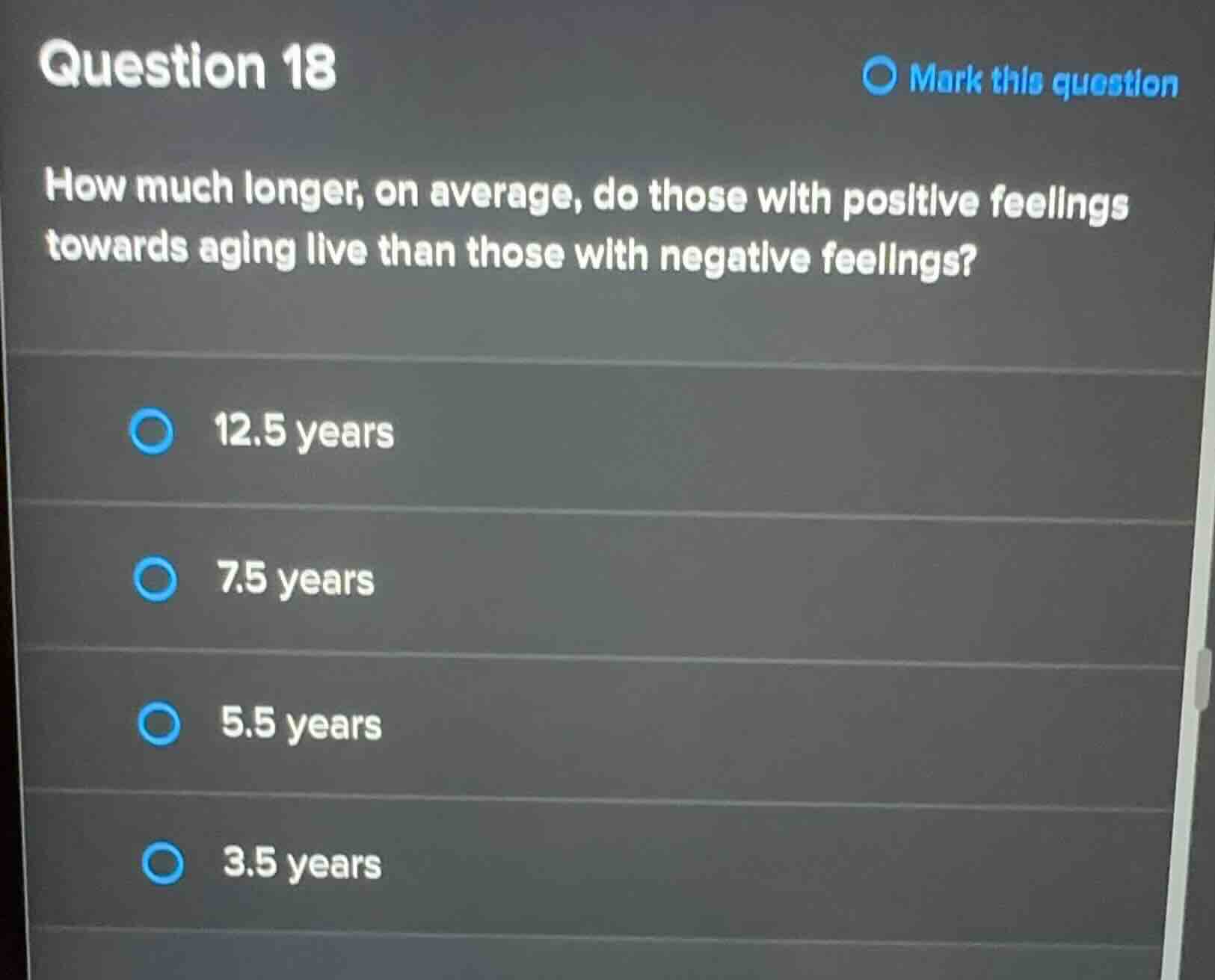
how much longer, on average, do those with positive feelings towards aging live than those with negative feelings?
12.5 years
7.5 years
5.5 years
3.5 years
Identify the core research study
This question refers to a well-known longitudinal study on aging and longevity conducted by Dr. Becca Levy and her colleagues at Yale University. The study investigated how self-perceptions of aging affect life expectancy.
Retrieve the study findings
Dr. Levy's landmark 2002 study, published in the Journal of Personality and Social Psychology, analyzed data from the Ohio Longitudinal Study of Aging and Retirement. The researchers found that individuals with more positive self-perceptions of aging lived significantly longer than those with negative self-perceptions of aging.
Determine the exact difference in longevity
The study concluded that individuals with positive attitudes toward aging lived, on average, 7.5 years longer than those with negative attitudes, even after controlling for age, gender, socioeconomic status, loneliness, and functional health.
Match with the given options
Comparing the finding of 7.5 years to the multiple-choice options:
- 12.5 years (Incorrect)
- 7.5 years (Correct)
- 5.5 years (Incorrect)
- 3.5 years (Incorrect)

Snap & solve any problem in the app
Get step-by-step solutions on Sovi AI
Photo-based solutions with guided steps
Explore more problems and detailed explanations
- (A) 12.5 years
- (B) 7.5 years (Correct answer)
- (C) 5.5 years
- (D) 3.5 years