QUESTION IMAGE
Question
question 18
15 pts
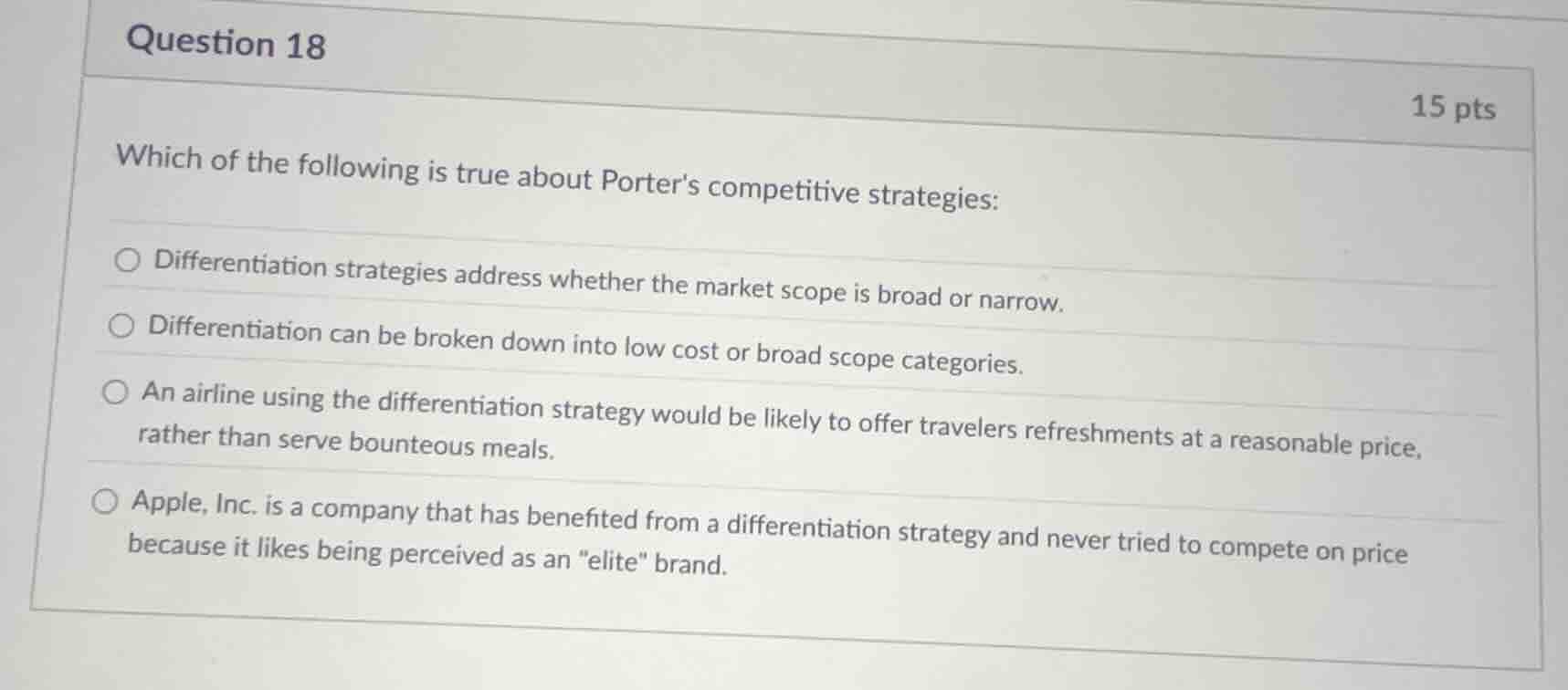
which of the following is true about porters competitive strategies:
- differentiation strategies address whether the market scope is broad or narrow.
- differentiation can be broken down into low cost or broad scope categories.
- an airline using the differentiation strategy would be likely to offer travelers refreshments at a reasonable price, rather than serve bounteous meals.
- apple, inc. is a company that has benefited from a differentiation strategy and never tried to compete on price because it likes being perceived as an \elite\ brand.
🆕 New Concept Discovered: Porter's Generic Strategies
How businesses choose to compete in the market.
Step 1: Understand Porter's Generic Strategies
Michael Porter's framework identifies how a company pursues competitive advantage across its chosen market scope. The strategy is built on two dimensions:
- Source of competitive advantage: Low Cost (keeping costs down) vs. Differentiation (offering unique, premium value).
- Competitive scope: Broad target (industry-wide) vs. Narrow target (niche market).
Step 2: Evaluate the options
- Option 1: "Differentiation strategies address whether the market scope is broad or narrow."
- Analysis: Incorrect. Differentiation is about how a company competes (by being unique), whereas market scope (broad vs. narrow) is a separate dimension.
- Option 2: "Differentiation can be broken down into low cost or broad scope categories."
- Analysis: Incorrect. Differentiation and Low Cost are mutually exclusive sources of advantage in Porter's matrix.
- Option 3: "An airline using the differentiation strategy would be likely to offer travelers refreshments at a reasonable price, rather than serve bounteous meals."
- Analysis: Incorrect. Offering basic refreshments at a reasonable price is a cost-minimizing behavior (Cost Leadership). A differentiation strategy would focus on premium, unique services, such as serving bounteous, high-quality meals to stand out.
- Option 4: "Apple, Inc. is a company that has benefited from a differentiation strategy and never tried to compete on price because it likes being perceived as an "elite" brand."
- Analysis: Correct. Apple is a classic real-world example of a differentiation strategy. They focus on design, innovation, and brand image to charge premium prices, deliberately avoiding price wars with low-cost competitors.

Snap & solve any problem in the app
Get step-by-step solutions on Sovi AI
Photo-based solutions with guided steps
Explore more problems and detailed explanations
Apple, Inc. is a company that has benefited from a differentiation strategy and never tried to compete on price because it likes being perceived as an "elite" brand.