Sovi.AI - AI Math Tutor

Scan to solve math questions

QUESTION IMAGE

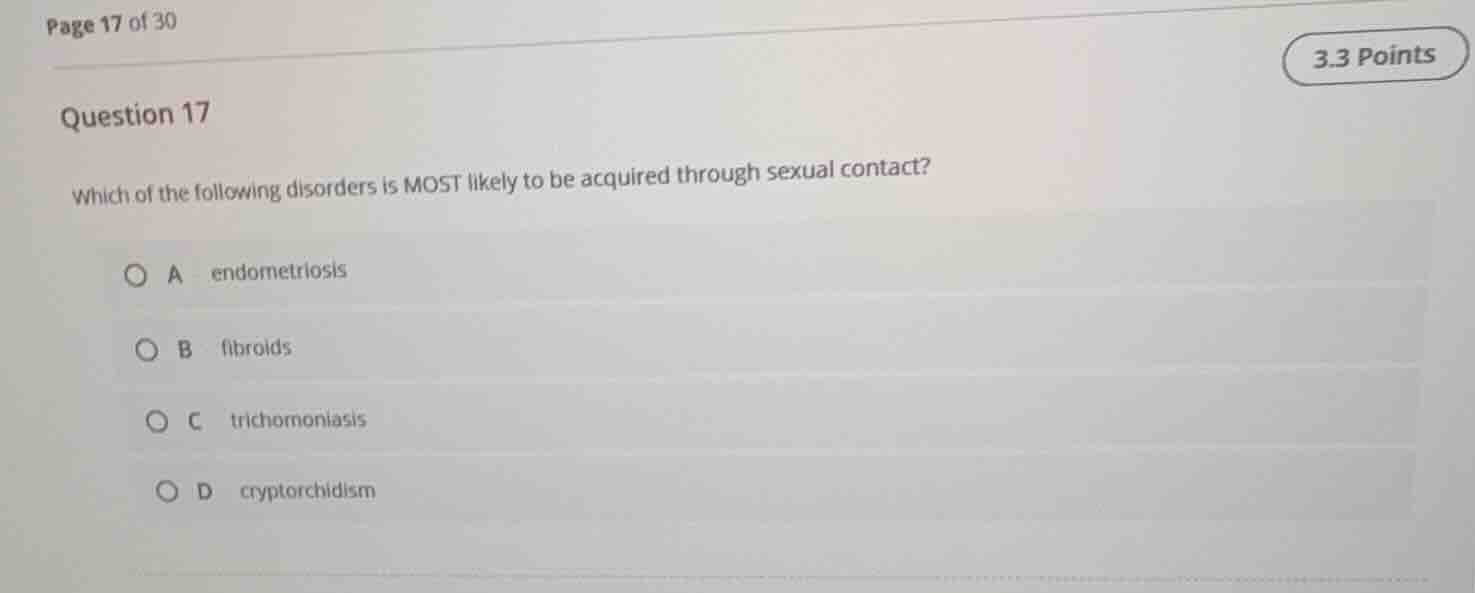
question 17 which of the following disorders is most likely to be acqui…

Question

question 17

which of the following disorders is most likely to be acquired through sexual contact?

a endometriosis
b fibroids
c trichomoniasis
d cryptorchidism

Explanation:

Response

<pre_analysis>
{
"quality": "clear",
"question_count": 1,
"skills_matched": [
"direct_cot",
"multiple_choice_formatter",
"explain_then_answer",
"tutor"
],
"needs_drawing": false,
"concepts_used": [
"Sexually Transmitted Infections"
],
"new_concepts": [
"Trichomoniasis Definition"
],
"current_concepts": [
"Sexually Transmitted Infections",
"Reproductive System Pathology",
"Trichomoniasis Definition"
]
}
</pre_analysis>

<reasoning>

Analyze the question prompt

The question asks to identify which of the listed disorders is most likely to be acquired through sexual contact.

Evaluate the options

  • A endometriosis: This is a condition where tissue similar to the lining of the uterus grows outside the uterus. It is not infectious or sexually transmitted.
  • B fibroids: These are non-cancerous growths in the uterus that develop during a woman's childbearing years. They are not infectious or sexually transmitted.
  • C trichomoniasis: This is a very common sexually transmitted infection (STI) caused by infection with a protozoan parasite called Trichomonas vaginalis.
  • D cryptorchidism: This is a condition in which one or both of the testes fail to descend from the abdomen into the scrotum. It is a congenital developmental condition, not an infection.

Apply mastered concepts

Using the Sexually Transmitted Infections knowledge point, we identify that trichomoniasis is classified as an STI, meaning it is primarily acquired and spread through sexual contact.
</reasoning>

<answer>
<mcq-option>(A) endometriosis</mcq-option>
<mcq-option>(B) fibroids</mcq-option>
<mcq-correct>(C) trichomoniasis</mcq-correct>
<mcq-option>(D) cryptorchidism</mcq-option>
</answer>

<post_analysis>
{
"subject": "Natural Science",
"question_type": "Multiple Choice",
"knowledge_point": [
"Natural Science",
"Medicine",
"Sexually Transmitted Infections"
]
}
</post_analysis>

Answer:

<pre_analysis>
{
"quality": "clear",
"question_count": 1,
"skills_matched": [
"direct_cot",
"multiple_choice_formatter",
"explain_then_answer",
"tutor"
],
"needs_drawing": false,
"concepts_used": [
"Sexually Transmitted Infections"
],
"new_concepts": [
"Trichomoniasis Definition"
],
"current_concepts": [
"Sexually Transmitted Infections",
"Reproductive System Pathology",
"Trichomoniasis Definition"
]
}
</pre_analysis>

<reasoning>

Analyze the question prompt

The question asks to identify which of the listed disorders is most likely to be acquired through sexual contact.

Evaluate the options

  • A endometriosis: This is a condition where tissue similar to the lining of the uterus grows outside the uterus. It is not infectious or sexually transmitted.
  • B fibroids: These are non-cancerous growths in the uterus that develop during a woman's childbearing years. They are not infectious or sexually transmitted.
  • C trichomoniasis: This is a very common sexually transmitted infection (STI) caused by infection with a protozoan parasite called Trichomonas vaginalis.
  • D cryptorchidism: This is a condition in which one or both of the testes fail to descend from the abdomen into the scrotum. It is a congenital developmental condition, not an infection.

Apply mastered concepts

Using the Sexually Transmitted Infections knowledge point, we identify that trichomoniasis is classified as an STI, meaning it is primarily acquired and spread through sexual contact.
</reasoning>

<answer>
<mcq-option>(A) endometriosis</mcq-option>
<mcq-option>(B) fibroids</mcq-option>
<mcq-correct>(C) trichomoniasis</mcq-correct>
<mcq-option>(D) cryptorchidism</mcq-option>
</answer>

<post_analysis>
{
"subject": "Natural Science",
"question_type": "Multiple Choice",
"knowledge_point": [
"Natural Science",
"Medicine",
"Sexually Transmitted Infections"
]
}
</post_analysis>