QUESTION IMAGE
Question
question 17
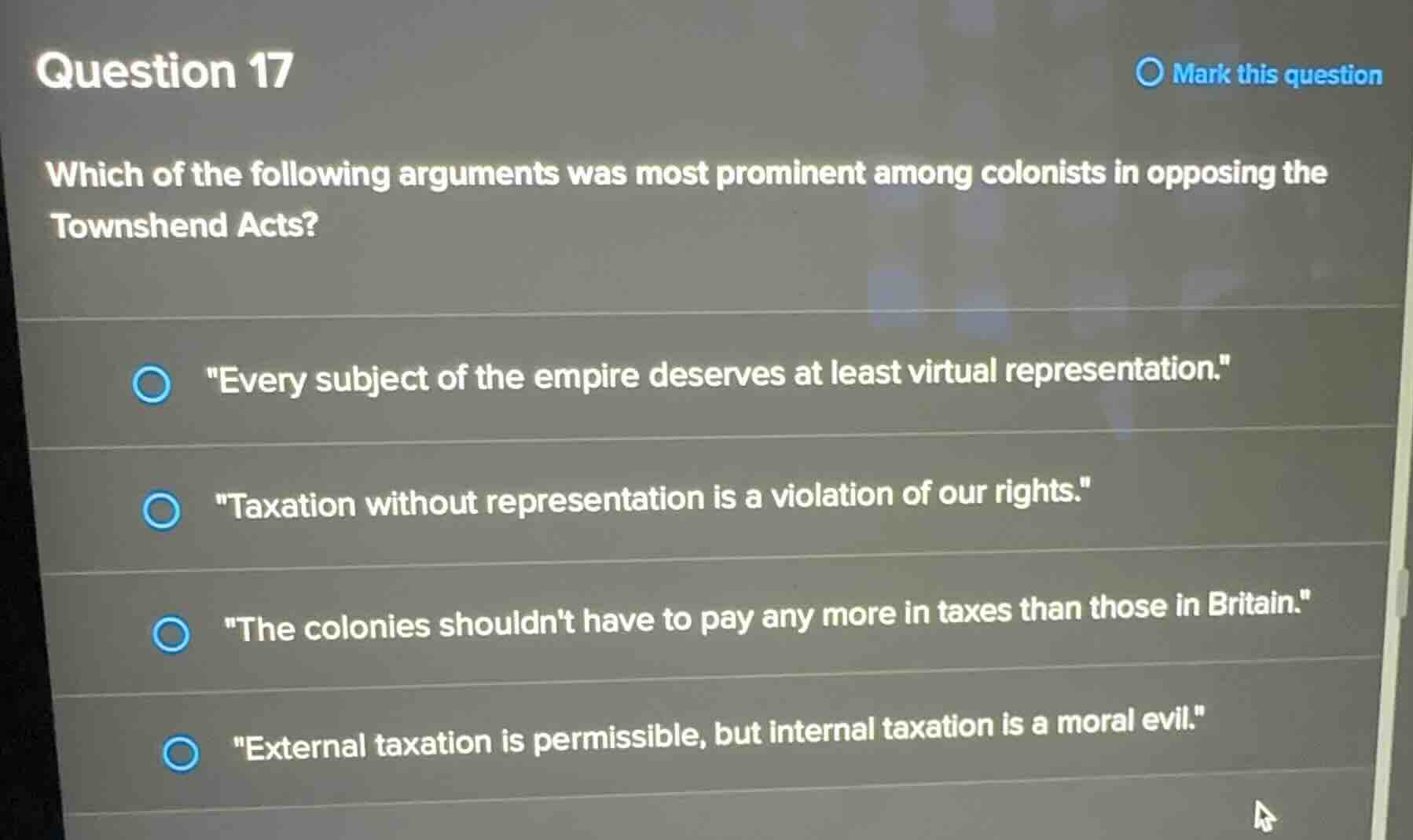
which of the following arguments was most prominent among colonists in opposing the townshend acts?
- \every subject of the empire deserves at least virtual representation.\
- \taxation without representation is a violation of our rights.\
- \the colonies shouldnt have to pay any more in taxes than those in britain.\
- \external taxation is permissible, but internal taxation is a moral evil.\
Analyze the Townshend Acts opposition
Using the Townshend Acts and Internal vs External Taxation knowledge points
The Townshend Acts (1767) imposed duties on imported goods such as glass, lead, paint, paper, and tea. British officials argued these were "external" taxes on trade, which they believed colonists previously accepted. However, colonists strongly rejected this distinction, arguing that any tax levied by Parliament to raise revenue—whether internal or external—without their consent violated their fundamental rights.
Evaluate the concept of representation
Using the Virtual Representation knowledge point
The British government defended its right to tax the colonies through the concept of "virtual representation," asserting that members of Parliament represented all British subjects, regardless of whether they voted for them. The colonists rejected this, demanding actual representation in the legislative body that taxed them. Thus, the core argument against these acts was that taxation without direct representation violated their constitutional rights as Englishmen.
Assess the incorrect options
Using the Virtual Representation and Internal vs External Taxation knowledge points
- "Every subject of the empire deserves at least virtual representation" is incorrect because colonists actively rejected virtual representation in favor of actual representation.
- "The colonies shouldn't have to pay any more in taxes than those in Britain" is incorrect because colonists actually paid significantly lower tax rates than residents of Great Britain; their objection was based on the principle of consent, not the comparative amount.
- "External taxation is permissible, but internal taxation is a moral evil" is incorrect because, by the time of the Townshend Acts, colonial leaders like John Dickinson argued that both internal and external taxes designed to raise revenue were unconstitutional without representation.

Snap & solve any problem in the app
Get step-by-step solutions on Sovi AI
Photo-based solutions with guided steps
Explore more problems and detailed explanations
- (A) "Every subject of the empire deserves at least virtual representation."
- (B) "Taxation without representation is a violation of our rights." (Correct answer)
- (C) "The colonies shouldn't have to pay any more in taxes than those in Britain."
- (D) "External taxation is permissible, but internal taxation is a moral evil."