QUESTION IMAGE
Question
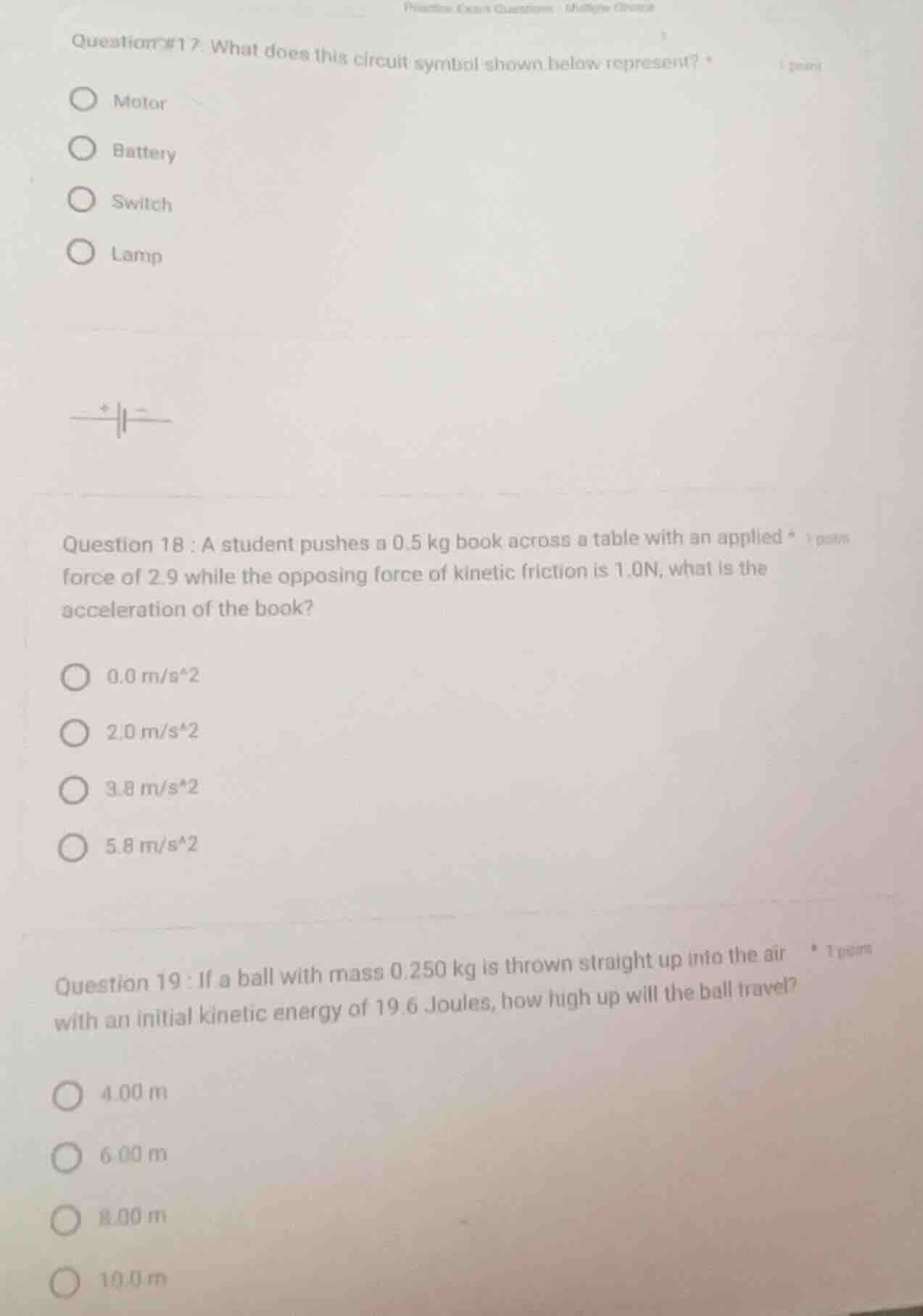
question #17: what does this circuit symbol shown below represent?
motor
battery
switch
lamp
question 18: a student pushes a \\(0.5\text{ kg}\\) book across a table with an applied force of \\(2.9\text{ n}\\) while the opposing force of kinetic friction is \\(1.0\text{ n}\\), what is the acceleration of the book?
\\(0.0\text{ m/s}^2\\)
\\(2.0\text{ m/s}^2\\)
\\(3.8\text{ m/s}^2\\)
\\(5.8\text{ m/s}^2\\)
question 19: if a ball with mass \\(0.250\text{ kg}\\) is thrown straight up into the air with an initial kinetic energy of \\(19.6\text{ joules}\\), how high up will the ball travel?
\\(4.00\text{ m}\\)
\\(6.00\text{ m}\\)
\\(8.00\text{ m}\\)
\\(10.0\text{ m}\\)
Identify the circuit symbol
The symbol in Question 17 consists of two parallel lines of unequal length. The longer, thinner line represents the positive terminal, and the shorter, thicker line represents the negative terminal. This is the standard schematic symbol for a single-cell battery (or cell).
Calculate the net force
For Question 18, we identify the forces acting horizontally on the book:
- Applied force: \(F_{\text{applied}} = 2.9\text{ N}\)
- Kinetic friction force: \(F_{\text{friction}} = 1.0\text{ N}\) (opposing motion)
The net force \(F_{\text{net}}\) is:
Calculate the acceleration
Using Newton's second law:
Given mass \(m = 0.5\text{ kg}\):
Apply conservation of energy
For Question 19, the initial kinetic energy of the ball is converted entirely into gravitational potential energy at its maximum height \(h\):
Given:
- Initial kinetic energy \(E_k = 19.6\text{ J}\)
- Mass \(m = 0.250\text{ kg}\)
- Acceleration due to gravity \(g \approx 9.8\text{ m/s}^2\)
Solve for maximum height
Rearranging the energy equation to solve for \(h\):

Snap & solve any problem in the app
Get step-by-step solutions on Sovi AI
Photo-based solutions with guided steps
Explore more problems and detailed explanations
Question 17
- Motor
- Battery (Correct answer)
- Switch
- Lamp
Question 18
- 0.0 m/s^2
- 2.0 m/s^2
- 3.8 m/s^2 (Correct answer)
- 5.8 m/s^2
Question 19
- 4.00 m
- 6.00 m
- 8.00 m (Correct answer)
- 10.0 m