Sovi.AI - AI Math Tutor

Scan to solve math questions

QUESTION IMAGE

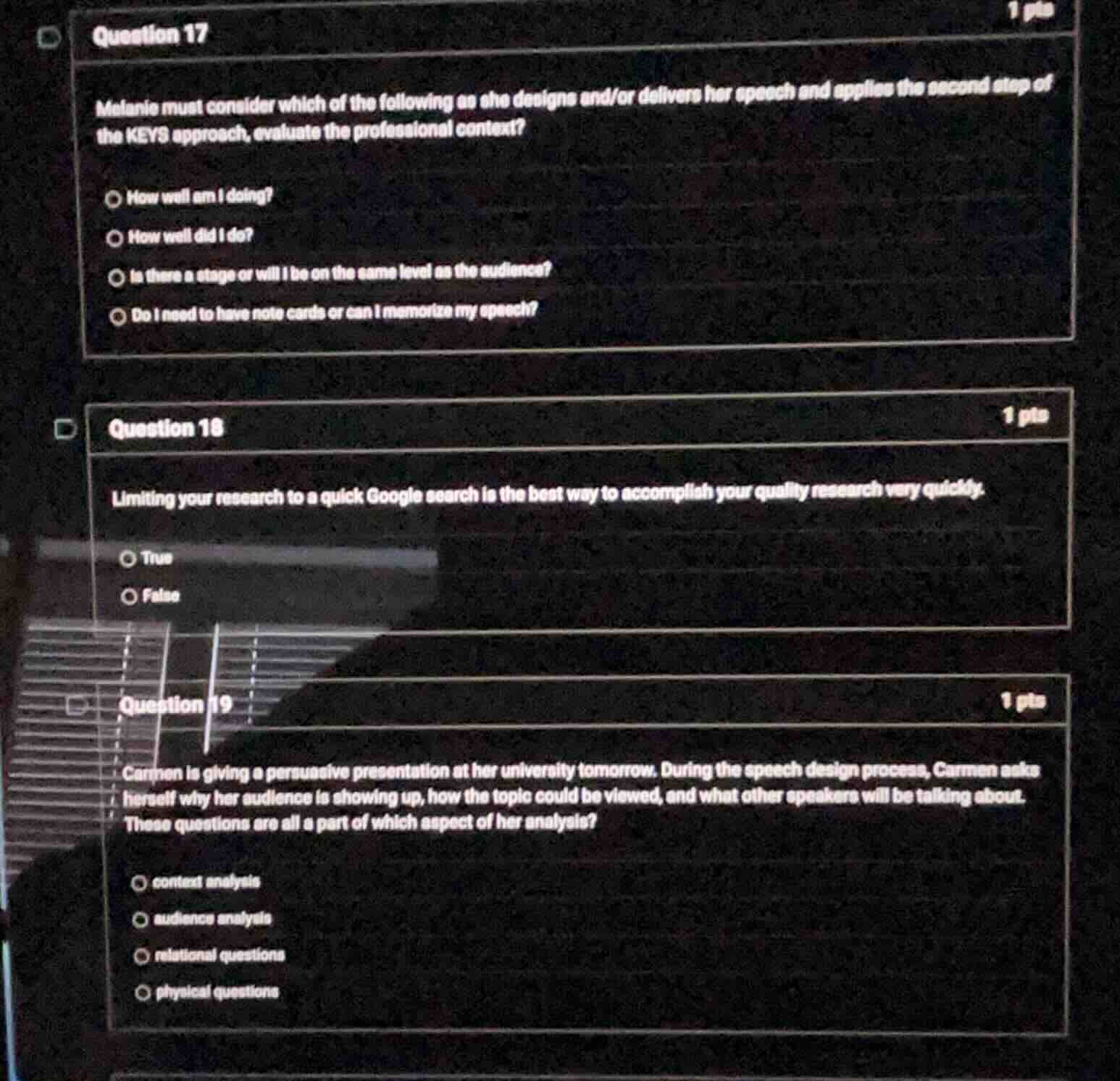
question 17 melanie must consider which of the following as she designs…

Question

question 17
melanie must consider which of the following as she designs and/or delivers her speech and applies the second step of the keys approach, evaluate the professional context?
how well am i doing?
how well did i do?
is there a stage or will i be on the same level as the audience?
do i need to have note cards or can i memorize my speech?

question 18
limiting your research to a quick google search is the best way to accomplish your quality research very quickly.
true
false

question 19
carmen is giving a persuasive presentation at her university tomorrow. during the speech design process, carmen asks herself why her audience is showing up, how the topic could be viewed, and what other speakers will be talking about. these questions are all a part of which aspect of her analysis?
context analysis
audience analysis
relational questions
physical questions

Explanation:

Response

<pre_analysis>
{
"quality": "clear",
"question_count": 3,
"skills_matched": [
"direct_cot",
"multiple_choice_formatter",
"explain_then_answer",
"tutor"
],
"needs_drawing": false,
"concepts_used": [
"KEYS Communication Approach"
],
"new_concepts": [
"Audience Analysis",
"Research Methodologies"
],
"current_concepts": [
"KEYS Communication Approach",
"Audience Analysis",
"Research Methodologies"
]
}
</pre_analysis>

<reasoning>

Analyze Question 17

This question asks about the second step of the KEYS Communication Approach, which is "Evaluate the professional context" (E).

  • Know yourself.
  • Evaluate the professional context.
  • Your communication relations.
  • Step back and reflect.

Evaluating the professional context involves analyzing the physical environment, situational factors, and audience expectations. Among the choices:

  • "How well am I doing?" and "How well did I do?" relate to self-monitoring and reflection (K and S).
  • "Is there a stage or will I be on the same level as the audience?" directly addresses the physical and situational environment of the presentation, which is a key element of evaluating the professional context.
  • "Do I need to have note cards..." is a tactical delivery choice.

Therefore, the correct option is "Is there a stage or will I be on the same level as the audience?".

Analyze Question 18

This question is a True/False statement: "Limiting your research to a quick Google search is the best way to accomplish your quality research very quickly."

  • Quality academic and professional research requires credible, peer-reviewed, or highly authoritative sources, which often cannot be comprehensively gathered solely from a basic, unfiltered Google search.
  • Relying exclusively on a quick search engine query limits depth, accuracy, and academic rigor.
  • Thus, the statement is false.

Analyze Question 19

Carmen is asking herself why her audience is showing up, how the topic could be viewed by them, and what other speakers will be talking about.

  • These questions focus on understanding the demographics, motivations, attitudes, and expectations of the listeners, as well as the immediate situational environment of the speech.
  • In communication studies, analyzing who the listeners are, their motivations, and how they relate to the topic is defined as audience analysis (or more broadly, situational/context analysis, but specifically focusing on the audience's perspective and expectations here). Let's look at the options: "context analysis", "audience analysis", "relational questions", "physical questions".
  • "Why her audience is showing up" and "how the topic could be viewed [by them]" are classic components of audience analysis.

</reasoning>

<answer>

Question 17

<mcq-option>How well am I doing?</mcq-option>
<mcq-option>How well did I do?</mcq-option>
<mcq-correct>Is there a stage or will I be on the same level as the audience?</mcq-correct>
<mcq-option>Do I need to have note cards or can I memorize my speech?</mcq-option>

Question 18

<mcq-option>True</mcq-option>
<mcq-correct>False</mcq-correct>

Question 19

<mcq-option>context analysis</mcq-option>
<mcq-correct>audience analysis</mcq-correct>
<mcq-option>relational questions</mcq-option>
<mcq-option>physical questions</mcq-option>
</answer>

<post_analysis>
{
"subject": "Social Science",
"question_type": "Multiple Choice",
"knowledge_point": [
"Social Science",
"Communication Studies",
"Public Speaking and Presentation"
]
}
</post_analysis>

Answer:

<pre_analysis>
{
"quality": "clear",
"question_count": 3,
"skills_matched": [
"direct_cot",
"multiple_choice_formatter",
"explain_then_answer",
"tutor"
],
"needs_drawing": false,
"concepts_used": [
"KEYS Communication Approach"
],
"new_concepts": [
"Audience Analysis",
"Research Methodologies"
],
"current_concepts": [
"KEYS Communication Approach",
"Audience Analysis",
"Research Methodologies"
]
}
</pre_analysis>

<reasoning>

Analyze Question 17

This question asks about the second step of the KEYS Communication Approach, which is "Evaluate the professional context" (E).

  • Know yourself.
  • Evaluate the professional context.
  • Your communication relations.
  • Step back and reflect.

Evaluating the professional context involves analyzing the physical environment, situational factors, and audience expectations. Among the choices:

  • "How well am I doing?" and "How well did I do?" relate to self-monitoring and reflection (K and S).
  • "Is there a stage or will I be on the same level as the audience?" directly addresses the physical and situational environment of the presentation, which is a key element of evaluating the professional context.
  • "Do I need to have note cards..." is a tactical delivery choice.

Therefore, the correct option is "Is there a stage or will I be on the same level as the audience?".

Analyze Question 18

This question is a True/False statement: "Limiting your research to a quick Google search is the best way to accomplish your quality research very quickly."

  • Quality academic and professional research requires credible, peer-reviewed, or highly authoritative sources, which often cannot be comprehensively gathered solely from a basic, unfiltered Google search.
  • Relying exclusively on a quick search engine query limits depth, accuracy, and academic rigor.
  • Thus, the statement is false.

Analyze Question 19

Carmen is asking herself why her audience is showing up, how the topic could be viewed by them, and what other speakers will be talking about.

  • These questions focus on understanding the demographics, motivations, attitudes, and expectations of the listeners, as well as the immediate situational environment of the speech.
  • In communication studies, analyzing who the listeners are, their motivations, and how they relate to the topic is defined as audience analysis (or more broadly, situational/context analysis, but specifically focusing on the audience's perspective and expectations here). Let's look at the options: "context analysis", "audience analysis", "relational questions", "physical questions".
  • "Why her audience is showing up" and "how the topic could be viewed [by them]" are classic components of audience analysis.

</reasoning>

<answer>

Question 17

<mcq-option>How well am I doing?</mcq-option>
<mcq-option>How well did I do?</mcq-option>
<mcq-correct>Is there a stage or will I be on the same level as the audience?</mcq-correct>
<mcq-option>Do I need to have note cards or can I memorize my speech?</mcq-option>

Question 18

<mcq-option>True</mcq-option>
<mcq-correct>False</mcq-correct>

Question 19

<mcq-option>context analysis</mcq-option>
<mcq-correct>audience analysis</mcq-correct>
<mcq-option>relational questions</mcq-option>
<mcq-option>physical questions</mcq-option>
</answer>

<post_analysis>
{
"subject": "Social Science",
"question_type": "Multiple Choice",
"knowledge_point": [
"Social Science",
"Communication Studies",
"Public Speaking and Presentation"
]
}
</post_analysis>