QUESTION IMAGE
Question
question 17 of 25
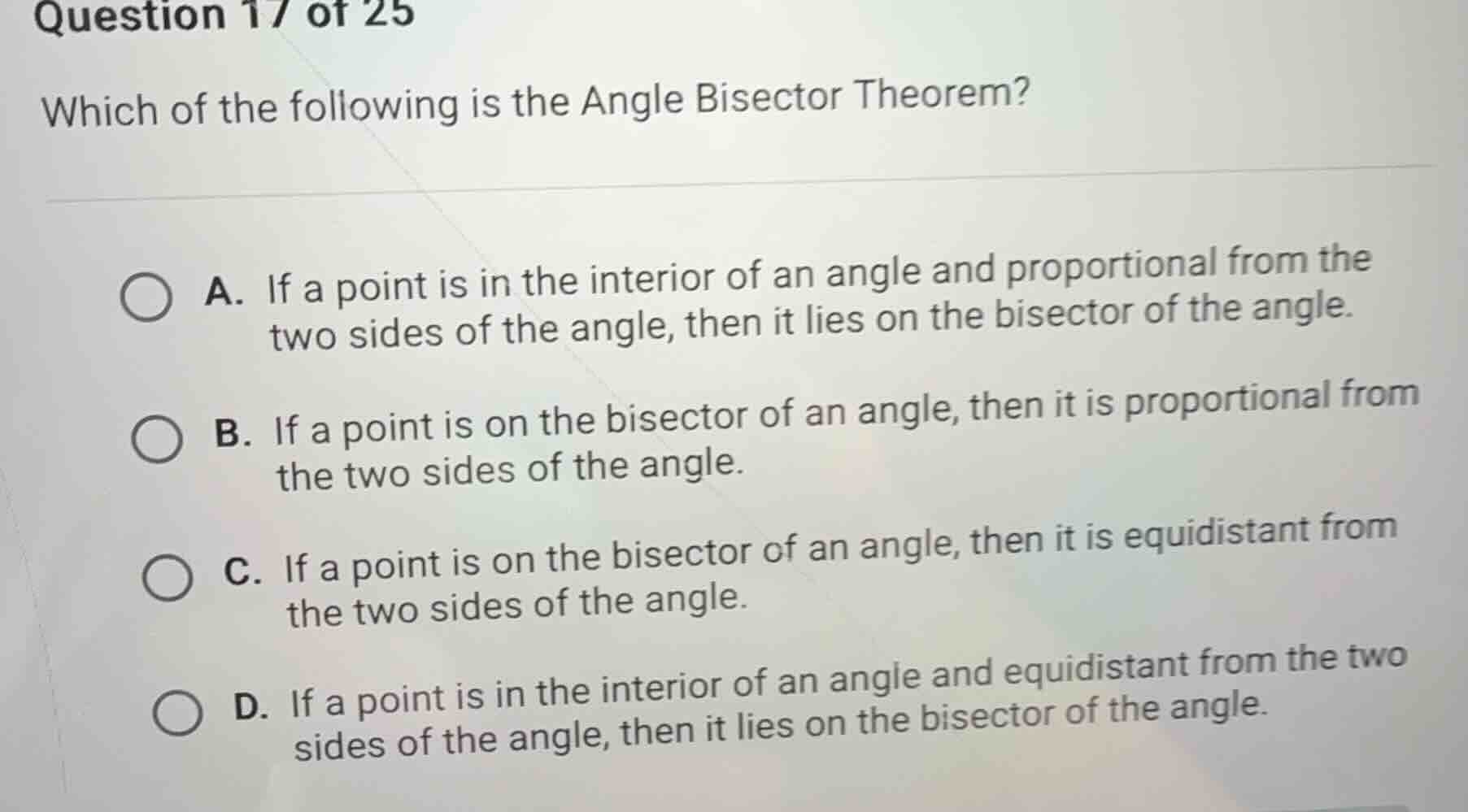
which of the following is the angle bisector theorem?
a. if a point is in the interior of an angle and proportional from the two sides of the angle, then it lies on the bisector of the angle.
b. if a point is on the bisector of an angle, then it is proportional from the two sides of the angle.
c. if a point is on the bisector of an angle, then it is equidistant from the two sides of the angle.
d. if a point is in the interior of an angle and equidistant from the two sides of the angle, then it lies on the bisector of the angle.
Define the Angle Bisector Theorem
Using the Angle Bisector Theorem knowledge point:
- Hypothesis: A point lies on the bisector of an angle.
- Conclusion: The point is equidistant from the two sides of the angle.
Analyze the given options
- Option A describes a proportional relationship for a point in the interior, which is mathematically incorrect.
- Option B mentions a proportional relationship, which is incorrect because the actual relationship is equality of distance (equidistant).
- Option C states: "If a point is on the bisector of an angle, then it is equidistant from the two sides of the angle." This matches the definition of the theorem.
- Option D describes the converse of the theorem: "If a point is in the interior of an angle and equidistant from the two sides of the angle, then it lies on the bisector of the angle."

Snap & solve any problem in the app
Get step-by-step solutions on Sovi AI
Photo-based solutions with guided steps
Explore more problems and detailed explanations
- (A) If a point is in the interior of an angle and proportional from the two sides of the angle, then it lies on the bisector of the angle.
- (B) If a point is on the bisector of an angle, then it is proportional from the two sides of the angle.
- (C) If a point is on the bisector of an angle, then it is equidistant from the two sides of the angle. (Correct answer)
- (D) If a point is in the interior of an angle and equidistant from the two sides of the angle, then it lies on the bisector of the angle.