QUESTION IMAGE
Question
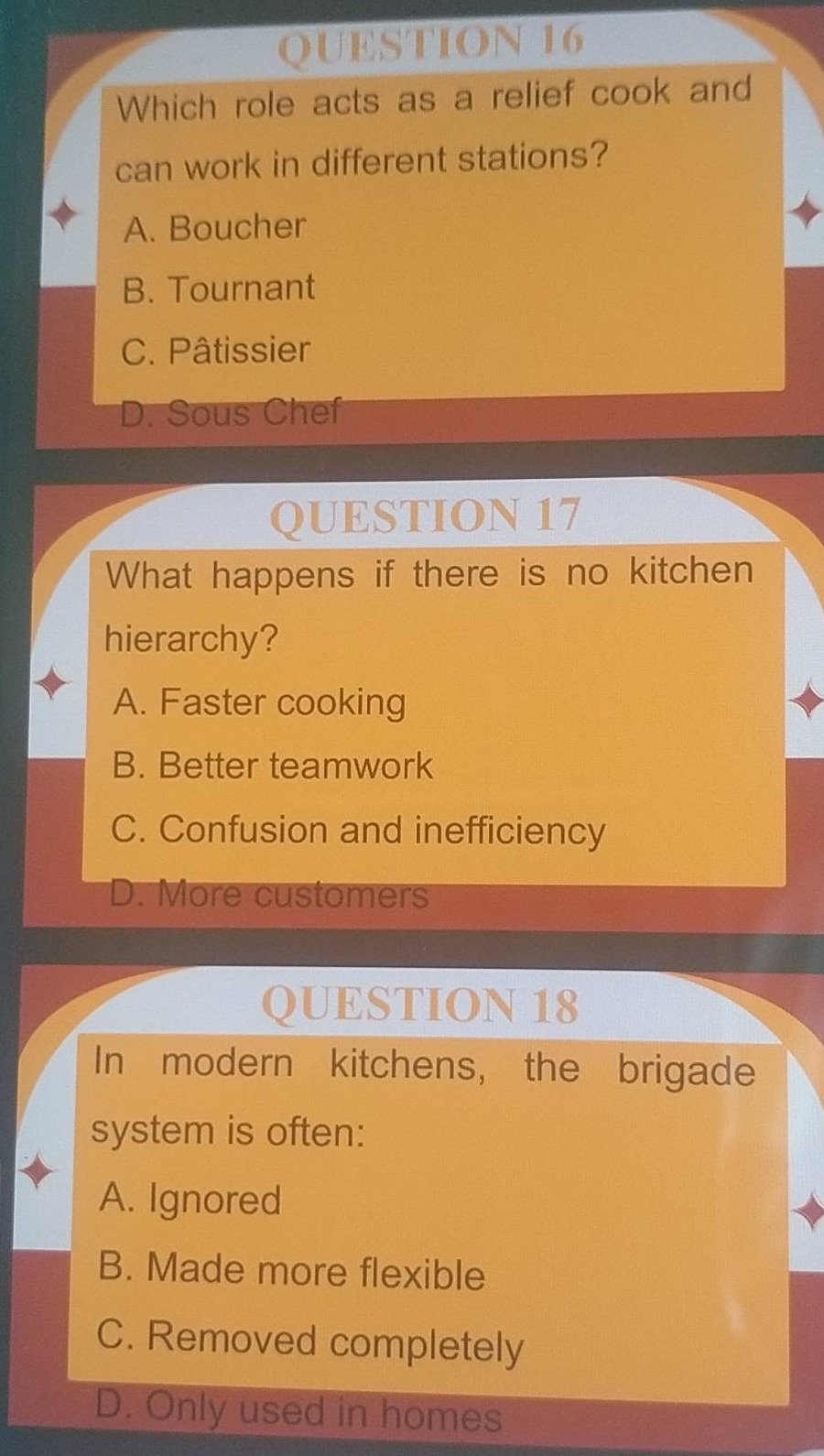
question 16
which role acts as a relief cook and can work in different stations?
a. boucher
b. tournant
c. pâtissier
d. sous chef
question 17
what happens if there is no kitchen hierarchy?
a. faster cooking
b. better teamwork
c. confusion and inefficiency
d. more customers
question 18
in modern kitchens, the brigade system is often:
a. ignored
b. made more flexible
c. removed completely
d. only used in homes
🆕 New Concept Discovered: Brigade de Cuisine (Kitchen Hierarchy)
Organizing professional kitchen staff roles and responsibilities
Step 1: Analyze Question 16
The question asks for the role that acts as a relief cook and can work in different stations. Let's define the options in the traditional French kitchen brigade system (Brigade de Cuisine):
- Boucher (Butcher): Prepares meats and poultry before they go to their respective stations.
- Tournant (Relief cook / Swing cook): Moves throughout the kitchen, filling in for other station chefs (chefs de partie) when they have days off or during exceptionally busy periods.
- Pâtissier (Pastry chef): Prepares desserts, pastries, and breads.
- Sous Chef (Second in command): Manages the daily operations of the kitchen under the head chef.
Therefore, the correct option is B. Tournant.
Step 2: Analyze Question 17
The question asks about the consequences of having no kitchen hierarchy.
- A professional kitchen is a fast-paced, high-stress environment requiring precise coordination.
- Without a clear hierarchy (defined roles, chain of command, and division of labor), there is no clear direction on who prepares what or who makes final decisions.
- This lack of structure directly leads to chaos, overlapping tasks, delayed orders, and overall confusion and inefficiency.
Therefore, the correct option is C. Confusion and inefficiency.
Step 3: Analyze Question 18
The question asks how the traditional brigade system is applied in modern kitchens.
- The classic Escoffier brigade system was highly rigid, with dozens of highly specialized, distinct roles.
- Modern kitchens are typically smaller, have fewer staff members, and require cross-training.
- While modern kitchens still use the basic hierarchical structure (like Head Chef, Sous Chef, Line Cooks), they adapt it to be more flexible so that cooks can handle multiple stations as needed.
Therefore, the correct option is B. Made more flexible.

Snap & solve any problem in the app
Get step-by-step solutions on Sovi AI
Photo-based solutions with guided steps
Explore more problems and detailed explanations
- Question 16: B. Tournant
- Question 17: C. Confusion and inefficiency
- Question 18: B. Made more flexible