QUESTION IMAGE
Question
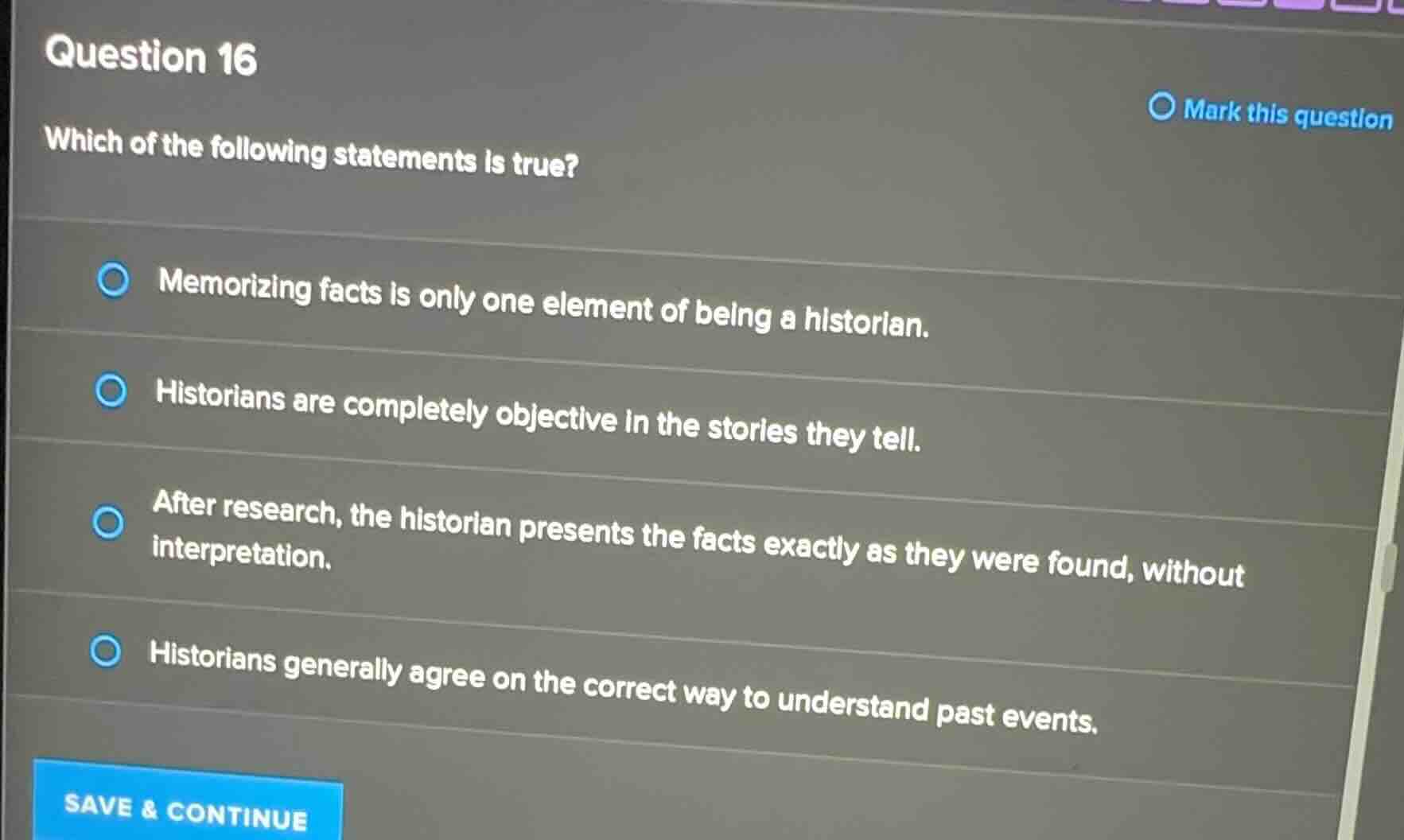
question 16
which of the following statements is true?
- memorizing facts is only one element of being a historian.
- historians are completely objective in the stories they tell.
- after research, the historian presents the facts exactly as they were found, without interpretation.
- historians generally agree on the correct way to understand past events.
Analyze the nature of historical inquiry
The discipline of history involves much more than simply compiling and memorizing chronological lists of dates, names, and events. While factual accuracy is foundational, the core work of a historian lies in analyzing primary sources, contextualizing evidence, and constructing interpretive narratives to explain why and how events occurred. Therefore, memorizing facts is merely one component of the broader Historical Process.
Evaluate the alternative options
- "Historians are completely objective in the stories they tell": This statement is false. Historians bring their own perspectives, cultural backgrounds, and theoretical frameworks to their research, making absolute objectivity impossible to achieve.
- "After research, the historian presents the facts exactly as they were found, without interpretation": This statement is false. Raw facts do not speak for themselves; historians must select, organize, and interpret evidence to construct a meaningful historical narrative.
- "Historians generally agree on the correct way to understand past events": This statement is false. Historical Methodology thrives on debate, revisionism, and differing interpretations of the same historical evidence.

Snap & solve any problem in the app
Get step-by-step solutions on Sovi AI
Photo-based solutions with guided steps
Explore more problems and detailed explanations
- Memorizing facts is only one element of being a historian. (Correct answer)
- Historians are completely objective in the stories they tell.
- After research, the historian presents the facts exactly as they were found, without interpretation.
- Historians generally agree on the correct way to understand past events.