QUESTION IMAGE
Question
question #16
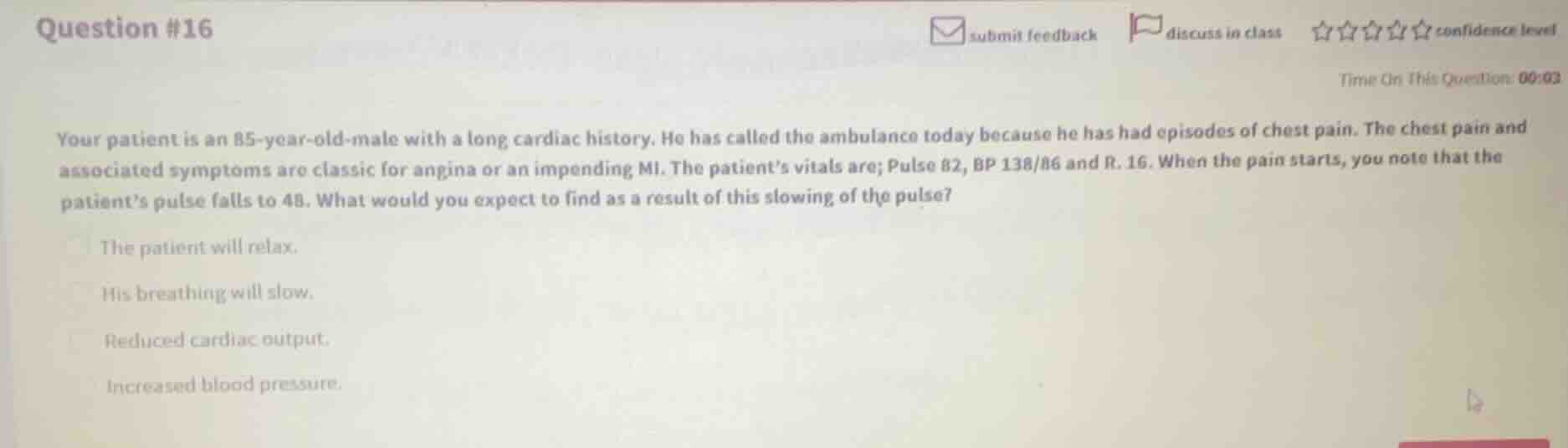
your patient is an 85-year-old-male with a long cardiac history. he has called the ambulance today because he has had episodes of chest pain. the chest pain and associated symptoms are classic for angina or an impending mi. the patients vitals are; pulse 82, bp 138/86 and r. 16. when the pain starts, you note that the patients pulse falls to 48. what would you expect to find as a result of this slowing of the pulse?
the patient will relax.
his breathing will slow.
reduced cardiac output.
increased blood pressure.
<pre_analysis>
{
"quality": "clear",
"question_count": 1,
"skills_matched": [
"direct_cot",
"multiple_choice_formatter",
"explain_then_answer",
"tutor"
],
"needs_drawing": false,
"concepts_used": [],
"new_concepts": [
"Cardiac Output Dynamics",
"Bradycardia Pathophysiology"
],
"current_concepts": [
"Cardiac Output Dynamics",
"Bradycardia Pathophysiology",
"Myocardial Infarction Assessment"
]
}
</pre_analysis>
<reasoning>
Analyze the physiological parameters
The patient is an 85-year-old male experiencing chest pain indicative of angina or an impending myocardial infarction (MI). His baseline vitals show a pulse of 82 beats per minute (bpm), blood pressure of 138/86 mmHg, and respirations of 16 breaths per minute. When the chest pain episodes begin, his pulse drops significantly from 82 bpm to 48 bpm (bradycardia).
Evaluate cardiac output formula
Cardiac output (\(\text{CO}\)) is the volume of blood pumped by the heart per minute. It is determined by the formula:
\[
\text{CO} = \text{Heart Rate (HR)} \times \text{Stroke Volume (SV)}
\]
When the heart rate drops suddenly from 82 to 48 bpm, the heart is beating much slower. Unless there is a massive, instantaneous compensatory increase in stroke volume (which is highly unlikely in an 85-year-old patient with an active ischemic cardiac event), a drop in heart rate will directly lead to a decrease in cardiac output.
Assess clinical consequences
A reduction in cardiac output means less oxygenated blood is being circulated to the body's vital organs and tissues. This can lead to systemic hypoperfusion, hypotension, altered mental status, and worsening myocardial ischemia due to decreased coronary artery perfusion. Therefore, the direct physiological expectation of this acute slowing of the pulse is a reduced cardiac output.
Rule out incorrect options
- The patient will relax: A sudden drop in heart rate during an ischemic event is a sign of worsening pathology (such as an inferior MI affecting the SA/AV node), which increases physiological stress and anxiety rather than causing relaxation.
- His breathing will slow: Respiratory rate is controlled by metabolic demand and blood gas levels; it does not automatically slow down just because the heart rate slows. In fact, the patient may become tachypneic due to hypoxia or anxiety.
- Increased blood pressure: A drop in cardiac output typically leads to a decrease in blood pressure (hypotension), not an increase.
</reasoning>
<answer>
<mcq-option>The patient will relax.</mcq-option>
<mcq-option>His breathing will slow.</mcq-option>
<mcq-correct>Reduced cardiac output.</mcq-correct>
<mcq-option>Increased blood pressure.</mcq-option>
</answer>
<post_analysis>
{
"subject": "Natural Science",
"question_type": "Multiple Choice",
"knowledge_point": [
"Natural Science",
"Medicine and Health",
"Cardiovascular Pathophysiology"
]
}
</post_analysis>
Snap & solve any problem in the app
Get step-by-step solutions on Sovi AI
Photo-based solutions with guided steps
Explore more problems and detailed explanations
<pre_analysis>
{
"quality": "clear",
"question_count": 1,
"skills_matched": [
"direct_cot",
"multiple_choice_formatter",
"explain_then_answer",
"tutor"
],
"needs_drawing": false,
"concepts_used": [],
"new_concepts": [
"Cardiac Output Dynamics",
"Bradycardia Pathophysiology"
],
"current_concepts": [
"Cardiac Output Dynamics",
"Bradycardia Pathophysiology",
"Myocardial Infarction Assessment"
]
}
</pre_analysis>
<reasoning>
Analyze the physiological parameters
The patient is an 85-year-old male experiencing chest pain indicative of angina or an impending myocardial infarction (MI). His baseline vitals show a pulse of 82 beats per minute (bpm), blood pressure of 138/86 mmHg, and respirations of 16 breaths per minute. When the chest pain episodes begin, his pulse drops significantly from 82 bpm to 48 bpm (bradycardia).
Evaluate cardiac output formula
Cardiac output (\(\text{CO}\)) is the volume of blood pumped by the heart per minute. It is determined by the formula:
\[
\text{CO} = \text{Heart Rate (HR)} \times \text{Stroke Volume (SV)}
\]
When the heart rate drops suddenly from 82 to 48 bpm, the heart is beating much slower. Unless there is a massive, instantaneous compensatory increase in stroke volume (which is highly unlikely in an 85-year-old patient with an active ischemic cardiac event), a drop in heart rate will directly lead to a decrease in cardiac output.
Assess clinical consequences
A reduction in cardiac output means less oxygenated blood is being circulated to the body's vital organs and tissues. This can lead to systemic hypoperfusion, hypotension, altered mental status, and worsening myocardial ischemia due to decreased coronary artery perfusion. Therefore, the direct physiological expectation of this acute slowing of the pulse is a reduced cardiac output.
Rule out incorrect options
- The patient will relax: A sudden drop in heart rate during an ischemic event is a sign of worsening pathology (such as an inferior MI affecting the SA/AV node), which increases physiological stress and anxiety rather than causing relaxation.
- His breathing will slow: Respiratory rate is controlled by metabolic demand and blood gas levels; it does not automatically slow down just because the heart rate slows. In fact, the patient may become tachypneic due to hypoxia or anxiety.
- Increased blood pressure: A drop in cardiac output typically leads to a decrease in blood pressure (hypotension), not an increase.
</reasoning>
<answer>
<mcq-option>The patient will relax.</mcq-option>
<mcq-option>His breathing will slow.</mcq-option>
<mcq-correct>Reduced cardiac output.</mcq-correct>
<mcq-option>Increased blood pressure.</mcq-option>
</answer>
<post_analysis>
{
"subject": "Natural Science",
"question_type": "Multiple Choice",
"knowledge_point": [
"Natural Science",
"Medicine and Health",
"Cardiovascular Pathophysiology"
]
}
</post_analysis>