QUESTION IMAGE
Question
question 15
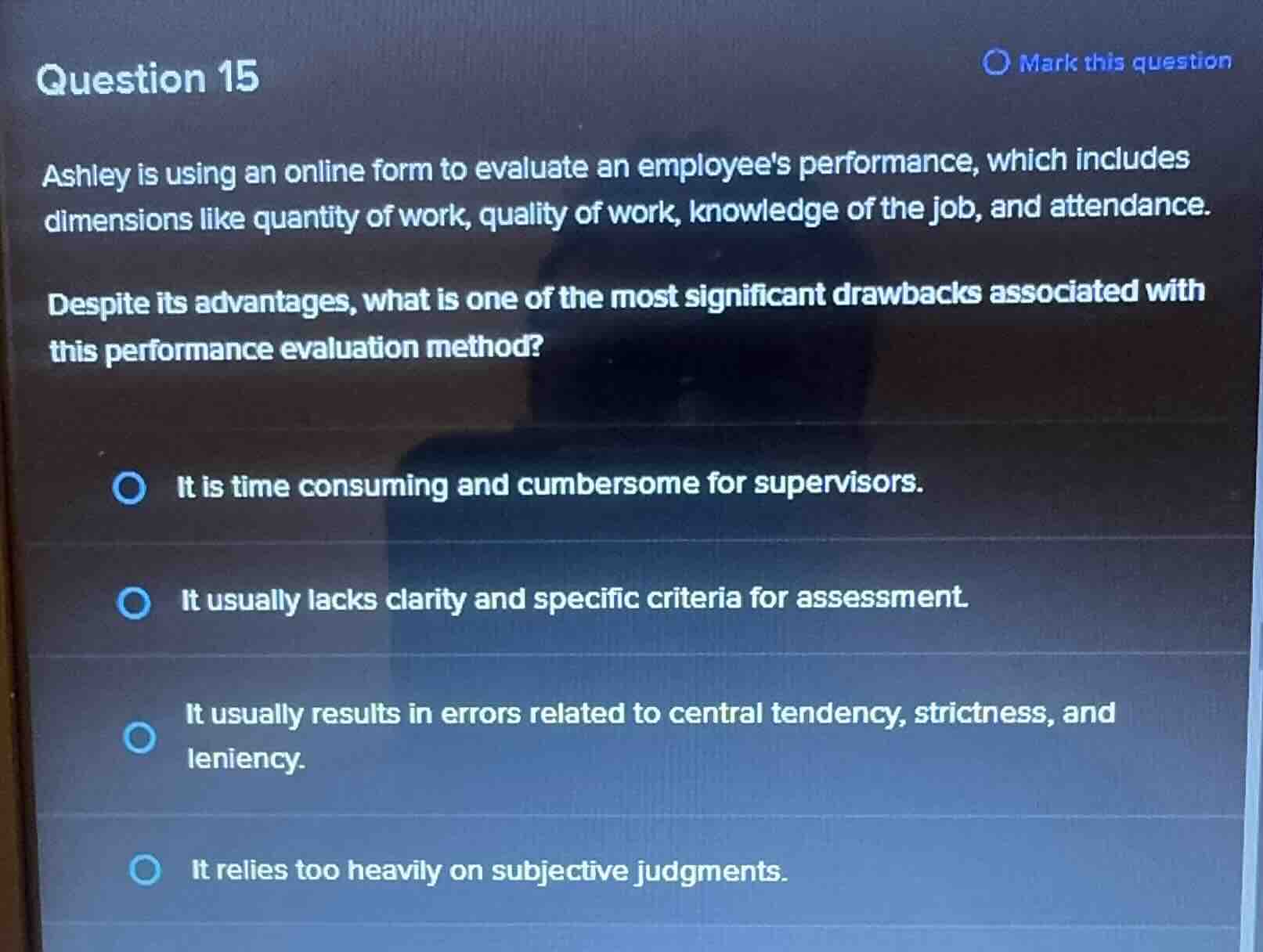
ashley is using an online form to evaluate an employees performance, which includes dimensions like quantity of work, quality of work, knowledge of the job, and attendance.
despite its advantages, what is one of the most significant drawbacks associated with this performance evaluation method?
- it is time consuming and cumbersome for supervisors.
- it usually lacks clarity and specific criteria for assessment.
- it usually results in errors related to central tendency, strictness, and leniency.
- it relies too heavily on subjective judgments.
Identify the evaluation method
The question describes a performance evaluation method where an employee is evaluated on specific dimensions such as quantity of work, quality of work, knowledge of the job, and attendance using an online form. This structured approach of rating predetermined dimensions is characteristic of a Graphic Rating Scale (or standard rating scale form).
Analyze the characteristics of the method
A graphic rating scale is popular because it is quick, structured, and easy to administer. However, because it relies on a supervisor's personal assessment of broad categories (like "quality of work" or "attendance") on a scale (e.g., 1 to 5), it is highly susceptible to subjective rater biases.
Evaluate the given options
- "It is time consuming and cumbersome for supervisors.": Incorrect. Standardized forms and rating scales are actually among the quickest and least cumbersome methods to complete.
- "It usually lacks clarity and specific criteria for assessment.": Incorrect. The form explicitly lists dimensions like quantity, quality, job knowledge, and attendance, which provide clear categories.
- "It usually results in errors related to central tendency, strictness, and leniency.": Correct. Because supervisors must assign ratings on a scale, they frequently fall prey to rating errors such as leniency (rating everyone highly), strictness (rating everyone harshly), or central tendency (rating everyone near the average/middle).
- "It relies too heavily on subjective judgments.": While there is subjectivity, the structured nature of the dimensions attempts to limit pure subjectivity. The most distinct, well-documented systemic drawback of standard rating scales is the high prevalence of specific distribution errors (central tendency, strictness, and leniency).
Connect to mastered concepts
Using the Performance Appraisal and Employee Performance knowledge points, we evaluate how different appraisal tools function. Standardized rating scales are designed to simplify the evaluation of Employee Performance, but their structured scale format inherently invites rater distribution errors like central tendency, strictness, and leniency.

Snap & solve any problem in the app
Get step-by-step solutions on Sovi AI
Photo-based solutions with guided steps
Explore more problems and detailed explanations
- It is time consuming and cumbersome for supervisors.
- It usually lacks clarity and specific criteria for assessment.
- It usually results in errors related to central tendency, strictness, and leniency. (Correct answer)
- It relies too heavily on subjective judgments.