QUESTION IMAGE
Question
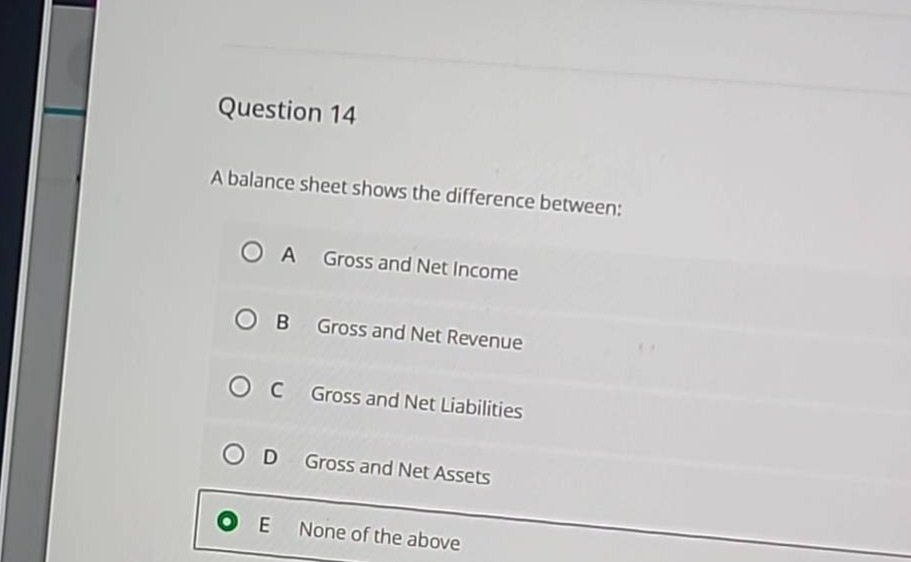
question 14
a balance sheet shows the difference between:
a gross and net income
b gross and net revenue
c gross and net liabilities
d gross and net assets
e none of the above
🆕 New Concept Discovered: The Accounting Equation
The fundamental relationship balancing assets, liabilities, and equity.
Step 1: Define the purpose of a Balance Sheet
A balance sheet is a financial statement that provides a snapshot of a company's financial position at a specific point in time. It is structured around the fundamental accounting equation:
This means it shows what a company owns (Assets), what it owes to external parties (Liabilities), and the remaining interest of the owners (Equity).
Step 2: Analyze the relationship shown on a Balance Sheet
The primary "difference" highlighted by the structure of a balance sheet is the difference between a company's total assets and its total liabilities, which equals its net worth or equity:
Step 3: Evaluate the given options
- A (Gross and Net Income): These are found on the Income Statement, not the Balance Sheet.
- B (Gross and Net Revenue): Revenue metrics are found on the Income Statement.
- C (Gross and Net Liabilities): This is not a standard financial relationship shown as a primary difference on a balance sheet.
- D (Gross and Net Assets): While "Net Assets" (Assets minus Liabilities) is equivalent to Equity, the balance sheet does not exist to show a difference between "Gross Assets" and "Net Assets" as a primary definition.
- E (None of the above): Since none of the options A, B, C, or D correctly describe the fundamental difference shown by a balance sheet (which is Assets minus Liabilities equals Equity), this is the correct choice.

Snap & solve any problem in the app
Get step-by-step solutions on Sovi AI
Photo-based solutions with guided steps
Explore more problems and detailed explanations
E None of the above