QUESTION IMAGE
Question
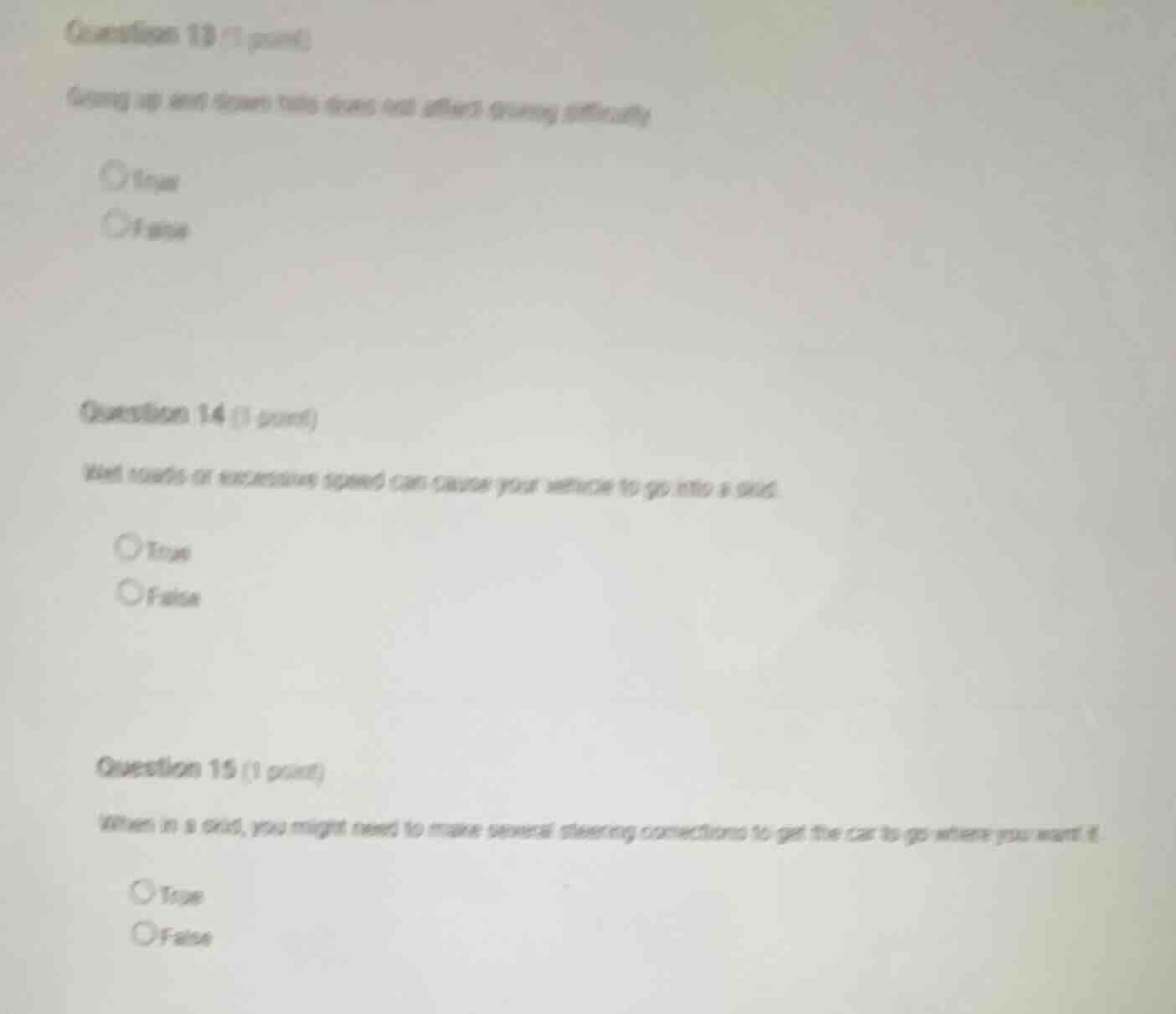
question 13 (1 point)
going up and down hills does not affect driving difficulty.
true
false
question 14 (1 point)
wet roads or excessive speed can cause your vehicle to go into a skid.
true
false
question 15 (1 point)
when in a skid, you might need to make several steering corrections to get the car to go where you want it.
true
false
🆕 New Concept Discovered: Safe Driving Dynamics
Understanding how gravity, traction, and steering affect vehicle control.
Step 1: Analyze Question 13
The statement is: "Going up and down hills does not affect driving difficulty."
- Reasoning: Gravity affects a vehicle's speed and braking distance when traveling on hills. Going uphill requires more engine power to maintain speed, while going downhill increases speed naturally and requires longer braking distances. Visibility is also often limited at the crest of a hill. Therefore, hills significantly affect driving difficulty.
- Result: False
Step 2: Analyze Question 14
The statement is: "Wet roads or excessive speed can cause your vehicle to go into a skid."
- Reasoning: Skidding occurs when tires lose their grip (traction) on the road surface. Wet roads reduce friction between the tires and the pavement (potentially causing hydroplaning), while excessive speed makes it harder for tires to maintain grip during turns or sudden stops. Both factors are primary causes of skidding.
- Result: True
Step 3: Analyze Question 15
The statement is: "When in a skid, you might need to make several steering corrections to get the car to go where you want it."
- Reasoning: When recovering from a skid, oversteering or understeering can happen easily as the tires struggle to regain traction. Drivers often have to make multiple, gradual steering adjustments (counter-steering) to stabilize the vehicle and align it with the intended path of travel.
- Result: True

Snap & solve any problem in the app
Get step-by-step solutions on Sovi AI
Photo-based solutions with guided steps
Explore more problems and detailed explanations
- Question 13: False
- Question 14: True
- Question 15: True