Sovi.AI - AI Math Tutor

Scan to solve math questions

QUESTION IMAGE

question 13 ___ and a few other elements play a key role in determining…

Question

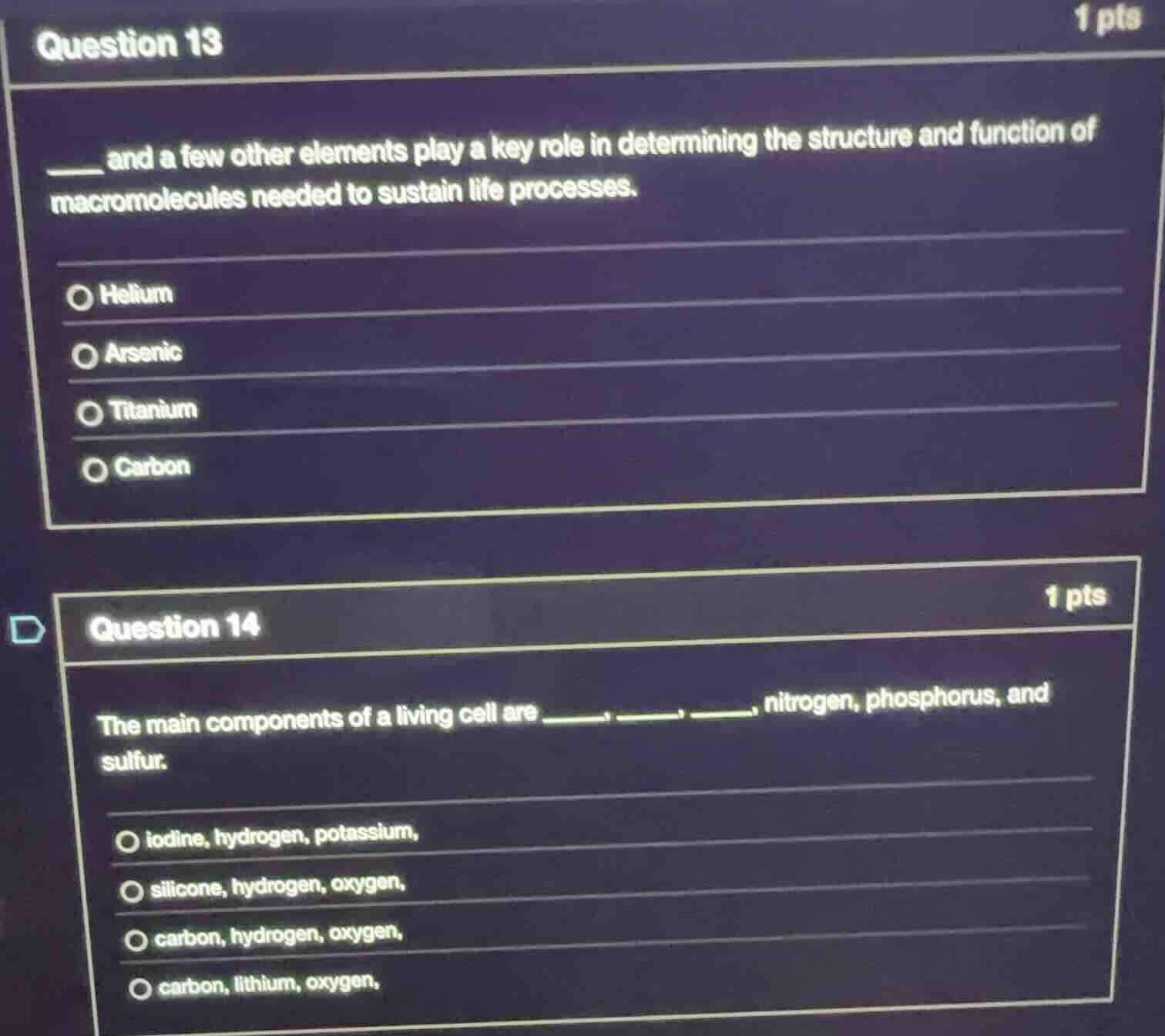
question 13

___ and a few other elements play a key role in determining the structure and function of macromolecules needed to sustain life processes.

  • helium
  • arsenic
  • titanium
  • carbon

question 14

the main components of a living cell are _, _, ___, nitrogen, phosphorus, and sulfur.

  • iodine, hydrogen, potassium,
  • silicone, hydrogen, oxygen,
  • carbon, hydrogen, oxygen,
  • carbon, lithium, oxygen,

Explanation:

Response

<pre_analysis>
{
"quality": "clear",
"question_count": 2,
"skills_matched": [
"direct_cot",
"multiple_choice_formatter",
"explain_then_answer",
"tutor"
],
"needs_drawing": false,
"concepts_used": [
"Organic Molecules"
],
"new_concepts": [
"Biomolecules",
"CHNOPS Elements"
],
"current_concepts": [
"Organic Molecules",
"Biomolecules",
"CHNOPS Elements"
]
}
</pre_analysis>

<reasoning>

Analyze Question 13

The question asks which element, along with a few others, plays a key role in determining the structure and function of macromolecules needed to sustain life. Macromolecules (proteins, carbohydrates, lipids, and nucleic acids) are organic molecules. By definition, Organic Molecules are built around carbon backbones due to carbon's ability to form four stable covalent bonds. Therefore, Carbon is the essential element.

Analyze Question 14

The question asks for the main components of a living cell, completing the list: "_, _, ___, nitrogen, phosphorus, and sulfur." The six primary elements that make up all living organisms and their macromolecules are Carbon, Hydrogen, Nitrogen, Oxygen, Phosphorus, and Sulfur (often abbreviated as CHNOPS). The missing three elements from this list are carbon, hydrogen, and oxygen.
</reasoning>

<answer>

Question 13

<mcq-option>O Helium</mcq-option>
<mcq-option>O Arsenic</mcq-option>
<mcq-option>O Titanium</mcq-option>
<mcq-correct>O Carbon</mcq-correct>

Question 14

<mcq-option>O iodine, hydrogen, potassium,</mcq-option>
<mcq-option>O silicone, hydrogen, oxygen,</mcq-option>
<mcq-correct>O carbon, hydrogen, oxygen,</mcq-correct>
<mcq-option>O carbon, lithium, oxygen,</mcq-option>
</answer>

<post_analysis>
{
"subject": "Natural Science",
"question_type": "Multiple Choice",
"knowledge_point": [
"Natural Science",
"Biology",
"Biochemistry"
]
}
</post_analysis>

Answer:

<pre_analysis>
{
"quality": "clear",
"question_count": 2,
"skills_matched": [
"direct_cot",
"multiple_choice_formatter",
"explain_then_answer",
"tutor"
],
"needs_drawing": false,
"concepts_used": [
"Organic Molecules"
],
"new_concepts": [
"Biomolecules",
"CHNOPS Elements"
],
"current_concepts": [
"Organic Molecules",
"Biomolecules",
"CHNOPS Elements"
]
}
</pre_analysis>

<reasoning>

Analyze Question 13

The question asks which element, along with a few others, plays a key role in determining the structure and function of macromolecules needed to sustain life. Macromolecules (proteins, carbohydrates, lipids, and nucleic acids) are organic molecules. By definition, Organic Molecules are built around carbon backbones due to carbon's ability to form four stable covalent bonds. Therefore, Carbon is the essential element.

Analyze Question 14

The question asks for the main components of a living cell, completing the list: "_, _, ___, nitrogen, phosphorus, and sulfur." The six primary elements that make up all living organisms and their macromolecules are Carbon, Hydrogen, Nitrogen, Oxygen, Phosphorus, and Sulfur (often abbreviated as CHNOPS). The missing three elements from this list are carbon, hydrogen, and oxygen.
</reasoning>

<answer>

Question 13

<mcq-option>O Helium</mcq-option>
<mcq-option>O Arsenic</mcq-option>
<mcq-option>O Titanium</mcq-option>
<mcq-correct>O Carbon</mcq-correct>

Question 14

<mcq-option>O iodine, hydrogen, potassium,</mcq-option>
<mcq-option>O silicone, hydrogen, oxygen,</mcq-option>
<mcq-correct>O carbon, hydrogen, oxygen,</mcq-correct>
<mcq-option>O carbon, lithium, oxygen,</mcq-option>
</answer>

<post_analysis>
{
"subject": "Natural Science",
"question_type": "Multiple Choice",
"knowledge_point": [
"Natural Science",
"Biology",
"Biochemistry"
]
}
</post_analysis>