QUESTION IMAGE
Question
question 11 (multiple choice worth 3 points)
(02.01r lc)
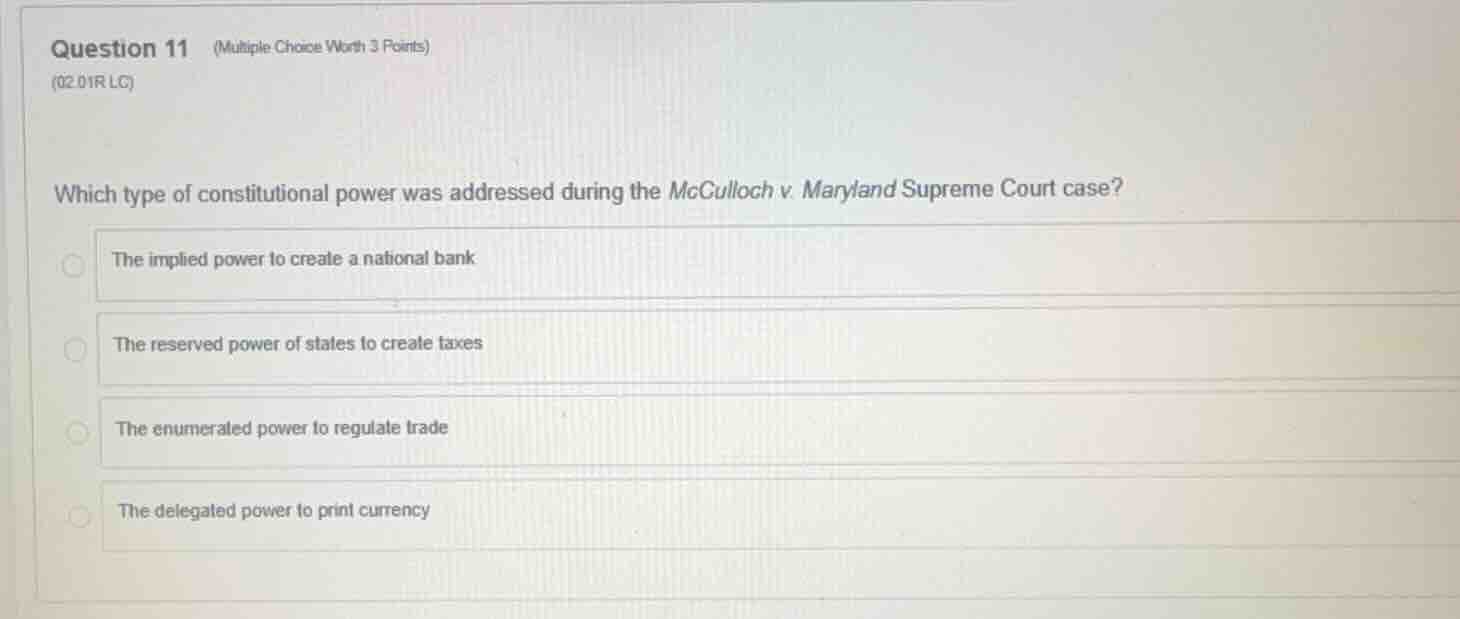
which type of constitutional power was addressed during the mcculloch v. maryland supreme court case?
- the implied power to create a national bank
- the reserved power of states to create taxes
- the enumerated power to regulate trade
- the delegated power to print currency
Identify the core issue in McCulloch v. Maryland
The landmark Supreme Court case McCulloch v. Maryland (1819) centered on whether Congress had the authority to establish the Second Bank of the United States, and whether the state of Maryland could tax that bank.
Analyze the constitutional powers involved
The Supreme Court ruled that Congress possessed the authority to charter a national bank under the Necessary and Proper Clause (Article I, Section 8), which grants Congress Implied Powers to execute its enumerated responsibilities.
Evaluate the given options
- Option 1 correctly identifies the implied power to create a national bank.
- Option 2 is incorrect because the case restricted state power to tax federal entities.
- Option 3 is incorrect because regulating trade (Commerce Clause) was not the primary basis for establishing the bank in this case.
- Option 4 is incorrect because printing currency, while a delegated power, was not the specific constitutional mechanism addressed for chartering the bank.

Snap & solve any problem in the app
Get step-by-step solutions on Sovi AI
Photo-based solutions with guided steps
Explore more problems and detailed explanations
- (A) The implied power to create a national bank (Correct answer)
- (B) The reserved power of states to create taxes
- (C) The enumerated power to regulate trade
- (D) The delegated power to print currency