Sovi.AI - AI Math Tutor

Scan to solve math questions

QUESTION IMAGE

question 11 gaba, dopamine, and norepinephrine are examples of which of…

Question

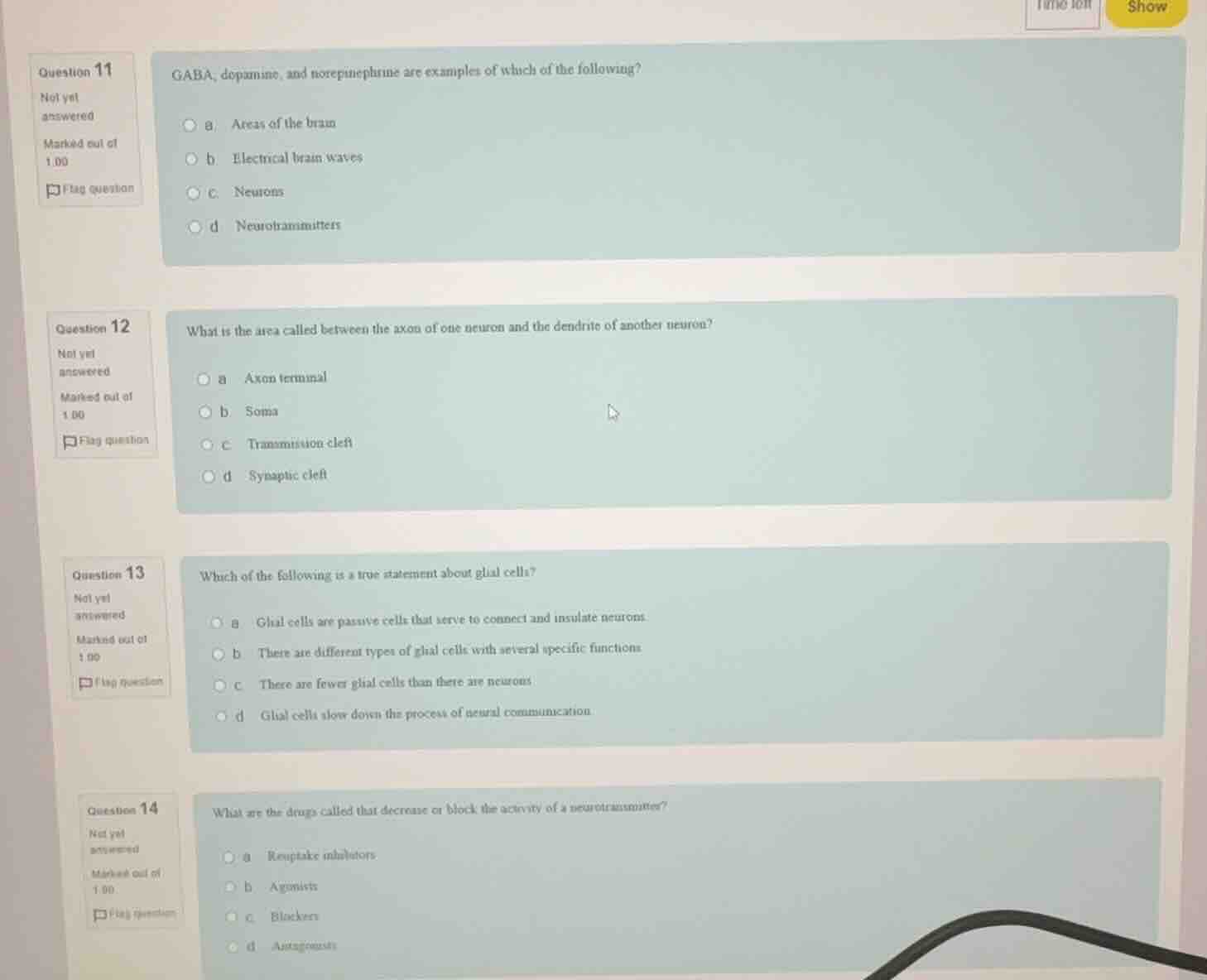
question 11
gaba, dopamine, and norepinephrine are examples of which of the following?
a. areas of the brain
b. electrical brain waves
c. neurons
d. neurotransmitters

question 12
what is the area called between the axon of one neuron and the dendrite of another neuron?
a. axon terminal
b. soma
c. transmission cleft
d. synaptic cleft

question 13
which of the following is a true statement about glial cells?
a. glial cells are passive cells that serve to connect and insulate neurons.
b. there are different types of glial cells with several specific functions.
c. there are fewer glial cells than there are neurons.
d. glial cells slow down the process of neural communication.

question 14
what are the drugs called that decrease or block the activity of a neurotransmitter?
a. reuptake inhibitors
b. agonists
c. blockers
d. antagonists

Explanation:

Response

<pre_analysis>
{
"quality": "clear",
"question_count": 4,
"skills_matched": [
"direct_cot",
"explain_then_answer",
"tutor"
],
"needs_drawing": false,
"concepts_used": [],
"new_concepts": [
"Neurotransmitters",
"Synaptic Transmission",
"Glial Cells"
],
"current_concepts": [
"Neurotransmitters",
"Synaptic Transmission",
"Glial Cells",
"Neuropharmacology"
]
}
</pre_analysis>

<reasoning>

Identify chemical messengers

GABA, dopamine, and norepinephrine are chemical substances released by neurons to transmit signals across synapses. These molecules are classified as neurotransmitters.

Define the synaptic gap

The microscopic space between the axon terminal of a sending neuron and the dendrite of a receiving neuron is called the synaptic cleft.

Analyze glial cell functions

Glial cells are non-neuronal cells in the nervous system. They are active contributors to nervous system function, exist in several distinct types (such as astrocytes, oligodendrocytes, and microglia), and perform diverse, specialized roles.

Classify receptor blockers

Drugs that bind to receptors and decrease or block the physiological activity of a neurotransmitter are called antagonists.
</reasoning>

<answer>

Question 11

<mcq-option>a. Areas of the brain</mcq-option>
<mcq-option>b. Electrical brain waves</mcq-option>
<mcq-option>c. Neurons</mcq-option>
<mcq-correct>d. Neurotransmitters</mcq-correct>

Question 12

<mcq-option>a. Axon terminal</mcq-option>
<mcq-option>b. Soma</mcq-option>
<mcq-option>c. Transmission cleft</mcq-option>
<mcq-correct>d. Synaptic cleft</mcq-correct>

Question 13

<mcq-option>a. Glial cells are passive cells that serve to connect and insulate neurons.</mcq-option>
<mcq-correct>b. There are different types of glial cells with several specific functions.</mcq-correct>
<mcq-option>c. There are fewer glial cells than there are neurons.</mcq-option>
<mcq-option>d. Glial cells slow down the process of neural communication.</mcq-option>

Question 14

<mcq-option>a. Reuptake inhibitors</mcq-option>
<mcq-option>b. Agonists</mcq-option>
<mcq-option>c. Blockers</mcq-option>
<mcq-correct>d. Antagonists</mcq-correct>
</answer>

<post_analysis>
{
"subject": "Natural Science",
"question_type": "Multiple Choice",
"knowledge_point": [
"Natural Science",
"Biology",
"Neurobiology"
]
}
</post_analysis>

Answer:

<pre_analysis>
{
"quality": "clear",
"question_count": 4,
"skills_matched": [
"direct_cot",
"explain_then_answer",
"tutor"
],
"needs_drawing": false,
"concepts_used": [],
"new_concepts": [
"Neurotransmitters",
"Synaptic Transmission",
"Glial Cells"
],
"current_concepts": [
"Neurotransmitters",
"Synaptic Transmission",
"Glial Cells",
"Neuropharmacology"
]
}
</pre_analysis>

<reasoning>

Identify chemical messengers

GABA, dopamine, and norepinephrine are chemical substances released by neurons to transmit signals across synapses. These molecules are classified as neurotransmitters.

Define the synaptic gap

The microscopic space between the axon terminal of a sending neuron and the dendrite of a receiving neuron is called the synaptic cleft.

Analyze glial cell functions

Glial cells are non-neuronal cells in the nervous system. They are active contributors to nervous system function, exist in several distinct types (such as astrocytes, oligodendrocytes, and microglia), and perform diverse, specialized roles.

Classify receptor blockers

Drugs that bind to receptors and decrease or block the physiological activity of a neurotransmitter are called antagonists.
</reasoning>

<answer>

Question 11

<mcq-option>a. Areas of the brain</mcq-option>
<mcq-option>b. Electrical brain waves</mcq-option>
<mcq-option>c. Neurons</mcq-option>
<mcq-correct>d. Neurotransmitters</mcq-correct>

Question 12

<mcq-option>a. Axon terminal</mcq-option>
<mcq-option>b. Soma</mcq-option>
<mcq-option>c. Transmission cleft</mcq-option>
<mcq-correct>d. Synaptic cleft</mcq-correct>

Question 13

<mcq-option>a. Glial cells are passive cells that serve to connect and insulate neurons.</mcq-option>
<mcq-correct>b. There are different types of glial cells with several specific functions.</mcq-correct>
<mcq-option>c. There are fewer glial cells than there are neurons.</mcq-option>
<mcq-option>d. Glial cells slow down the process of neural communication.</mcq-option>

Question 14

<mcq-option>a. Reuptake inhibitors</mcq-option>
<mcq-option>b. Agonists</mcq-option>
<mcq-option>c. Blockers</mcq-option>
<mcq-correct>d. Antagonists</mcq-correct>
</answer>

<post_analysis>
{
"subject": "Natural Science",
"question_type": "Multiple Choice",
"knowledge_point": [
"Natural Science",
"Biology",
"Neurobiology"
]
}
</post_analysis>