Sovi.AI - AI Math Tutor

Scan to solve math questions

QUESTION IMAGE

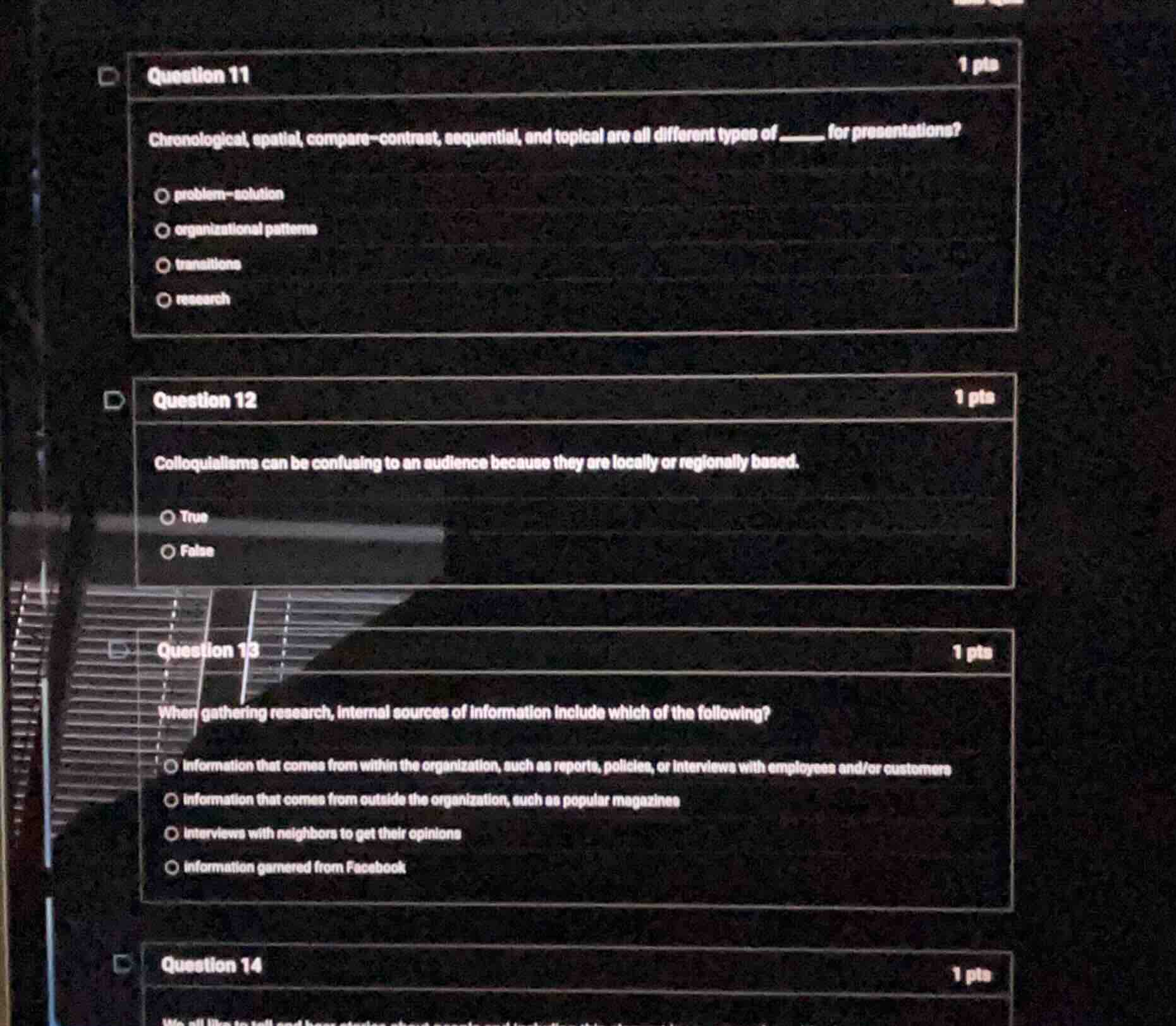
question 11 chronological, spatial, compare-contrast, sequential, and t…

Question

question 11
chronological, spatial, compare-contrast, sequential, and topical are all different types of ___ for presentations?

  • problem-solution
  • organizational patterns
  • transitions
  • research

question 12
colloquialisms can be confusing to an audience because they are locally or regionally based.

  • true
  • false

question 13
when gathering research, internal sources of information include which of the following?

  • information that comes from within the organization, such as reports, policies, or interviews with employees and/or customers
  • information that comes from outside the organization, such as popular magazines
  • interviews with neighbors to get their opinions
  • information garnered from facebook

question 14

Explanation:

Response

<pre_analysis>
{
"quality": "clear",
"question_count": 3,
"skills_matched": [
"direct_cot",
"multiple_choice_formatter",
"explain_then_answer",
"tutor"
],
"needs_drawing": false,
"concepts_used": [
"Speech Organization"
],
"new_concepts": [
"Colloquialisms in Communication",
"Internal Research Sources"
],
"current_concepts": [
"Speech Organization",
"Colloquialisms in Communication",
"Internal Research Sources"
]
}
</pre_analysis>

<reasoning>

Analyze Question 11

The question asks to identify what chronological, spatial, compare-contrast, sequential, and topical represent in the context of presentations.

  • Chronological, spatial, compare-contrast, sequential, and topical are methods used to structure and arrange the main points of a speech or presentation.
  • In communication studies, these methods are formally referred to as Speech Organization patterns or organizational patterns.
  • Therefore, the correct option is "organizational patterns".

Analyze Question 12

The statement is: "Colloquialisms can be confusing to an audience because they are locally or regionally based."

  • Colloquialisms are informal words, phrases, or slang used in everyday conversation, which are often unique to specific geographic regions, cultures, or communities.
  • When presenting to a diverse or non-local audience, these terms can easily lead to misunderstandings because listeners from other regions may not share the same linguistic background.
  • Therefore, the statement is True.

Analyze Question 13

The question asks to identify what constitutes internal sources of information when gathering research.

  • "Internal" refers to sources originating from within the specific organization, institution, or entity being researched.
  • Looking at the options:
  • "information that comes from within the organization, such as reports, policies, or interviews with employees and/or customers" directly aligns with the definition of internal research.
  • Popular magazines, neighbor interviews (unless relevant to a highly localized neighborhood study), and Facebook are external sources.
  • Therefore, the first option is correct.

</reasoning>

<answer>

Question 11

<mcq-option>problem-solution</mcq-option>
<mcq-correct>organizational patterns</mcq-correct>
<mcq-option>transitions</mcq-option>
<mcq-option>research</mcq-option>

Question 12

<mcq-correct>True</mcq-correct>
<mcq-option>False</mcq-option>

Question 13

<mcq-correct>information that comes from within the organization, such as reports, policies, or interviews with employees and/or customers</mcq-correct>
<mcq-option>information that comes from outside the organization, such as popular magazines</mcq-option>
<mcq-option>interviews with neighbors to get their opinions</mcq-option>
<mcq-option>information garnered from Facebook</mcq-option>
</answer>

<post_analysis>
{
"subject": "Social Science",
"question_type": "Multiple Choice",
"knowledge_point": [
"Social Science",
"Communication Studies",
"Public Speaking and Presentation Skills"
]
}
</post_analysis>

Answer:

<pre_analysis>
{
"quality": "clear",
"question_count": 3,
"skills_matched": [
"direct_cot",
"multiple_choice_formatter",
"explain_then_answer",
"tutor"
],
"needs_drawing": false,
"concepts_used": [
"Speech Organization"
],
"new_concepts": [
"Colloquialisms in Communication",
"Internal Research Sources"
],
"current_concepts": [
"Speech Organization",
"Colloquialisms in Communication",
"Internal Research Sources"
]
}
</pre_analysis>

<reasoning>

Analyze Question 11

The question asks to identify what chronological, spatial, compare-contrast, sequential, and topical represent in the context of presentations.

  • Chronological, spatial, compare-contrast, sequential, and topical are methods used to structure and arrange the main points of a speech or presentation.
  • In communication studies, these methods are formally referred to as Speech Organization patterns or organizational patterns.
  • Therefore, the correct option is "organizational patterns".

Analyze Question 12

The statement is: "Colloquialisms can be confusing to an audience because they are locally or regionally based."

  • Colloquialisms are informal words, phrases, or slang used in everyday conversation, which are often unique to specific geographic regions, cultures, or communities.
  • When presenting to a diverse or non-local audience, these terms can easily lead to misunderstandings because listeners from other regions may not share the same linguistic background.
  • Therefore, the statement is True.

Analyze Question 13

The question asks to identify what constitutes internal sources of information when gathering research.

  • "Internal" refers to sources originating from within the specific organization, institution, or entity being researched.
  • Looking at the options:
  • "information that comes from within the organization, such as reports, policies, or interviews with employees and/or customers" directly aligns with the definition of internal research.
  • Popular magazines, neighbor interviews (unless relevant to a highly localized neighborhood study), and Facebook are external sources.
  • Therefore, the first option is correct.

</reasoning>

<answer>

Question 11

<mcq-option>problem-solution</mcq-option>
<mcq-correct>organizational patterns</mcq-correct>
<mcq-option>transitions</mcq-option>
<mcq-option>research</mcq-option>

Question 12

<mcq-correct>True</mcq-correct>
<mcq-option>False</mcq-option>

Question 13

<mcq-correct>information that comes from within the organization, such as reports, policies, or interviews with employees and/or customers</mcq-correct>
<mcq-option>information that comes from outside the organization, such as popular magazines</mcq-option>
<mcq-option>interviews with neighbors to get their opinions</mcq-option>
<mcq-option>information garnered from Facebook</mcq-option>
</answer>

<post_analysis>
{
"subject": "Social Science",
"question_type": "Multiple Choice",
"knowledge_point": [
"Social Science",
"Communication Studies",
"Public Speaking and Presentation Skills"
]
}
</post_analysis>