Sovi.AI - AI Math Tutor

Scan to solve math questions

QUESTION IMAGE

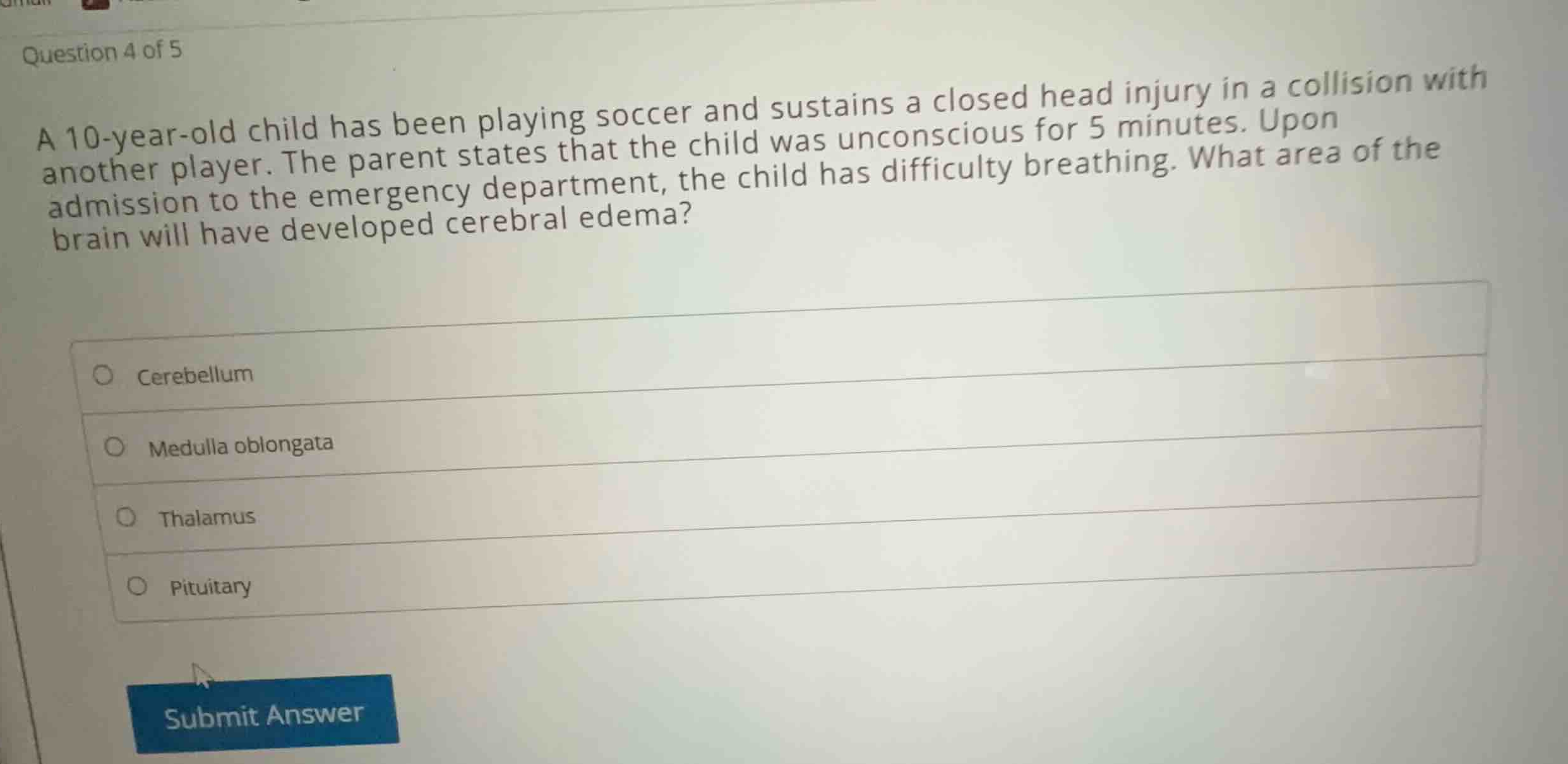
question 4 of 5 a 10-year-old child has been playing soccer and sustain…

Question

question 4 of 5

a 10-year-old child has been playing soccer and sustains a closed head injury in a collision with another player. the parent states that the child was unconscious for 5 minutes. upon admission to the emergency department, the child has difficulty breathing. what area of the brain will have developed cerebral edema?

  • cerebellum
  • medulla oblongata
  • thalamus
  • pituitary

Explanation:

Response

<pre_analysis>
{
"quality": "clear",
"question_count": 1,
"skills_matched": [
"direct_cot",
"multiple_choice_formatter",
"explain_then_answer",
"tutor"
],
"needs_drawing": false,
"concepts_used": [
"Brain Regions",
"Brainstem Nuclei"
],
"new_concepts": [
"Respiratory Control Centers",
"Cerebral Edema Localization"
],
"current_concepts": [
"Brain Regions",
"Brainstem Nuclei",
"Respiratory Control Centers",
"Cerebral Edema Localization"
]
}
</pre_analysis>

<reasoning>

Analyze clinical presentation

The patient is a 10-year-old child presenting with a closed head injury, a history of unconsciousness, and subsequent difficulty breathing. Difficulty breathing (respiratory depression or dyspnea) following trauma suggests dysfunction or compression of the primary respiratory control centers in the brain.

Identify respiratory control centers

Using the Brain Regions and Brainstem Nuclei knowledge points, we locate the vital autonomic centers. The primary respiratory centers that regulate the automatic rhythm of breathing (the dorsal and ventral respiratory groups) are located in the medulla oblongata of the brainstem.

Relate trauma to cerebral edema

Cerebral edema or increased intracranial pressure in the posterior fossa can directly compress or compromise the medulla oblongata. This compression disrupts its vital nuclei, leading to respiratory distress, irregular breathing patterns, or apnea.

Evaluate the given options

  • Cerebellum: Primarily coordinates voluntary movement and balance, not primary respiratory drive.
  • Medulla oblongata: Contains the vital cardiac, vasomotor, and respiratory centers. Edema here directly causes breathing difficulty.
  • Thalamus: Relays sensory and motor signals to the cerebral cortex, not responsible for automatic breathing.
  • Pituitary: Regulates endocrine function, not acute respiratory control.

</reasoning>

<answer>
<mcq-option>Cerebellum</mcq-option>
<mcq-correct>Medulla oblongata</mcq-correct>
<mcq-option>Thalamus</mcq-option>
<mcq-option>Pituitary</mcq-option>
</answer>

<post_analysis>
{
"subject": "Natural Science",
"question_type": "Multiple Choice",
"knowledge_point": [
"Natural Science",
"Biology",
"Neuroanatomy"
]
}
</post_analysis>

Answer:

<pre_analysis>
{
"quality": "clear",
"question_count": 1,
"skills_matched": [
"direct_cot",
"multiple_choice_formatter",
"explain_then_answer",
"tutor"
],
"needs_drawing": false,
"concepts_used": [
"Brain Regions",
"Brainstem Nuclei"
],
"new_concepts": [
"Respiratory Control Centers",
"Cerebral Edema Localization"
],
"current_concepts": [
"Brain Regions",
"Brainstem Nuclei",
"Respiratory Control Centers",
"Cerebral Edema Localization"
]
}
</pre_analysis>

<reasoning>

Analyze clinical presentation

The patient is a 10-year-old child presenting with a closed head injury, a history of unconsciousness, and subsequent difficulty breathing. Difficulty breathing (respiratory depression or dyspnea) following trauma suggests dysfunction or compression of the primary respiratory control centers in the brain.

Identify respiratory control centers

Using the Brain Regions and Brainstem Nuclei knowledge points, we locate the vital autonomic centers. The primary respiratory centers that regulate the automatic rhythm of breathing (the dorsal and ventral respiratory groups) are located in the medulla oblongata of the brainstem.

Relate trauma to cerebral edema

Cerebral edema or increased intracranial pressure in the posterior fossa can directly compress or compromise the medulla oblongata. This compression disrupts its vital nuclei, leading to respiratory distress, irregular breathing patterns, or apnea.

Evaluate the given options

  • Cerebellum: Primarily coordinates voluntary movement and balance, not primary respiratory drive.
  • Medulla oblongata: Contains the vital cardiac, vasomotor, and respiratory centers. Edema here directly causes breathing difficulty.
  • Thalamus: Relays sensory and motor signals to the cerebral cortex, not responsible for automatic breathing.
  • Pituitary: Regulates endocrine function, not acute respiratory control.

</reasoning>

<answer>
<mcq-option>Cerebellum</mcq-option>
<mcq-correct>Medulla oblongata</mcq-correct>
<mcq-option>Thalamus</mcq-option>
<mcq-option>Pituitary</mcq-option>
</answer>

<post_analysis>
{
"subject": "Natural Science",
"question_type": "Multiple Choice",
"knowledge_point": [
"Natural Science",
"Biology",
"Neuroanatomy"
]
}
</post_analysis>