QUESTION IMAGE
Question
question 8 of 10
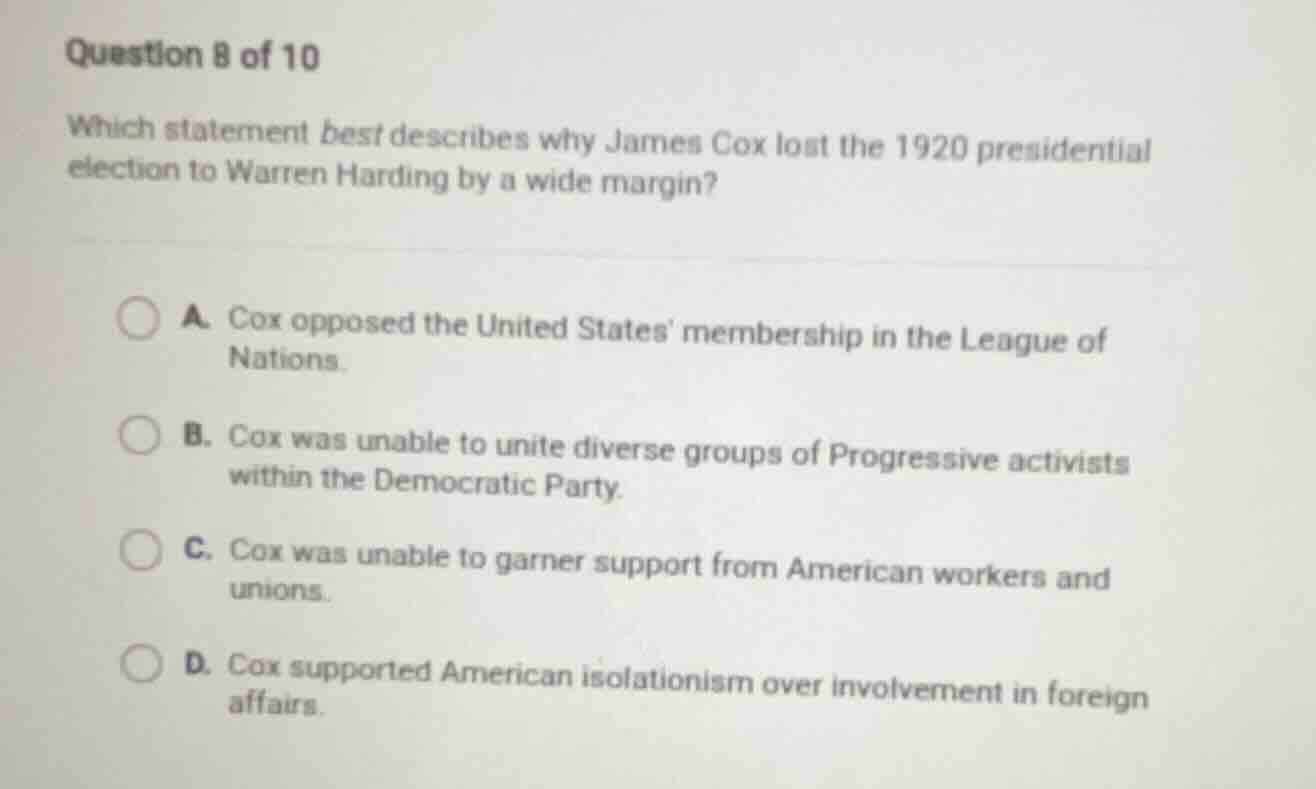
which statement best describes why james cox lost the 1920 presidential election to warren harding by a wide margin?
a. cox opposed the united states membership in the league of nations.
b. cox was unable to unite diverse groups of progressive activists within the democratic party.
c. cox was unable to garner support from american workers and unions.
d. cox supported american isolationism over involvement in foreign affairs.
Analyze the political context of the 1920 election
Using the Warren Harding Presidency and League of Nations knowledge points
- The 1920 presidential election took place immediately after World War I, a period marked by intense public desire to move away from wartime sacrifices, international entanglements, and the domestic crusades of the Progressive Era.
- Republican candidate Warren G. Harding campaigned on a platform of a "return to normalcy," which favored isolationism, lower taxes, and a retreat from progressive reforms.
- Democratic candidate James M. Cox supported Woodrow Wilson's internationalist vision, specifically advocating for United States membership in the League of Nations.
Evaluate the candidate platforms and public sentiment
- Cox's support for the League of Nations alienated voters who favored isolationism, making Option A and Option D historically incorrect because Cox supported internationalism rather than opposing it.
- The Democratic coalition was deeply fractured by 1920. The party struggled to unite urban immigrant workers, rural southern whites, and various factions of progressive reformers who were disillusioned by wartime civil liberties crackdowns and post-war inflation.
- Consequently, Cox was unable to unite these diverse groups of progressive activists and traditional Democratic voters, leading to a landslide victory for Harding.
Determine the correct option
- Option A is incorrect because Cox supported, rather than opposed, the League of Nations.
- Option B is correct because the internal division and inability to unite the diverse progressive factions within the Democratic Party severely weakened Cox's campaign.
- Option C is incorrect because labor unions and workers did not monolithically abandon Cox; rather, the broader coalition fell apart.
- Option D is incorrect because Cox was an internationalist, not an isolationist.

Snap & solve any problem in the app
Get step-by-step solutions on Sovi AI
Photo-based solutions with guided steps
Explore more problems and detailed explanations
- (A) Cox opposed the United States' membership in the League of Nations.
- (B) Cox was unable to unite diverse groups of Progressive activists within the Democratic Party. (Correct answer)
- (C) Cox was unable to garner support from American workers and unions.
- (D) Cox supported American isolationism over involvement in foreign affairs.