QUESTION IMAGE
Question
question 7 of 10
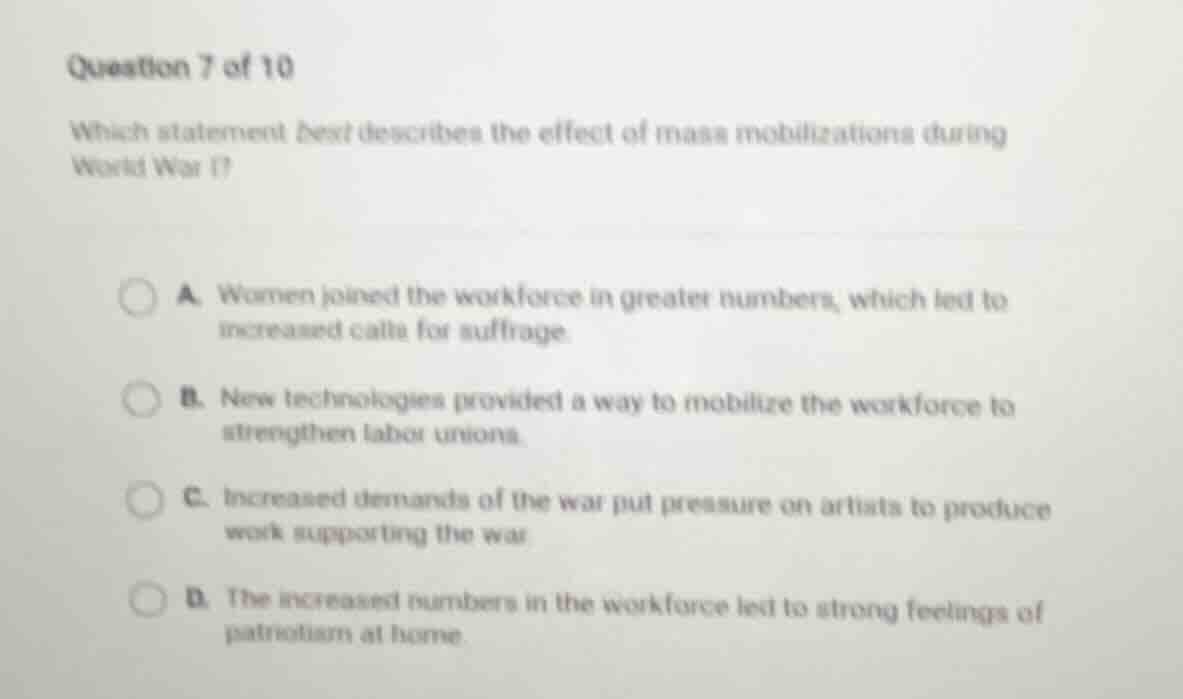
which statement best describes the effect of mass mobilizations during world war i?
a. women joined the workforce in greater numbers, which led to increased calls for suffrage.
b. new technologies provided a way to mobilize the workforce to strengthen labor unions.
c. increased demands of the war put pressure on artists to produce work supporting the war.
d. the increased numbers in the workforce led to strong feelings of patriotism at home.
Analyze the question prompt
The question asks for the statement that best describes the effect of mass mobilizations during World War I. Mass mobilization refers to the mobilization of the home front, including the workforce, resources, and public opinion, to support the war effort.
Evaluate Option A
Using the Womens Suffrage Movement knowledge point
During World War I, millions of men left their jobs to serve in the military, creating a massive labor shortage. Women stepped into the workforce in unprecedented numbers, working in munitions factories, agriculture, and public services. This vital contribution to the war effort strengthened their arguments for political equality, directly leading to increased calls and support for women's suffrage, which culminated in the passage of the Nineteenth Amendment.
Evaluate Option B
This option suggests new technologies mobilized the workforce to strengthen labor unions. While technology changed production, it was not the primary driver of mobilization that strengthened unions during the war.
Evaluate Option C
Using the WWI Home Front Propaganda knowledge point
While artists were indeed mobilized to produce propaganda (such as posters for the Committee on Public Information), this was a top-down government initiative rather than a direct consequence of general "mass mobilization" of the workforce, and it does not represent the primary societal effect described.
Evaluate Option D
This option states that increased numbers in the workforce led to strong feelings of patriotism. While patriotism was high, the causal relationship is reversed; patriotism and government campaigns led to workforce mobilization, rather than the workforce expansion itself causing patriotism. Option A provides a much more direct, historically significant, and widely recognized socio-political consequence of mobilization.

Snap & solve any problem in the app
Get step-by-step solutions on Sovi AI
Photo-based solutions with guided steps
Explore more problems and detailed explanations
- A. Women joined the workforce in greater numbers, which led to increased calls for suffrage. (Correct answer)
- B. New technologies provided a way to mobilize the workforce to strengthen labor unions.
- C. Increased demands of the war put pressure on artists to produce work supporting the war
- D. The increased numbers in the workforce led to strong feelings of patriotism at home.