QUESTION IMAGE
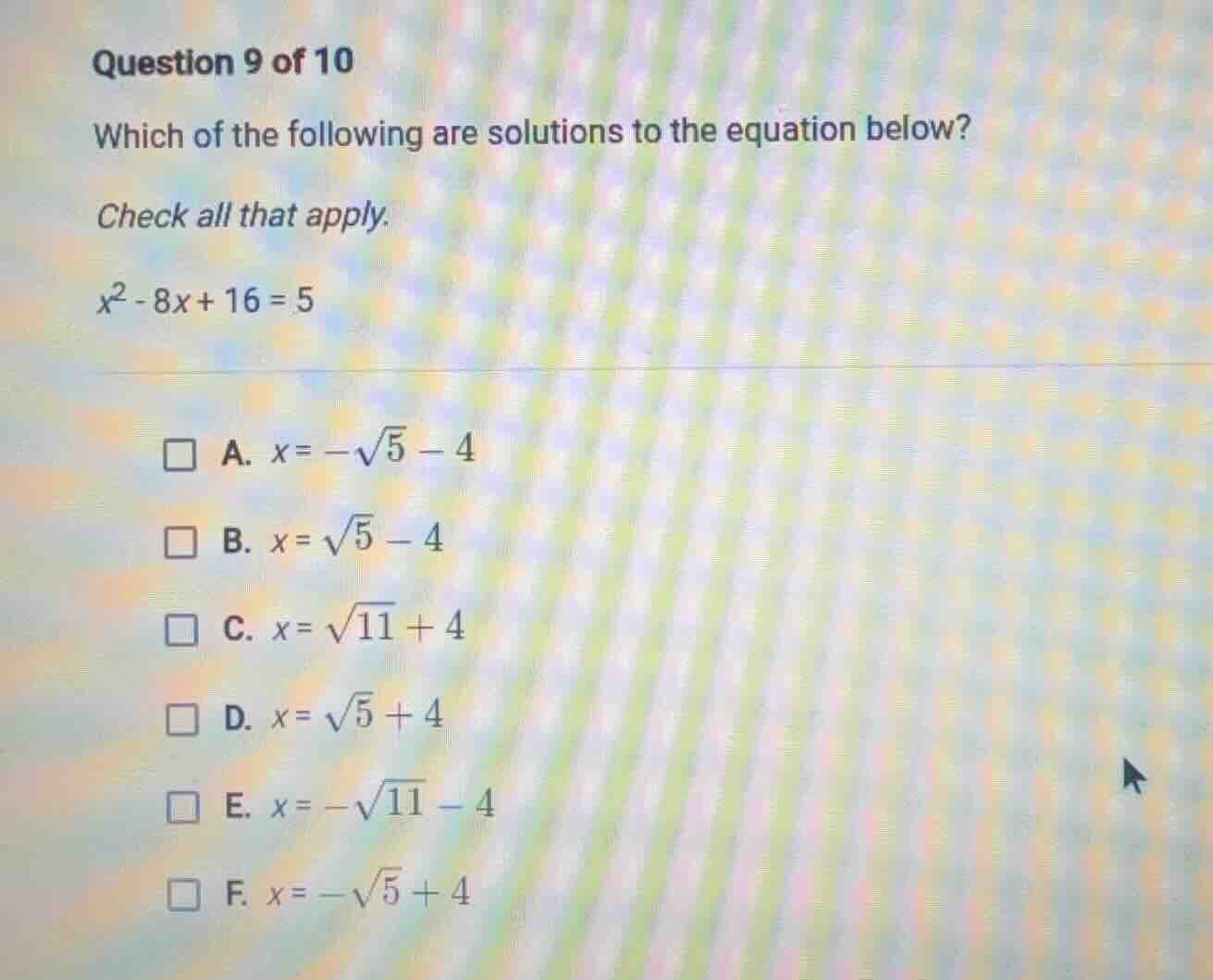
Question
question 9 of 10
which of the following are solutions to the equation below?
check all that apply.
$x^2 - 8x + 16 = 5$
a. $x = -sqrt{5} - 4$
b. $x = sqrt{5} - 4$
c. $x = sqrt{11} + 4$
d. $x = sqrt{5} + 4$
e. $x = -sqrt{11} - 4$
f. $x = -sqrt{5} + 4$
Step1: Factor the left - hand side
The left - hand side of the equation \(x^{2}-8x + 16=5\) is a perfect square trinomial. Recall that \(a^{2}-2ab + b^{2}=(a - b)^{2}\). For \(x^{2}-8x + 16\), we have \(a = x\) and \(b = 4\) (since \(2ab=8x\), so \(2\times x\times b = 8x\), which gives \(b = 4\)). So \(x^{2}-8x + 16=(x - 4)^{2}\). The equation becomes \((x - 4)^{2}=5\).
Step2: Take the square root of both sides
Taking the square root of both sides of the equation \((x - 4)^{2}=5\), we get \(x-4=\pm\sqrt{5}\).
Step3: Solve for x
We solve the two equations:
- When \(x - 4=\sqrt{5}\), add 4 to both sides of the equation. We have \(x=\sqrt{5}+4\).
- When \(x - 4=-\sqrt{5}\), add 4 to both sides of the equation. We have \(x = 4-\sqrt{5}=-\sqrt{5}+4\).

Snap & solve any problem in the app
Get step-by-step solutions on Sovi AI
Photo-based solutions with guided steps
Explore more problems and detailed explanations
D. \(x=\sqrt{5}+4\), F. \(x = -\sqrt{5}+4\)