QUESTION IMAGE
Question
question 10
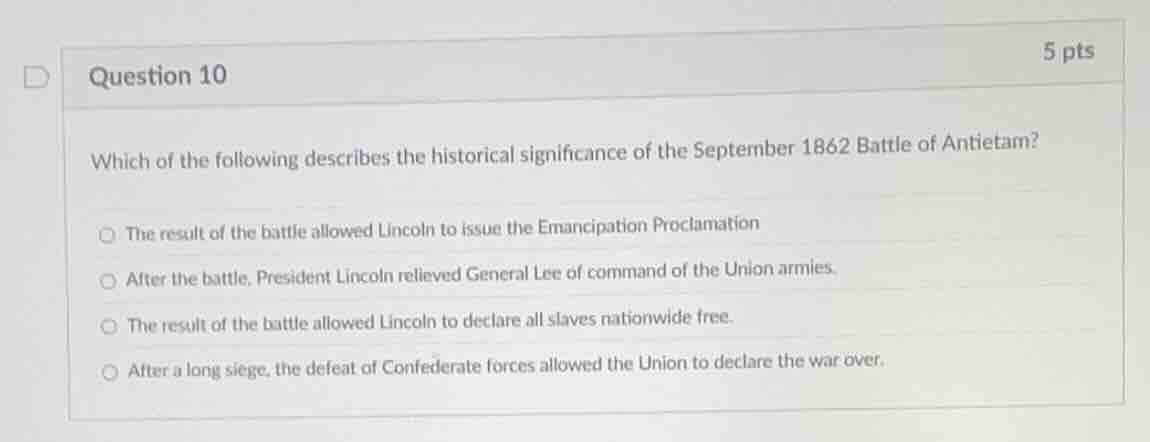
which of the following describes the historical significance of the september 1862 battle of antietam?
- the result of the battle allowed lincoln to issue the emancipation proclamation
- after the battle, president lincoln relieved general lee of command of the union armies.
- the result of the battle allowed lincoln to declare all slaves nationwide free.
- after a long siege, the defeat of confederate forces allowed the union to declare the war over.
Analyze the Battle of Antietam
The Battle of Antietam, fought on September 17, 1862, was the bloodiest single-day battle in American history. It ended General Robert E. Lee's first invasion of the North.
Evaluate the strategic outcome
Although tactically a draw, the Union's strategic victory at Antietam gave President Abraham Lincoln the political leverage and positive military momentum he needed to issue the preliminary Emancipation Proclamation on September 22, 1862.
Assess the given options
- Option 1 correctly states that the battle allowed Lincoln to issue the Emancipation Proclamation.
- Option 2 is incorrect; General Lee commanded the Confederate Army, not the Union Army, and Lincoln relieved Union General George B. McClellan of command after the battle.
- Option 3 is incorrect; the Emancipation Proclamation only declared free those slaves residing in territory still in rebellion against the Union, not all slaves nationwide.
- Option 4 is incorrect; Antietam was not a siege, nor did it end the Civil War.

Snap & solve any problem in the app
Get step-by-step solutions on Sovi AI
Photo-based solutions with guided steps
Explore more problems and detailed explanations
- The result of the battle allowed Lincoln to issue the Emancipation Proclamation (Correct answer)
- After the battle, President Lincoln relieved General Lee of command of the Union armies.
- The result of the battle allowed Lincoln to declare all slaves nationwide free.
- After a long siege, the defeat of Confederate forces allowed the Union to declare the war over.