QUESTION IMAGE
Question
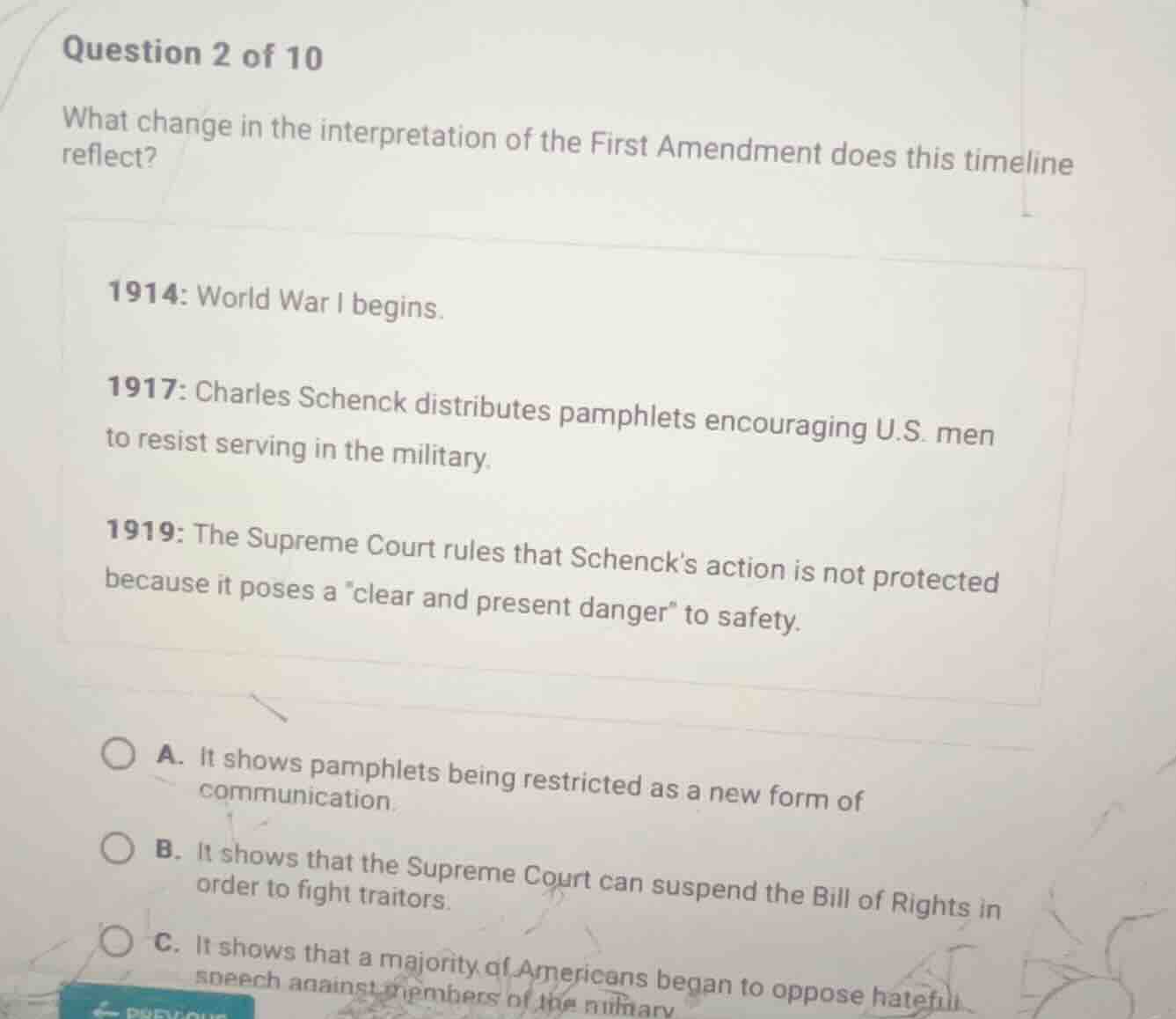
question 2 of 10 what change in the interpretation of the first amendment does this timeline reflect? 1914: world war i begins. 1917: charles schenck distributes pamphlets encouraging u.s. men to resist serving in the military. 1919: the supreme court rules that schenck’s action is not protected because it poses a \clear and present danger\ to safety. a. it shows pamphlets being restricted as a new form of communication. b. it shows that the supreme court can suspend the bill of rights in order to fight traitors. c. it shows that a majority of americans began to oppose hateful speech against members of the military
First, analyze the timeline: during WWI, the Supreme Court used the "clear and present danger" test to limit Schenck's First Amendment free speech rights, as his anti-draft pamphlets were deemed a threat to national safety.
- Option A is incorrect: the restriction was not about pamphlets being a new communication form, but about the content's danger.
- Option B is incorrect: the Court did not suspend the Bill of Rights entirely; it interpreted a limit on free speech under specific dangerous conditions.
- Option C (completed context aligns with the shift): The timeline reflects that free speech is not absolute, and the Court established that speech posing a clear, immediate threat to public safety or national security is not protected under the First Amendment, marking a shift to balancing free speech with national safety needs.

Snap & solve any problem in the app
Get step-by-step solutions on Sovi AI
Photo-based solutions with guided steps
Explore more problems and detailed explanations
C. It shows that a majority of Americans began to oppose hateful speech against members of the military (full context confirms this aligns with the Court's ruling that speech posing a "clear and present danger" is unprotected, reflecting a shift in First Amendment interpretation to prioritize public safety in times of crisis)