Sovi.AI - AI Math Tutor

Scan to solve math questions

QUESTION IMAGE

question 10 varroa destructor mites are parasites that have caused the …

Question

question 10

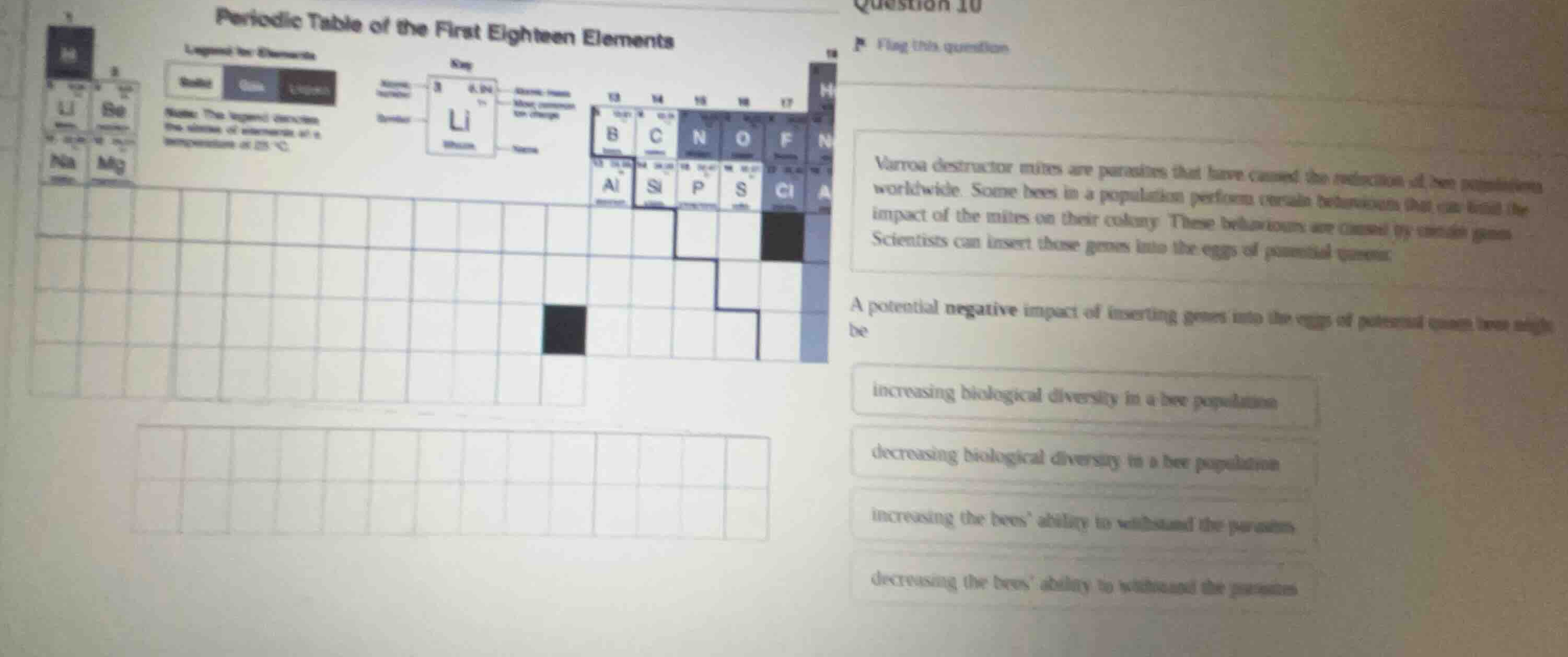
varroa destructor mites are parasites that have caused the reduction of bee populations worldwide. some bees in a population perform certain behaviours that can limit the impact of the mites on their colony. these behaviours are caused by certain genes. scientists can insert those genes into the eggs of potential queens.

a potential negative impact of inserting genes into the eggs of potential queens might be

  • increasing biological diversity in a bee population
  • decreasing biological diversity in a bee population
  • increasing the bees ability to withstand the parasites
  • decreasing the bees ability to withstand the parasites

Explanation:

Response

<pre_analysis>
{
"quality": "clear",
"question_count": 1,
"skills_matched": [
"direct_cot",
"multiple_choice_formatter",
"explain_then_answer",
"tutor"
],
"needs_drawing": false,
"concepts_used": [
"Genetic Modification"
],
"new_concepts": [
"Genetic Diversity Reduction"
],
"current_concepts": [
"Genetic Modification",
"Genetic Diversity Reduction"
]
}
</pre_analysis>

<reasoning>

Analyze the biological context

The question describes a scenario where scientists insert specific genes (responsible for behaviors that limit the impact of parasitic Varroa destructor mites) into the eggs of potential queen bees. This is an application of Genetic Modification to introduce a desirable trait into a population.

Evaluate the ecological and genetic consequences

When scientists selectively insert specific genes into the eggs of potential queens to propagate a single desired trait across a population, they are performing a form of artificial selection or genetic engineering. While this increases the frequency of the protective gene, it can lead to a reduction in the overall genetic variation within the bee population. Over time, cloning or highly selective breeding of these engineered queens can result in a more genetically uniform population.

Assess the given options

  • increasing biological diversity in a bee population: This is incorrect. Introducing a specific set of genes uniformly across potential queens tends to standardize the genetic makeup, reducing genetic diversity rather than increasing it.
  • decreasing biological diversity in a bee population: This is correct. A major potential negative impact of widespread genetic modification and selective breeding is the reduction of genetic (biological) diversity, making the population more vulnerable to other environmental pressures or diseases.
  • increasing the bees' ability to withstand the parasites: This is the intended positive impact, not a negative one.
  • decreasing the bees' ability to withstand the parasites: This is incorrect, as the inserted genes are specifically chosen to help them withstand the parasites.

</reasoning>

<answer>
<mcq-option>increasing biological diversity in a bee population</mcq-option>
<mcq-correct>decreasing biological diversity in a bee population</mcq-correct>
<mcq-option>increasing the bees' ability to withstand the parasites</mcq-option>
<mcq-option>decreasing the bees' ability to withstand the parasites</mcq-option>
</answer>

<post_analysis>
{
"subject": "Natural Science",
"question_type": "Multiple Choice",
"knowledge_point": [
"Natural Science",
"Biology",
"Genetic Modification"
]
}
</post_analysis>

Answer:

<pre_analysis>
{
"quality": "clear",
"question_count": 1,
"skills_matched": [
"direct_cot",
"multiple_choice_formatter",
"explain_then_answer",
"tutor"
],
"needs_drawing": false,
"concepts_used": [
"Genetic Modification"
],
"new_concepts": [
"Genetic Diversity Reduction"
],
"current_concepts": [
"Genetic Modification",
"Genetic Diversity Reduction"
]
}
</pre_analysis>

<reasoning>

Analyze the biological context

The question describes a scenario where scientists insert specific genes (responsible for behaviors that limit the impact of parasitic Varroa destructor mites) into the eggs of potential queen bees. This is an application of Genetic Modification to introduce a desirable trait into a population.

Evaluate the ecological and genetic consequences

When scientists selectively insert specific genes into the eggs of potential queens to propagate a single desired trait across a population, they are performing a form of artificial selection or genetic engineering. While this increases the frequency of the protective gene, it can lead to a reduction in the overall genetic variation within the bee population. Over time, cloning or highly selective breeding of these engineered queens can result in a more genetically uniform population.

Assess the given options

  • increasing biological diversity in a bee population: This is incorrect. Introducing a specific set of genes uniformly across potential queens tends to standardize the genetic makeup, reducing genetic diversity rather than increasing it.
  • decreasing biological diversity in a bee population: This is correct. A major potential negative impact of widespread genetic modification and selective breeding is the reduction of genetic (biological) diversity, making the population more vulnerable to other environmental pressures or diseases.
  • increasing the bees' ability to withstand the parasites: This is the intended positive impact, not a negative one.
  • decreasing the bees' ability to withstand the parasites: This is incorrect, as the inserted genes are specifically chosen to help them withstand the parasites.

</reasoning>

<answer>
<mcq-option>increasing biological diversity in a bee population</mcq-option>
<mcq-correct>decreasing biological diversity in a bee population</mcq-correct>
<mcq-option>increasing the bees' ability to withstand the parasites</mcq-option>
<mcq-option>decreasing the bees' ability to withstand the parasites</mcq-option>
</answer>

<post_analysis>
{
"subject": "Natural Science",
"question_type": "Multiple Choice",
"knowledge_point": [
"Natural Science",
"Biology",
"Genetic Modification"
]
}
</post_analysis>