QUESTION IMAGE
Question
question 5
10 pts
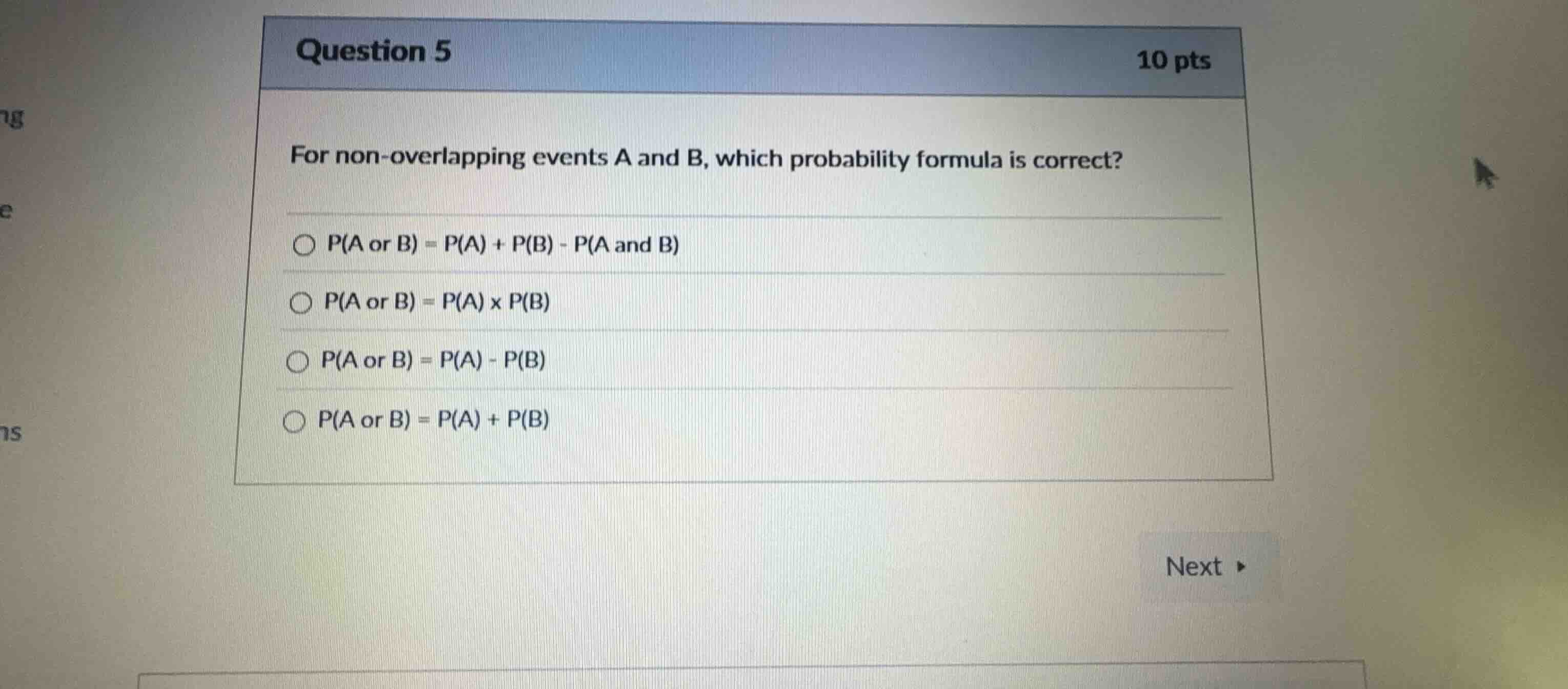
for non-overlapping events a and b, which probability formula is correct?
\\( p(a \text{ or } b) = p(a) + p(b) - p(a \text{ and } b) \\)
\\( p(a \text{ or } b) = p(a) \times p(b) \\)
\\( p(a \text{ or } b) = p(a) - p(b) \\)
\\( p(a \text{ or } b) = p(a) + p(b) \\)
Define non-overlapping events
Non-overlapping (mutually exclusive) events cannot occur simultaneously:
$$
P(A \text{ and } B) = 0
$$
Apply the general addition rule
The general addition rule for any two events is:
$$
P(A \text{ or } B) = P(A) + P(B) - P(A \text{ and } B)
$$
Simplify for non-overlapping events
Substituting \(P(A \text{ and } B) = 0\) into the general formula:
$$
P(A \text{ or } B) = P(A) + P(B)
$$

Snap & solve any problem in the app
Get step-by-step solutions on Sovi AI
Photo-based solutions with guided steps
Explore more problems and detailed explanations
- (A) \(P(A \text{ or } B) = P(A) + P(B) - P(A \text{ and } B)\)
- (B) \(P(A \text{ or } B) = P(A) \times P(B)\)
- (C) \(P(A \text{ or } B) = P(A) - P(B)\)
- (D) \(P(A \text{ or } B) = P(A) + P(B)\) (Correct answer)